
Habitat
A widespread species found on both living and dead broad-leaved trees, where it acts as a weak parasite or decomposer. It most frequently colonizes the base of tree trunks, stumps, and logs, particularly ancient oaks and sweet chestnuts, though it is also found on Chinquapin, Pacific Wax Myrtle, and occasionally Western Hemlock. It typically grows solitary or in small overlapping clusters, sometimes appearing to grow from the ground when attached to buried wood or rooting from the trunk base. The fungus causes a brown rot that stains wood a deep, rich color.
Photos
Appearance
- Fruit body
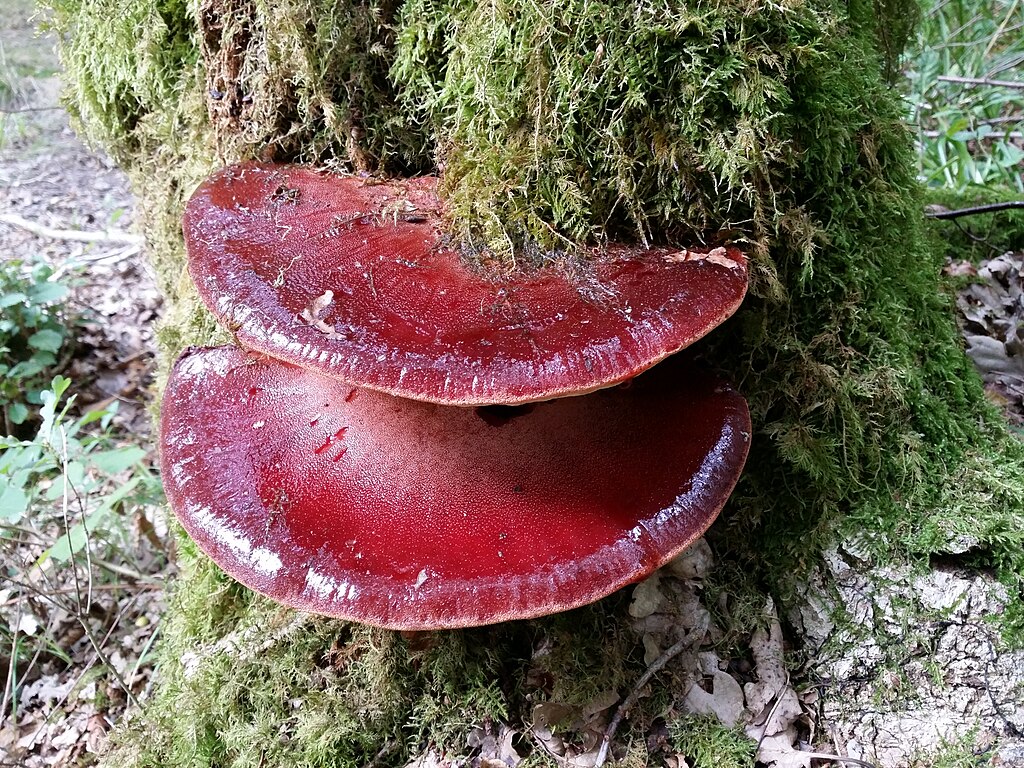
- 7.5–25 cm wide (occasionally larger), 2–6 cm thick. Shaped like a tongue, fan, or kidney; initially spherical and velvety, becoming lobed or wavy. Color is pinkish-beige when young, turning blood-red to purple-brown, resembling a piece of raw meat.
- Upper surface
- Sticky, tacky, or gelatinous, especially when moist. Texture is rough, pebbly, or warty with minute pimples; often radially grooved or wrinkled and may exude droplets of reddish, blood-like sap.
- Stem
- Often rudimentary or absent, but sometimes present as a short, thick, lateral, or rooting stalk colored similarly to the fruit body.
- Flesh
- Thick, soft, and succulent with a fibrous, meat-like texture. Mottled or marbled with pink, red, and yellowish tones and pale veins; exudes a dark red, blood-like juice when cut.
- Tubes
- 10–15 mm long; unique for being individual, discrete, and free from one another rather than fused. Whitish, yellowish, or straw-colored.
- Pores
- Circular and small (2–3 per mm). Initially white to pale yellow, bruising reddish-brown or pinkish-brown upon contact.
- Spore print
- Varies from white to pinkish-salmon, pinkish-brown, or pale rusty brown.
Sporecast is better in the app
Plan ahead with 10-day forecasts, see what people are finding nearby, get photo IDs, and track your finds.
Edibility
The mushroom has a soft, fibrous, meat-like texture and a sour, fruity, or lemony flavor. It can be eaten raw when very young and fresh, but older specimens accumulate tannins that may make them inedible; soaking slices in milk for several hours is recommended to remove this bitterness and strong acidity. While its appearance resembles raw beef, it is unique for its independent, unfused tube structure and thin red sap. Potential lookalikes include Pseudofistulina radicata, which is distinguished by its yellowish-white to brown color and a prominent rooting stalk.
Misidentification can be fatal. Never eat a mushroom unless you're 100% sure. This information may be inaccurate. Always consult multiple sources.
Nutrient Source
facultativeIt obtains nutrients by decomposing dead wood, but can also act as a weak parasite on living trees, entering through wounds and feeding on dead heartwood.
Common Names
- Danish
- Oksetunge
- English
- Beef-Steak Fungus, Beefsteak Fungus
- Finnish
- häränkieli
- French
- Fistuline hépatique, Langue de bœuf
- German
- Leberreischling, Ochsenzunge
- Norwegian Bokmål
- oksetungesopp
- Norwegian Nynorsk
- oksetungesopp
- Spanish
- cetas, higado de buey, hígado de buey, lengua de buey, lengua de gato
- Swedish
- oxtungssvamp
- Welsh
- Tafod Bustach
Synonyms
- Agarico-carnis lingua-bovis
- Boletus buglossum
- Boletus bulliardii
- Boletus hepaticus
- Boletus hepaticus
- Boletus hepaticus
- Buglossus quercinus
- Ceriomyces hepaticus
- Confistulina hepatica
- Fistulina buglossoides
- Fistulina buglossum
- Fistulina endoxantha
- Fistulina sarcoides
- Hypodrys hepaticus
- Ptychogaster hepaticus