
Habitat
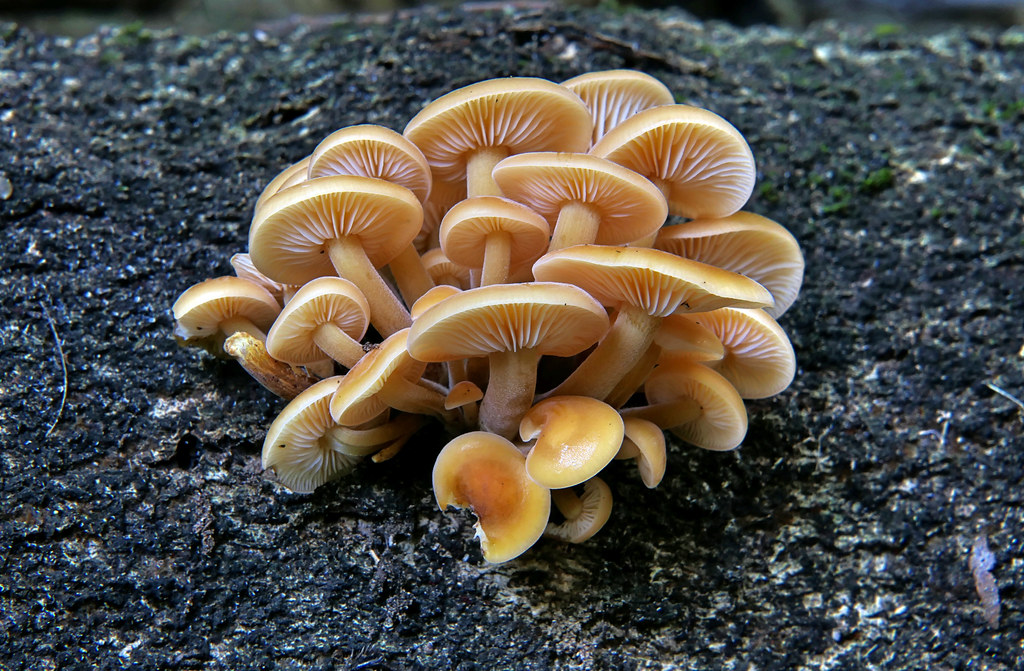
This common wood-decomposing fungus grows in small to very large clusters on the dead or dying wood of broad-leaved trees and shrubs. It is frequently found on logs, stumps, and hardwood snags, or occasionally in soil rich in decaying wood. While it favors deciduous species like elm, poplar, willow, and aspen, some varieties are specifically restricted to coastal dunes and riparian zones where they grow on bush lupine. It can function as a weak parasite and is often found on ornamental trees as well as living trunks.
Photos
Appearance
- Cap
- 1 to 10 cm across, starting convex and becoming flat, sometimes with a low bump or central depression. Color ranges from yellow-tan and orange-brown to reddish-brown, often darker in the center and paler toward the edges. The surface is smooth, shiny, and notably slimy or greasy when moist, becoming translucent-striate at the margins.
- Stem
- 2.5 to 10 cm long and 2 to 8 mm thick; tough, cartilaginous, and often curved or flattened. The upper part is yellowish or white, while the lower portion is characteristically covered in a dense, dark brown to blackish velvet-like layer of fine hairs.
- Gills
- White to pale yellow or ocher-buff, later becoming grey-yellow or dirty green. They are closely spaced and attached to the stem, often with a distinct notch.
- Flesh
- Thin and tough; white, yellowish, or light brown in color. It has a mild to pleasant fruity odor and a generally mild taste, though it can occasionally be slightly bitter.
- Spore print
- White to cream-white.
Sporecast is better in the app
Plan ahead with 10-day forecasts, see what people are finding nearby, get photo IDs, and track your finds.
Edibility
This mushroom contains compounds that destroy red blood cells, which must be broken down by thorough cooking to ensure safety. Foragers must be extremely careful to distinguish it from the deadly Galerina marginata (Funeral Bell), which also grows on wood and has similar coloring; however, Galerina species have brown spores, a ring on the stem, and lack the distinctive slimy cap and velvety stem base of Flammulina velutipes. While the caps possess a pleasant flavor and fruity smell, the stems are notably tough and cartilaginous, often leading collectors to prefer the caps. The species has white spores and an exceptionally slimier surface than many similar wood-rotting fungi.
Misidentification can be fatal. Never eat a mushroom unless you're 100% sure. This information may be inaccurate. Always consult multiple sources.
Nutrient Source
SaprotrophicIt obtains nutrients by decomposing dead organic matter, such as wood and plant materials.
Common Names
- Danish
- Gul fløjlsfod
- Dutch
- Gewoon fluweelpootje
- English
- Vinternagelskivling, Velvet Foot, Velvet Shank
- Finnish
- puistotalvijuurekas
- French
- Collybie à pied velouté
- German
- Winterrübling, Samtfußrübling
- Norwegian Bokmål
- vintersopp
- Norwegian Nynorsk
- vintersopp
- Swedish
- vinterskivling, vinternagelskivling
- Welsh
- Coesyn Melfed
Synonyms
- Agaricus atropes
- Agaricus fuscipes
- Agaricus nigripes
- Agaricus sphinx
- Agaricus velutipes
- Collybia eriocephala
- Collybia lactea
- Collybia veluticeps
- Collybia velutipes
- Collybidium velutipes
- Flammulina velutipes
- Gymnopus velutipes
- Myxocollybia velutipes
- Paxillus veluticeps
- Pleurotus velutipes