
Habitat
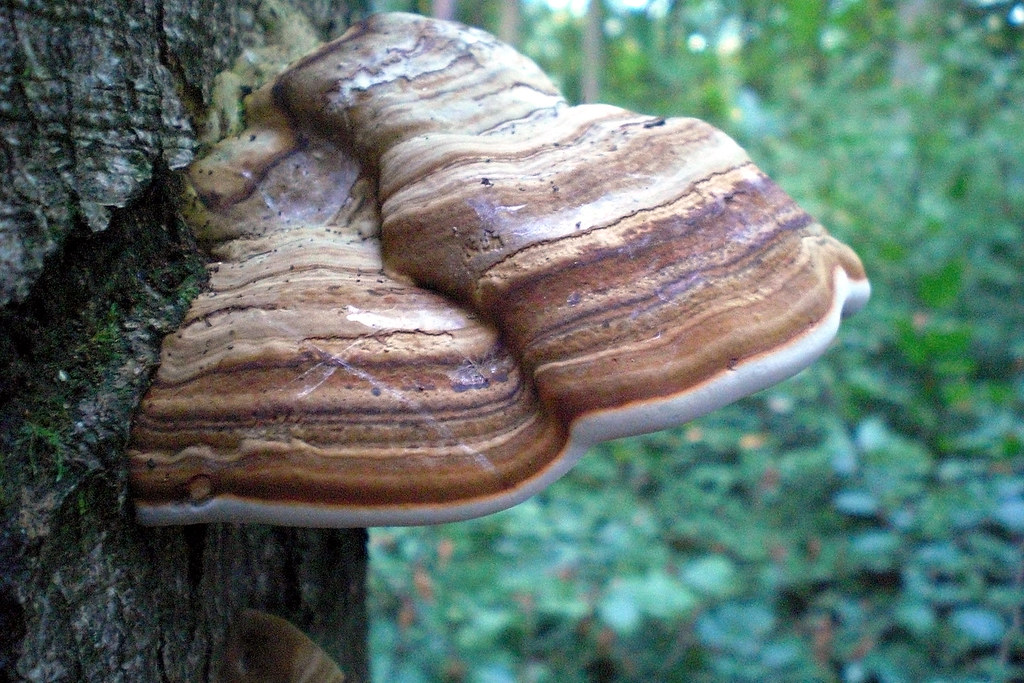
A common and widespread perennial bracket fungus found on dead, dying, or living deciduous trees, stumps, and logs. It acts as both a parasite and a decomposer, causing white rot. Primarily associated with birch and beech, it also occurs on alder, sycamore, maple, poplar, cherry, and hickory.
Photos
Appearance
- Fruit body
- Perennial, hard, and woody bracket measuring 5–45 cm across and up to 25 cm thick. It is classically hoof-shaped, broadly attached to the substrate, and may occur singly or in small groups.
- Upper surface
- Features a hard, horny crust that is concentrically grooved and zoned in shades of silver, grey, grey-brown, or grey-black. It is finely velvety or downy when young, becoming smooth with age, and the margin is typically blunt and lighter in color.
- Flesh
- Cinnamon-brown to yellow-brown, though sometimes mottled with white. The texture is tough, fibrous, leathery, or corky. It has a slightly fruity or banana-like smell and a taste that ranges from acrid to bitter.
- Tubes
- Layered and stratified in zones (representing growth years), typically rusty brown, pale brown, or ochraceous. Individual layers range from 2–7 mm or more in depth.
- Pores
- The pore surface is initially cream, tan, or pale grey-brown, darkening when handled or with age. Pores are small and circular, with a density of roughly 2–5 per mm.
- Spore print
- White to lemon-yellow or pale ochraceous.
Sporecast is better in the app
Plan ahead with 10-day forecasts, see what people are finding nearby, get photo IDs, and track your finds.
Edibility
The fruit body of this species is considered inedible because it is hard, woody, and fibrous. The flavor is described as acrid or bitter, with a smell that is pleasantly fungal, fruity, or similar to bananas. It could be confused with the Red-belted Bracket (Fomitopsis pinicola), which typically has red zoning near the margin, or Phellinus igniarius species, which generally have blackened, cracked caps and shelf-like forms.
Misidentification can be fatal. Never eat a mushroom unless you're 100% sure. This information may be inaccurate. Always consult multiple sources.
Nutrient Source
facultativeIt obtains nutrients by decomposing dead wood and can also parasitize living trees.
Common Names
- Basque
- ardoa, ardaya, ardagay, ardagaya, karduba
- Catalan
- bolet d´escá, bolets d´esca, bolet d´esc
- Danish
- Sydlig tøndersvamp
- Dutch
- Echte tonderzwam
- English
- Hoof Fungus, Tinder Bracket
- French
- Amadouvier, Polypore allume-feu
- German
- Zunderschwamm
- Northern Sami
- duovlecatna, duovli
- Norwegian Bokmål
- knuskkjuke
- Norwegian Nynorsk
- knuskkjuke
- Spanish
- agarico de encina, Hongo yesquero, Yesca, yesquero, casco de caballo, agárico ungulado, ardagaya, hongo de la yesca, bolet d´escà, jongo yesquero, agárico de encina, agárico de cirujanos
- Swedish
- fnöskticka, fnösk-ticka
- Welsh
- Carn y Fedwen
Synonyms
- Agaricus fomentarius
- Boletus fomentarius
- Boletus ungulatus
- Elfvingia fomentaria
- Elfvingiella fomentaria
- Fomes excavatus
- Fomes excavatus
- Fomes introstuppeus
- Fomes inzengae
- Fomes mirus
- Ochroporus fomentarius
- Placodes fomentarius
- Polyporus fomentarius
- Polyporus fomentarius
- Polyporus fomentarius
- Polyporus introstuppeus
- Polyporus inzengae
- Polyporus mirus
- Polyporus populinus
- Pyrenium fomentarium
- Pyropolyporus fomentarius
- Scindalma fomentarium
- Scindalma introstuppeum
- Scindalma mirum
- Ungularia albescens
- Ungularia populina
- Ungulina fomentaria
- Ungulina fomentaria