
Habitat
This common and widespread species is found exclusively on birch trees, growing on both living and dead wood. It acts as a parasite on living trees, eventually causing soft powdery rot or brown-rot decay as it transitions to a saprobic role. The fruit bodies appear on standing trunks, fallen logs, and stumps, occurring singly, in small groups, or in larger scattered troops. It is a dominant species wherever birch occurs, particularly in temperate regions of Europe, North America, and Asia.
Photos
Appearance
- Cap
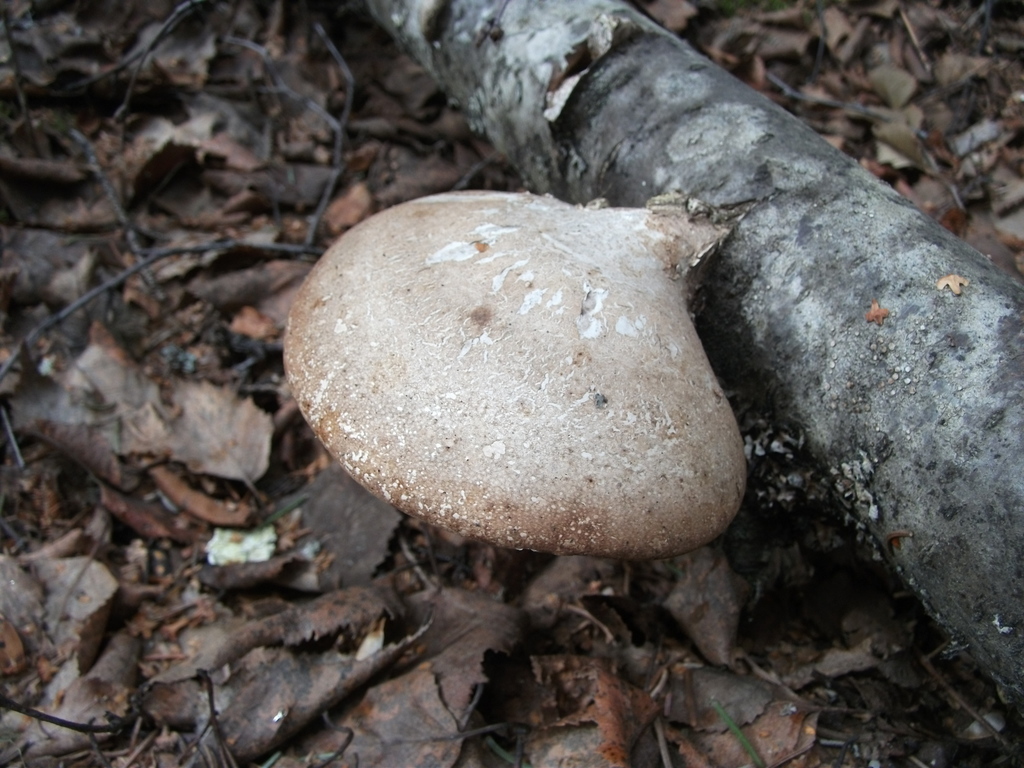
- 7–25 cm wide and up to 15 cm deep; ranges from subglobose or kidney-shaped to hoof or fan-shaped. The surface is smooth and leather-like, covered with a thin, separable skin that may crack or fracture into patches with age. Color varies from whitish or dirty white to pale tan, grey-brown, or light reddish-brown. The margin is thick, rounded, and typically inrolled, often projecting below the pore surface.
- Stem
- Usually absent, but may occur as a short, rudimentary, or umbonate extension of the cap base. If present, it is lateral and up to 6 cm tall by 5 cm wide.
- Pores
- 3–5 per mm, circular to rounded-angular. The pore surface is white to cream when young, becoming pale grey-brown or brownish in age, sometimes appearing tooth-like as the pore walls split and clump.
- Tubes
- 1.5–10 mm long, forming a thin, white to cream-colored layer that is easily peeled from the cap.
- Flesh
- White, thick, and tough. The texture ranges from rubbery or soft when fresh to corky and fibrous when dry.
- Spore print
- White.
- Odor
- Strong and pleasant, sometimes described as mild and mushroomy or slightly sweet.
- Taste
- Bitter to somewhat sour or astringent.
Sporecast is better in the app
Plan ahead with 10-day forecasts, see what people are finding nearby, get photo IDs, and track your finds.
Edibility
While some report this mushroom is edible when very young and tender, it is generally considered inedible due to its bitter, sour, or astringent taste and its tough, rubbery, or corky texture. It has a long history of medicinal use for its antibacterial, antiviral, and anti-inflammatory properties, and was historically used to treat intestinal parasites. Due to its host specificity on birch and its unique rounded, smooth, beige-to-tan cap with an inrolled margin, it is easily identified, though it may be compared to Fomes fomentarius which is much harder and hoof-shaped.
Misidentification can be fatal. Never eat a mushroom unless you're 100% sure. This information may be inaccurate. Always consult multiple sources.
Nutrient Source
facultativeIt can break down dead wood (saprotrophic) and also infect and live on living birch trees (parasitic).
Common Names
- Basque
- urki-ardagai, urki-ardagay
- Catalan
- bolet d´esca de bedoll
- Danish
- Birkeporesvamp
- Dutch
- Berkenzwam, Berkezwam
- English
- Razor Strop Fungus, Birch Polypore, Razorstrop Fungus
- Finnish
- pökkelökääpä
- French
- Polypore du bouleau
- German
- Birkenporling
- Northern Sami
- stohkkecatna
- Norwegian
- sop-kork, hvitt-knøsk, hvit-bjerke-sop, bløt-knøsk, forme-sop
- Norwegian Bokmål
- knivkjuke
- Norwegian Nynorsk
- knivkjuke
- Spanish
- yesquero de abedul
- Swedish
- björkticka
- Welsh
- Ysgwydd y Fedwen, Gogyrogo
Synonyms
- Agarico-pulpa pseudoagaricon
- Agaricum conchatum
- Boletus betulinus
- Boletus suberosus
- Boletus suberosus
- Boletus suberosus
- Boletus suberosus
- Buglossoporus betulinus
- Fomes betulinus
- Fomes betulinus
- Piptoporus betulinus — Birch Polypore
- Placodes betulinus
- Polyporus betulinus
- Suillus betulinus
- Ungularia betulina
- Ungulina betulina