
Habitat
This wood-rotting species typically grows on conifers but is also found on deciduous trees, particularly birch, aspen, and black cherry. It appears as solitary or clustered brackets on logs, dead wood, and occasionally living trees. While it is rare in Britain, it is widespread and common throughout Europe, Northern Asia, and North America, where it plays a significant role in producing forest humus. Fruit bodies are perennial and develop on the wood of both dead and dying trees.
Photos
Appearance
- Fruit body
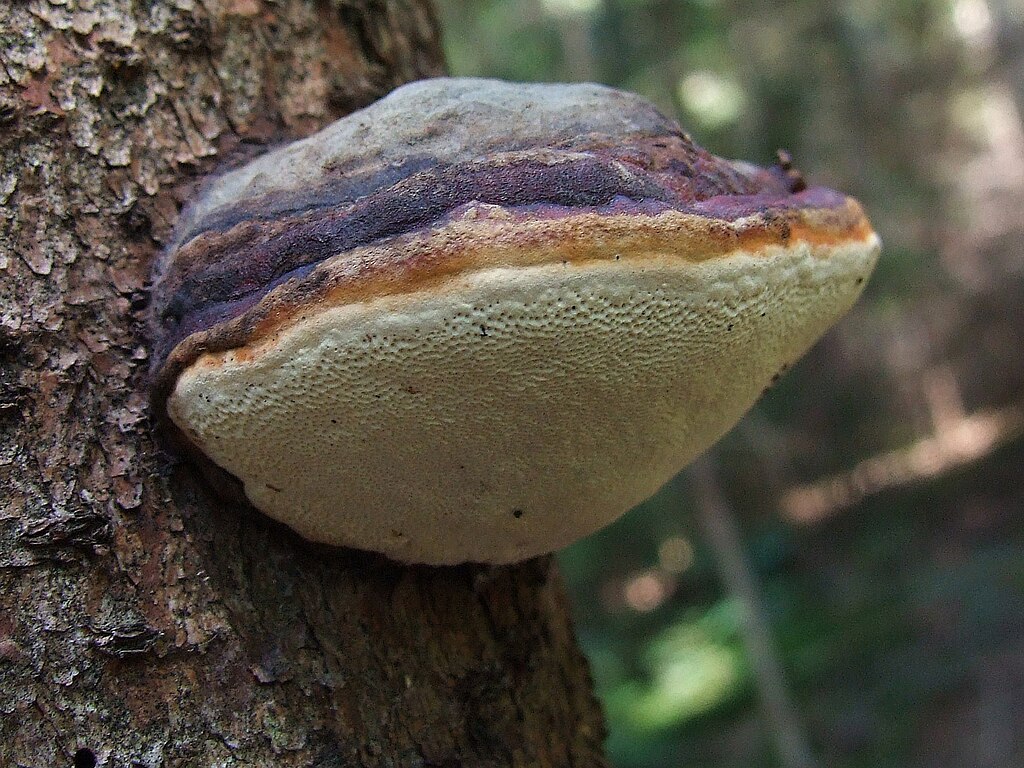
- A medium to very large perennial bracket, which is variously hoof-shaped, cushion-shaped, or fan-shaped. It often has concentric grooves or wrinkles and may feature a distinct, hard, resinous skin that can melt when heat is applied.
- Upper surface
- Smooth and glossy, appearing varnished. The color is typically zonated: older parts near the attachment are dark brown to blackish, followed by a reddish or orange-brown band, and ending in a cream or yellowish margin that can exude clear droplets when growing.
- Pores
- Small, circular, and numerous (3 to 4 per mm). The surface is white, buff, or cream, bruising to a yellow-brown, apricot, or grey-violet tint.
- Tubes
- Layered and relatively short, ranging from 1 to 8 mm in depth. The color is cream, straw-yellow, or pale ochre.
- Flesh
- White, cream, or pale yellow in color with a tough, corky to woody texture.
- Spore print
- White to creamy yellow.
- Odour
- Strong and distinctive, variously described as acidic, sour, unpleasant, or occasionally fragrant.
- Taste
- Bitter to lemony-sour.
Sporecast is better in the app
Plan ahead with 10-day forecasts, see what people are finding nearby, get photo IDs, and track your finds.
Edibility
This mushroom is not edible due to its corky or woody texture. It is characterized by an unpleasant, acidic, or sour smell and a flavor that is notably bitter or lemony sour. Foragers should be aware of the Hoof Fungus, which lacks the resinous coating of this species, and Ganoderma tsugae.
Misidentification can be fatal. Never eat a mushroom unless you're 100% sure. This information may be inaccurate. Always consult multiple sources.
Nutrient Source
SaprotrophicIt obtains nutrients by decomposing dead wood, breaking down complex organic compounds like lignin and cellulose.
Common Names
- Basque
- ardagay ezpain, ardagai ezpaingorri
- Catalan
- esca marginata
- Danish
- Randbæltet hovporesvamp
- Dutch
- Roodgerande houtzwam
- English
- Red-Belted Bracket, Red-banded Polypore
- Finnish
- kantokääpä
- French
- Polypore marginé
- German
- Rotrandiger Baumschwamm
- Northern Sami
- nivssat, guttocatna
- Norwegian Bokmål
- rødrandkjuke
- Norwegian Nynorsk
- raudrandkjuke
- Spanish
- yesquero de pino, cáncer derazón, Yesquero rebordeado, yesquero marginado, yesquero del pino
- Swedish
- klibbticka
- Welsh
- Carn Pinwydd
Synonyms
- Antrodia tuber
- Boletus ellipticus
- Boletus fulvus
- Boletus marginatus
- Boletus pinicola
- Boletus semiovatus
- Boletus ungulatus
- Boletus ungulatus
- Coriolus helveolus
- Favolus pinihalepensis
- Fomes albus
- Fomes cinnamomeus
- Fomes cinnamomeus
- Fomes cinnamomeus
- Fomes cinnamomeus
- Fomes lychneus
- Fomes marginatus
- Fomes marginatus
- Fomes marginatus
- Fomes pini-halepensis
- Fomes pinicola
- Fomes subungulatus
- Fomes thomsonii
- Fomes ungulatus
- Fomitopsis marginata
- Fomitopsis subungulata
- Friesia rubra
- Ganoderma rubrum
- Ischnoderma helveolum
- Leptodon strigosum
- Mensularia alba
- Mensularia marginata
- Piptoporus helveolus
- Placodes cinnamomeus
- Placodes helveolus
- Placodes marginatus
- Placodes pinicola
- Placodes ungulatus
- Polyporus helveolus
- Polyporus marginatus
- Polyporus marginatus
- Polyporus parvulus
- Polyporus pinicola
- Polyporus pinicola
- Polyporus semiovatus
- Polyporus thomsonii
- Polyporus ungulatus
- Pseudofomes pinicola
- Pyrenium ungulatum
- Scindalma cinnamomeum
- Scindalma cinnamomeum
- Scindalma marginatum
- Scindalma semiovatum
- Scindalma thomsonii
- Scindalma ungulatum
- Trametes marginata
- Trametes pinicola
- Ungularia parvula
- Ungulina marginata
- Ungulina pinicola
- Ungulina ungulata