
Habitat
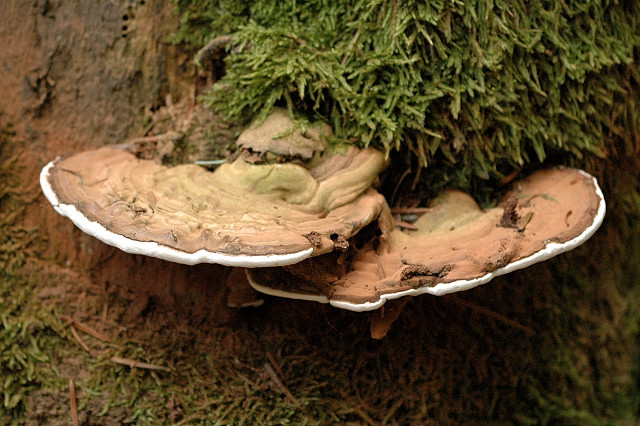
A perennial bracket fungus widely distributed across various regions. It grows on the wood of both living and dead trees, appearing on trunks, stumps, and fallen logs. While predominantly found on hardwoods—specifically beech—it is occasionally found on conifers. The species acts as a parasite on living trees, causing white heartwood rot, and continues to live as a saprope/decomposer after the host tree has died. Fruitbodies may grow alone, in small clusters, or in overlapping groups.
Photos
Appearance
- Fruit body
- Perennial, bracket-like to fan-shaped or shell-shaped, measuring 5–60 cm across and 2–10 cm thick. Being flattened to somewhat wavy, it projects outward from the wood and may grow solitary or in overlapping groups.
- Cap
- The upper surface is hard, woody, and concentrically grooved or ridged. Color ranges from grey-brown to dark brown or umber, often covered in a dusting of rusty brown spores. The margin is typically white to pale when actively growing.
- Pores
- Surface is initially white to cream, quickly and permanently bruising dark brown when scratched. Pores are tiny and circular, numbering about 4–6 per millimeter.
- Tubes
- Layered and stratified, with a new brown layer added each growing season; each layer is typically 7–25 mm deep.
- Flesh
- Tough, corky, and fibrous to woody. Color varies from cinnamon-brown to dark reddish-brown or grey-brown, often showing concentric growth zones or white spotting.
- Stem
- Usually absent; the fruit body is broadly attached directly to the substrate.
- Spore print
- Brown to rusty or chocolate-brown.
Sporecast is better in the app
Plan ahead with 10-day forecasts, see what people are finding nearby, get photo IDs, and track your finds.
Edibility
Due to its hard, woody, and corky consistency, this species is generally considered inedible for standard cooking. However, it can be ground into a food additive, used as a flavor enhancer, or prepared as a medicinal tea or tincture. It may have a bitter taste and should be distinguished from Ganoderma australe, Ganoderma brownii, and Fomes species. Looking similar, the Red-belted Conk and Western Varnished Conk can be differentiated because their pore surfaces do not permanently stain dark brown when scratched.
Misidentification can be fatal. Never eat a mushroom unless you're 100% sure. This information may be inaccurate. Always consult multiple sources.
Nutrient Source
facultativeThis species can obtain nutrients by decomposing dead organic matter or by consuming nutrients from living trees.
Common Names
- Basque
- ardagai zapal, ardagai zapala
- Catalan
- bolet d´esca
- Danish
- Flad lakporesvamp
- English
- Artist's Bracket
- Finnish
- lattakääpä
- French
- Ganoderme plat, Ganoderme aplani
- German
- Flacher Lackporling
- Norwegian Bokmål
- flatkjuke
- Norwegian Nynorsk
- flatkjuke
- Spanish
- hongo yesquero, Yesquero, Yesquero aplanado, ganoderma aplanada
- Swedish
- platt-ticka, platticka
- Welsh
- Paled y Peintiwr
Synonyms
- Agaricus flabelliformis
- Boletus applanatus
- Elfvingia applanata
- Elfvingia megaloma
- Fomes applanatus
- Fomes applanatus
- Fomes applanatus
- Fomes concentricus
- Fomes gelsicola
- Fomes incrassatus
- Fomes leucophaeus
- Fomes longoporus
- Fomes megaloma
- Fomes nigroporus
- Fomes stevenii
- Fomes vegetus
- Fomes vegetus
- Friesia applanata
- Friesia vegeta
- Ganoderma flabelliforme
- Ganoderma gelsicola
- Ganoderma incrassatum
- Ganoderma leucophaeum
- Ganoderma megaloma
- Ganoderma vegetum
- Phaeoporus applanatus
- Phaeoporus vegetus
- Placodes applanatus
- Placodes rubiginosus
- Placodes vegetus
- Polyporus applanatus
- Polyporus concentricus
- Polyporus incrassatus
- Polyporus leucophaeus
- Polyporus megaloma
- Polyporus merismoides
- Polyporus stevenii
- Polyporus subganodermicus
- Polyporus vegetus
- Scindalma concentricum
- Scindalma gelsicola
- Scindalma incrassatum
- Scindalma leucophaeum
- Scindalma megaloma
- Scindalma stevenii
- Scindalma vegetum
- Ungularia subganodermica