
Habitat
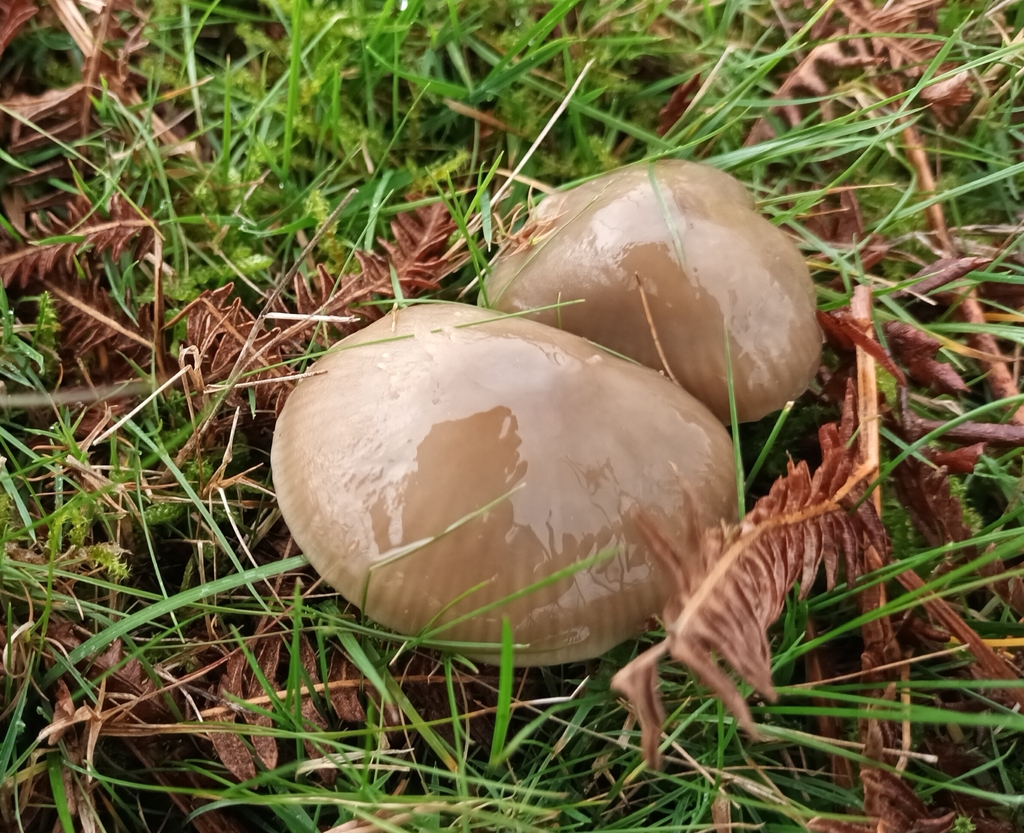
Found on soil or humus in unimproved grasslands, short-turf pastures, and cemeteries, as well as in open or mixed woodlands and under conifers like redwood. It can also appear in mossy, swampy areas. It typically grows solitary, scattered, or in small trooping groups.
Photos
Appearance
- Cap
- 1–5 cm wide; shapes range from hemispherical or bell-shaped to convex or flat, sometimes with a central bump. The surface is notably slimy or slippery, becoming shiny and paler when dry. Colors range from dark brownish-black and grayish-brown to grayish-white, typically darker at the center with a translucent-lined margin.
- Stem
- 2–10 cm long and 2–6 mm thick; often wavy, bent, or cylindrical and sometimes hollow. It matches the cap color but fades to white at the base. The surface is extremely slimy or viscid, sometimes featuring faint rippling bands or translucent zones.
- Gills
- Broadly attached (adnate), sometimes with a small descending tooth. They are thick, waxy, and widely spaced, often connected by veins or branching. Color is white to pale gray.
- Flesh
- Thin, fragile, and grayish to grayish-brown or white.
- Spore print
- White.
- Odor and Taste
- Mild and non-distinctive.
Sporecast is better in the app
Plan ahead with 10-day forecasts, see what people are finding nearby, get photo IDs, and track your finds.
Edibility
The mushroom is described as having a mild or indistinct taste and smell, though the texture is notably slimy or slippery. While it is considered edible by some, it is likely non-toxic but of unknown edibility to others. It is easily recognized as a waxcap due to its physical characteristics despite its lack of bright coloration.
Misidentification can be fatal. Never eat a mushroom unless you're 100% sure. This information may be inaccurate. Always consult multiple sources.
Nutrient Source
otherIt is thought that this mushroom may have a mutualistic relationship with mosses, rather than being strictly saprotrophic or mycorrhizal.
Common Names
- Catalan
- aragall
- Danish
- Slimet vokshat
- Dutch
- Grauwe wasplaat
- English
- Slimy Waxcap
- Finnish
- limavahakas
- German
- Grauer Saftling
- Norwegian Bokmål
- grå vokssopp
- Norwegian Nynorsk
- grå vokssopp
- Swedish
- grå vaxskivling, gråvaxing
- Welsh
- Cap Cŵyr Llysnafeddog
Synonyms
- Agaricus irrigatus
- Agaricus unguinosus
- Camarophyllus irrigatus
- Gliophorus irrigata
- Gliophorus unguinosus
- Hygrocybe irrigata — Slimy Waxcap
- Hygrocybe irrigata
- Hygrocybe unguinosa
- Hygrophorus irrigatus
- Hygrophorus unguinosus
- Hygrophorus unguinosus