
Habitat
This mushroom is found on soil, humus, and mosses in a diverse range of environments. It frequently occurs on acidic sites such as heaths and bogs, often growing among bracken, heather, or short turf. It favors moist to wet areas, including wetlands, mucky earth, and Sphagnum moss. In forested regions, it is found under redwoods, hardwood stands, or mixed forests containing both hardwoods and conifers, and it occasionally appears in gardens.
Photos
Appearance
- Cap
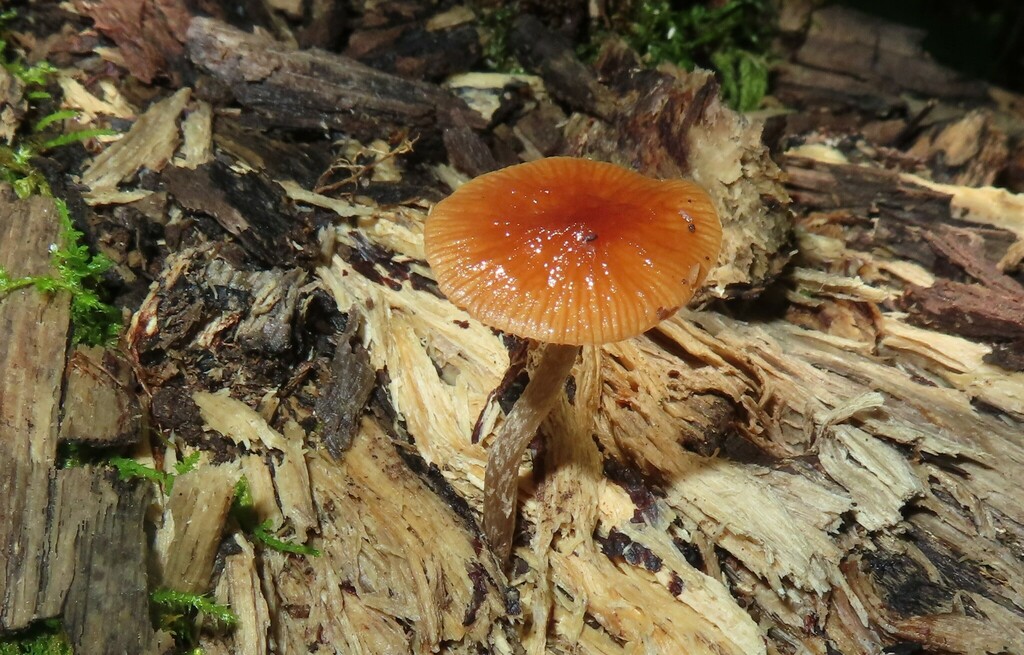
- 1–5 cm across; convex to flattened, often becoming depressed or sunken at the center with age; margin is translucent-striate and can be wavy or uplifted; surface is extremely slimy or sticky when moist; highly variable in color, including shades of orange-brown, peachy-pink, yellow, green, or purplish-grey, often fading to pinkish-orange as it matures.
- Stem
- 2–10 cm long and 2–7 mm thick; slender, equal, or slightly enlarged toward the base; very slimy and slippery to the touch; hollow; color is similar to the cap or paler, often retaining greenish or yellowish tints especially at the top or base.
- Gills
- Broadly attached to strongly decurrent; widely spaced and often connected by cross-veins; the edges are clear and sticky; color varies from whitish and greyish to pink, orange-pink, or occasionally tinged with green.
- Flesh
- Thin and fragile; colored similar to the cap surface or slightly paler (tawny, straw-colored, or greyish).
- Odour
- Highly variable; may be indistinct or notably unpleasant, with scents described as burnt rubber, fishy, skunk-like, or herbaceous.
- Spore print
- White.
Sporecast is better in the app
Plan ahead with 10-day forecasts, see what people are finding nearby, get photo IDs, and track your finds.
Edibility
The flavor is generally indistinct, but the odor can be unusual, ranging from herbaceous to unpleasant scents like burnt rubber, fishy, or skunk-like. This species is characterized by a heavy slime layer on the cap, stem, and gill edges, making it exceptionally slippery and difficult to handle. It can be confused with the Parrot Waxy Cap, which retains more green hues, whereas this species typically loses its green or purple colors as it matures.
Misidentification can be fatal. Never eat a mushroom unless you're 100% sure. This information may be inaccurate. Always consult multiple sources.
Nutrient Source
otherIt is believed to be biotrophic, possibly associating with mosses or grassland plants, and has unusual nitrogen nutrition. It is not known to associate with trees.
Common Names
- Danish
- Brusk-vokshat
- Dutch
- Slijmwasplaat
- English
- Heath Waxcap
- Finnish
- rustovahakas
- German
- Zäher Saftling
- Norwegian Bokmål
- seig vokssopp
- Norwegian Nynorsk
- seig vokssopp
- Swedish
- broskvaxskivling, broskvaxing
- Welsh
- Cap Cŵyr y Rhosydd
Synonyms
- Agaricus laetus
- Hygrocybe flava
- Hygrocybe houghtonii
- Hygrocybe laeta — Heath Waxcap
- Hygrophorus houghtonii
- Hygrophorus laetus