
Habitat
This species is found in a wide variety of environments, including grasslands, pastures, and roadsides, as well as forested areas. It grows on the ground in soil, humus, moss, or leaf litter (duff) under both hardwoods and conifers, such as redwood, California bay laurel, western redcedar, and bigleaf maple. It typically occurs in wet areas and can be found solitary, scattered, or in small clusters.
Photos
Appearance
- Cap
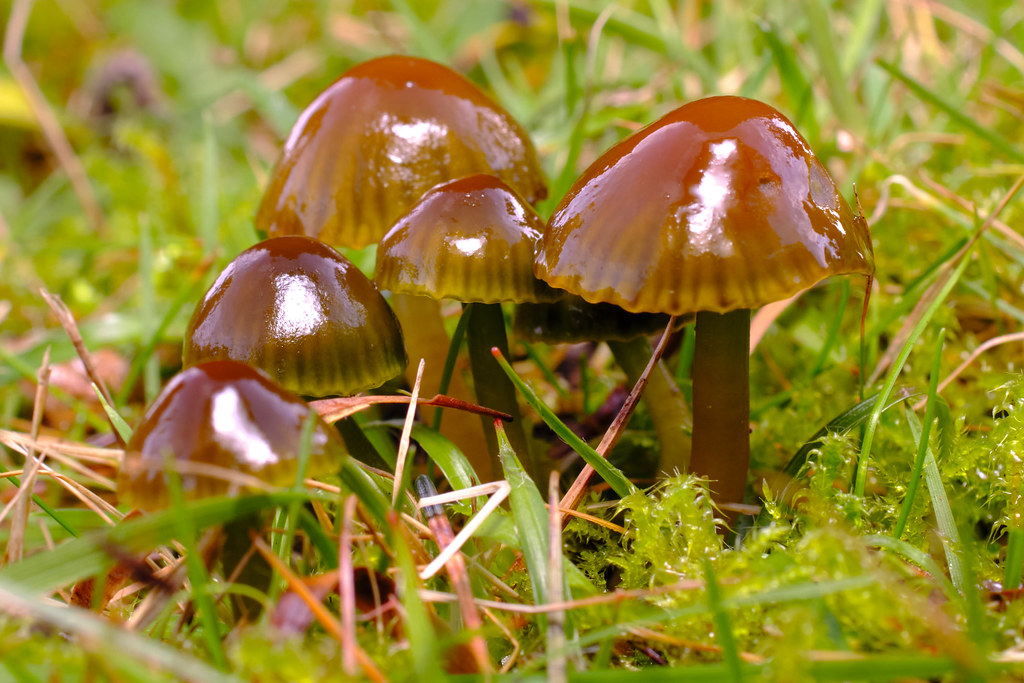
- 1 to 6 cm wide; bell-shaped or conical when young, becoming convex to flat, often with a central bump. The surface is extremely slimy or glutinous and smooth. Colors are highly variable and changeable; typically dark parrot-green when young, but fading or changing to yellow, mushroom-pink, orange, or even lilac as it ages. The margin is often translucent-striate when moist.
- Stem
- 2 to 8 cm long and slender; often curved and sometimes hollow. Like the cap, the surface is notably slimy and slippery. Colors range from green at the top to yellow, orange, or creamy white toward the base, changing color over time.
- Gills
- Attached to the stem, sometimes with a small notch or a slight tooth running down the stem. They are thick, waxy, and widely spaced. Colors vary from pale yellow or greenish-white to bright yellow, pinkish, or peach.
- Flesh
- Thin, fragile, and typically white to pale yellow or colored similarly to the cap.
- Spore print
- White.
- Odor
- Indistinct or mild.
Sporecast is better in the app
Plan ahead with 10-day forecasts, see what people are finding nearby, get photo IDs, and track your finds.
Edibility
Although labeled as nontoxic or edible by some sources, this species is considered mildly toxic by others and should not be eaten in large portions. Foragers should be wary of the similar poisonous Mousepee Pinkgill (Entoloma incanum), which is distinguished by its strong odor of mouse urine. Identifying this mushroom can be difficult because its extremely slimy, small fruitbodies undergo dramatic color changes as they age, ranging from parrot green to orange, pink, or lilac.
Misidentification can be fatal. Never eat a mushroom unless you're 100% sure. This information may be inaccurate. Always consult multiple sources.
Nutrient Source
facultativeIt is thought to obtain nutrients from living plants like grasses, mosses, or potentially trees, rather than decomposing dead organic matter. It is not strictly ectomycorrhizal, suggesting a flexible or unconventional nutrient acquisition strategy.
Common Names
- Danish
- Papegøje-vokshat
- Dutch
- Bruinrode wasplaat, Papegaaizwammetje
- English
- Parrot Waxcap, Parrot Mushroom, Parrot Wax-Cap
- Finnish
- papukaijavahakas
- French
- Hygrophore perroquet
- German
- Ziegelbrauner Saftling, Papageien-Saftling
- Norwegian Bokmål
- rød papegøyevokssopp, grønn vokssopp, papegøyevokssopp
- Norwegian Nynorsk
- papegøyevokssopp, grøn vokssopp, raud papegøyevokssopp
- Swedish
- papegojvaxskivling, papegojvaxing, rödgrön vaxskivling, rödgrön vaxing
- Welsh
- Cap Cŵyr y Parot
Synonyms
- Agaricus cameleon
- Agaricus psittacinus
- Agaricus sciophanus
- Gliophorus perplexus
- Gliophorus sciophanus
- Gymnopus psittacinus
- Hydrocybe psittacina
- Hygrocybe perplexa
- Hygrocybe perplexa
- Hygrocybe psittacina — Parrot Waxcap
- Hygrocybe psittacina
- Hygrocybe sciophana
- Hygrocybe sciophana
- Hygrocybe sciophanoides
- Hygrocybe sciophanoides
- Hygrophorus perplexus
- Hygrophorus psittacinus
- Hygrophorus sciophanoides
- Hygrophorus sciophanus
- Hygrophorus sciophanus