
Habitat
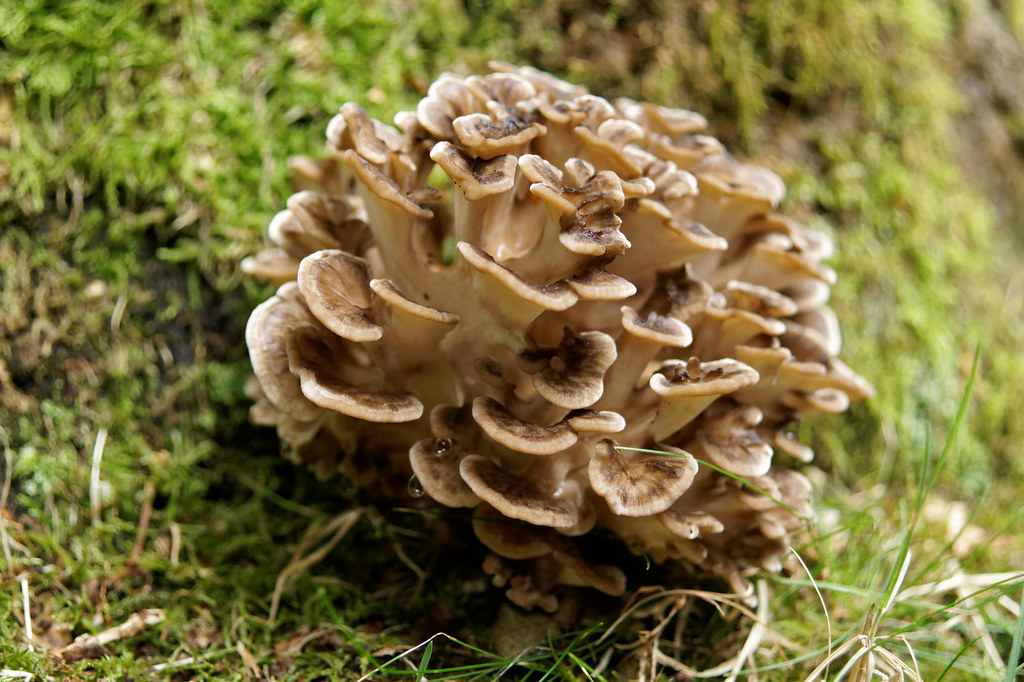
This species grows in small to massive clusters at the base of living hardwood trees, on standing dead trees, or around stumps and roots. It is a weak parasite that continues to live as a decomposer after the host tree dies, often causing a white rot. While it is most frequently associated with oak and beech, it can be found on various other broad-leaved species. It typically fruits on the ground or at the extreme base of the tree trunk.
Photos
Appearance
- Fruit body
- A large, dense, subglobose cluster measuring 15 to 50 cm across, composed of numerous overlapping individual caps or fronds branching from a common base.
- Cap
- Tongue, fan, or leaf-shaped, 2 to 10 cm wide and 0.5 to 1 cm thick. The upper surface is leathery, radially wrinkled, and may be fibrous or zonate. Colors range from grey, ochre-brown, or olivaceous to blackish-brown. The margins are wavy and often split.
- Stem
- A thick, stout, repeatedly branching structure that is white, cream, or pale grey. It is often flattened and eccentric.
- Pores
- Two to three per mm, appearing round to angular. The pore surface is white to off-white or cream, becoming yellowish with age, and descends far down the stem.
- Tubes
- White to whitish in color and up to 5 mm deep.
- Flesh
- White, soft yet fibrous or leathery. The taste is pleasant or mild when young, while the odor is often described as reminiscent of mice.
- Spore print
- White.
Sporecast is better in the app
Plan ahead with 10-day forecasts, see what people are finding nearby, get photo IDs, and track your finds.
Edibility
The flavor is mild and pleasant when young, but the mushroom may become acrid or develop an unpleasant mouse-like odor as it matures. There are no poisonous lookalikes, though it can be confused with the edible Cauliflower Fungus, Meripilus sumstinei (which stains black when bruised), or Polyporus umbellatus (distinguished by more defined central stalks and umbrella-shaped caps). It is suitable for grilling, sautéing, drying, or powdering into a flavoring.
Misidentification can be fatal. Never eat a mushroom unless you're 100% sure. This information may be inaccurate. Always consult multiple sources.
Nutrient Source
facultativeIt obtains nutrients by decomposing dead organic matter in trees and also by parasitizing living tree roots, weakening them.
Common Names
- Catalan
- gírbola de castanyer, Gamarús, girgola de castanyer, gírgola de castanyer
- Danish
- Tueporesvamp
- Dutch
- Eikhaas
- English
- Hen Of The Woods
- Finnish
- koppelokääpä
- French
- Polypore en touffes
- German
- Klapperschwamm
- Norwegian Bokmål
- korallkjuke
- Norwegian Nynorsk
- korallkjuke
- Spanish
- licia, políporo frondoso, poliporo frondoso
- Swedish
- korallticka
- Ukrainian
- Грифола листувата
- Welsh
- Iar y Coed
Synonyms
- Agaricus frondosus
- Boletus cristatus
- Boletus elegans
- Boletus frondosus
- Boletus frondosus
- Boletus frondosus
- Boletus intybaceus
- Caloporus frondosus
- Caloporus intybaceus
- Cladodendron frondosum
- Cladomeris frondosa
- Cladomeris intybacea
- Fungus squamatin-incumbens
- Grifola albicans
- Grifola intybacea
- Grifola intybacea
- Merisma frondosum
- Merisma intybaceus
- Polypilus frondosus
- Polypilus intybaceus
- Polyporus albicans
- Polyporus barrelieri
- Polyporus frondosus
- Polyporus frondosus
- Polyporus intybaceus