
Habitat
This mushroom is primarily associated with coniferous trees, particularly pine, and is often found on sandy or acidic soils. It typically grows on the ground in moss, needle litter, or duff, but may also be found on well-rotted wood or occasionally in lawns. Though widespread in mixed forests and lowland areas, it is especially common and locally abundant in mountainous or montane habitats, often fruiting near snowmelt.
Photos
Appearance
- Cap
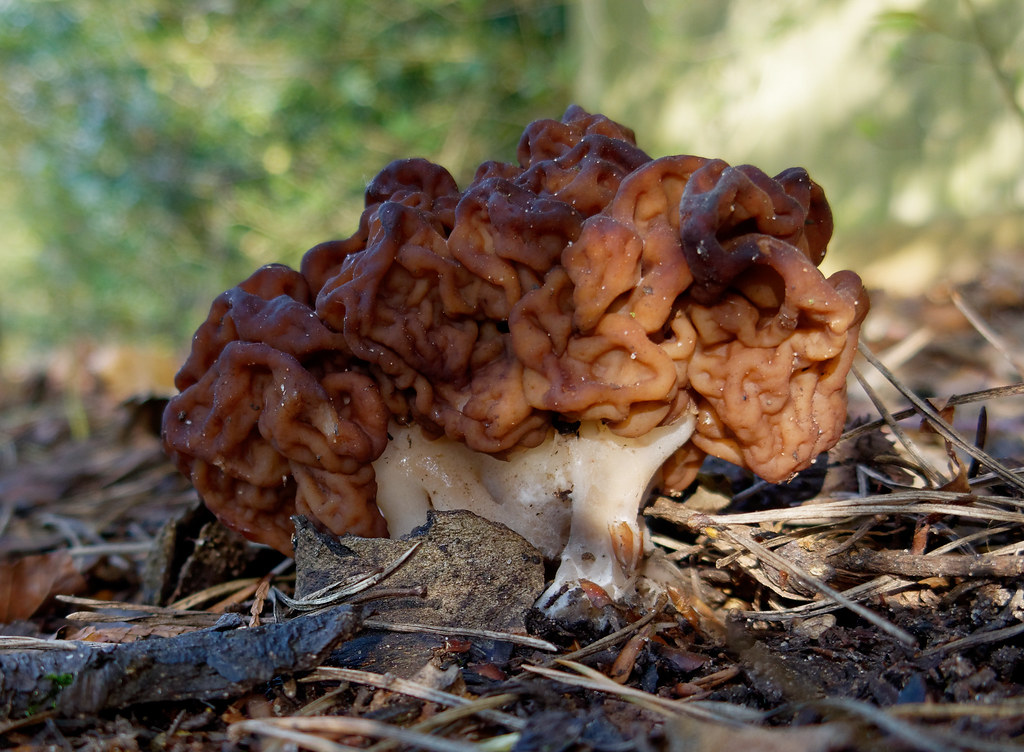
- 3–15 cm wide, irregularly lobed and highly convoluted into a brain-like form. The surface is wrinkled and folded, ranging in color from yellow-brown or reddish-brown to dark chocolate, rusty red, or vinaceous brown, occasionally turning black in age. The margins may be free or fused to the stem.
- Stem
- Short, stout, and irregular, measuring 1–12 cm tall. The surface is white, buff, or pale flesh-colored with occasional pink or purple tints, and can be smooth, finely hairy, or deeply grooved. Internally, it is stuffed with a white pith when young, becoming hollow or divided into irregular chambers at maturity.
- Flesh
- Thin and brittle in consistency, with a pallid or whitish color.
- Underside
- The reverse side of the cap is beige to tan and may be smooth or finely pubescent.
- Spore print
- White to yellow-brown.
- Odor
- Indistinct or not distinctive.
- Taste
- Mild, though tasting is not recommended due to high toxicity.
Sporecast is better in the app
Plan ahead with 10-day forecasts, see what people are finding nearby, get photo IDs, and track your finds.
Edibility
Potentially deadly poisonous, especially if eaten raw, this mushroom contains gyromitrin, which metabolizes into toxic monomethylhydrazine. Symptoms include headaches, nausea, organ damage, and long-term carcinogenic risks; the toxin's effect is cumulative, meaning severe illness can occur after multiple safe ingestions. While traditionally eaten in some regions following repeated boiling or drying, even steam from cooking can cause violent illness if inhaled. It is commonly confused with edible morels (Morchella), which have honeycombed rather than brain-like caps and a single hollow chamber inside, as well as toxic Helvella and other Gyromitra species like G. infula.
Misidentification can be fatal. Never eat a mushroom unless you're 100% sure. This information may be inaccurate. Always consult multiple sources.
Nutrient Source
facultativeThis species can obtain nutrients by decomposing dead organic matter in soil or wood, or it can form a symbiotic relationship with plant roots, exchanging nutrients.
Common Names
- Danish
- Ægte stenmorkel
- Dutch
- Voorjaarskluifzwam
- English
- False Morel
- Finnish
- korvasieni
- French
- Gyromitre commune, Cervelot, Fausse morille, Gyromitre fausse morille, Moricaude
- German
- Frühjahrslorchel
- Northern Sami
- bealljegouoppar
- Norwegian Bokmål
- sandmorkel
- Norwegian Nynorsk
- sandmorkel
- Swedish
- stenmurkla
- Welsh
- Morel Ffug
Synonyms
- Gyromitra esculenta
- Helvella esculenta
- Helvella phalloides
- Physomitra esculenta