
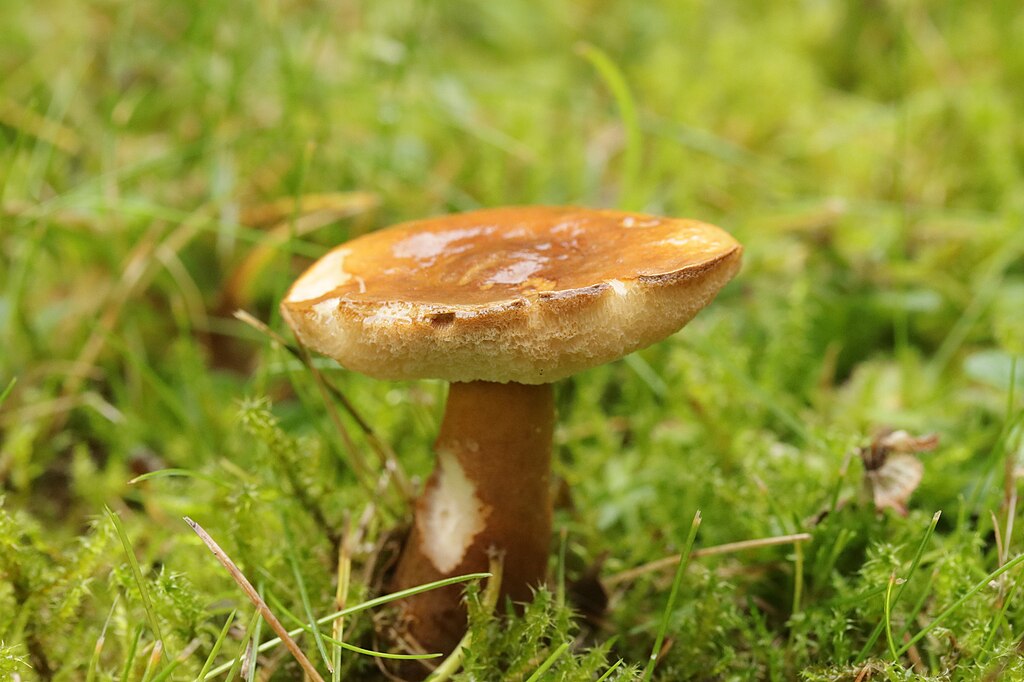
Habitat
Gyroporus castaneus is most commonly found on the ground in broadleaf or deciduous woodlands, showing a strong preference for oak trees. It is also found in mixed hardwood and conifer forests, and occasionally under pine. Often growing on soil or among moss, it can also appear in grassy areas, along road banks, or in disturbed ground. It grows as a solitary mushroom, in small groups, or in arcs, and is known for forming mycorrhizal relationships with various tree species.
Photos
Appearance
- Cap
- 3–10 cm wide; initially hemispherical or rounded, becoming convex to nearly flat, sometimes with a flared or uplifted margin. The color ranges from chestnut-brown and rusty-orange to cinnamon or tawny, often fading with age. The surface is dry, initially suede-like or velvety, and may become smooth or cracked as it matures.
- Stem
- 3–10 cm long and 1–3 cm thick; typically the same color as the cap or slightly paler. It is brittle and can be equal, swollen in the center, or club-shaped at the base. Internally, it is stuffed with a cottony pith when young but becomes distinctly hollow.
- Pores
- Very small and round, becoming irregular with age. They are initially white to creamy, maturing to straw yellow or lemon yellow, and generally do not bruise, though some sources note they may darken slightly with age or handling.
- Tubes
- Free from the stem or narrowly joined; colored white to pale yellow, darkening with age.
- Flesh
- White and generally unchanging when cut, though occasionally flushed pinkish. It is firm, brittle, and has a mealy texture.
- Spore print
- Pale straw yellow to lemon yellow or buff.
- Smell
- Faint and pleasant, sometimes described as sweet or nutty.
- Taste
- Mild, sweet, and nutty.
Sporecast is better in the app
Plan ahead with 10-day forecasts, see what people are finding nearby, get photo IDs, and track your finds.
Edibility
This mushroom has a mild, nutty, and sweetish flavor with firm flesh. In coastal regions of Portugal, Spain, and southern France, it can be nearly impossible to distinguish from its toxic relative Gyroporus ammophilus, which causes severe gastroenteritis. It may also be confused with the larger Gyroporus cyanescens, though that species is more yellow and stains blue when bruised.
Misidentification can be fatal. Never eat a mushroom unless you're 100% sure. This information may be inaccurate. Always consult multiple sources.
Nutrient Source
EctomycorrhizalIt forms a symbiotic relationship with trees, exchanging nutrients through their root systems.
Common Names
- Catalan
- ciureny, Sureny castany
- Danish
- Kastanie-kammerrørhat
- Dutch
- Kaneelboleet
- English
- Chestnut Bolete
- Finnish
- kastanjatatti
- French
- Bolet châtain, Bolet des sables
- German
- Hasenröhrling
- Norwegian Bokmål
- kastanjerørsopp
- Norwegian Nynorsk
- kastanjerøyrsopp
- Spanish
- boleto castaño
- Swedish
- kastanjesopp
- Ukrainian
- Гіропор каштановий
- Welsh
- Boled Castan
Synonyms
- Boletus castaneus
- Boletus castaneus
- Boletus fulvidus
- Boletus rufocastaneus
- Boletus testaceus
- Boletus testaceus
- Gyroporus ammophilus
- Gyroporus fulvidus
- Leucobolites castaneus
- Leucobolites fulvidus
- Suillus castaneus
- Suillus fulvidus
- Suillus fulvidus
- Suillus testaceus