
Habitat
This common species grows on soil in broad-leaved, deciduous, and mixed woodlands. It is frequently found along path sides and in damp areas, appearing either solitary or in small trooping groups.
Photos
Appearance
- Cap
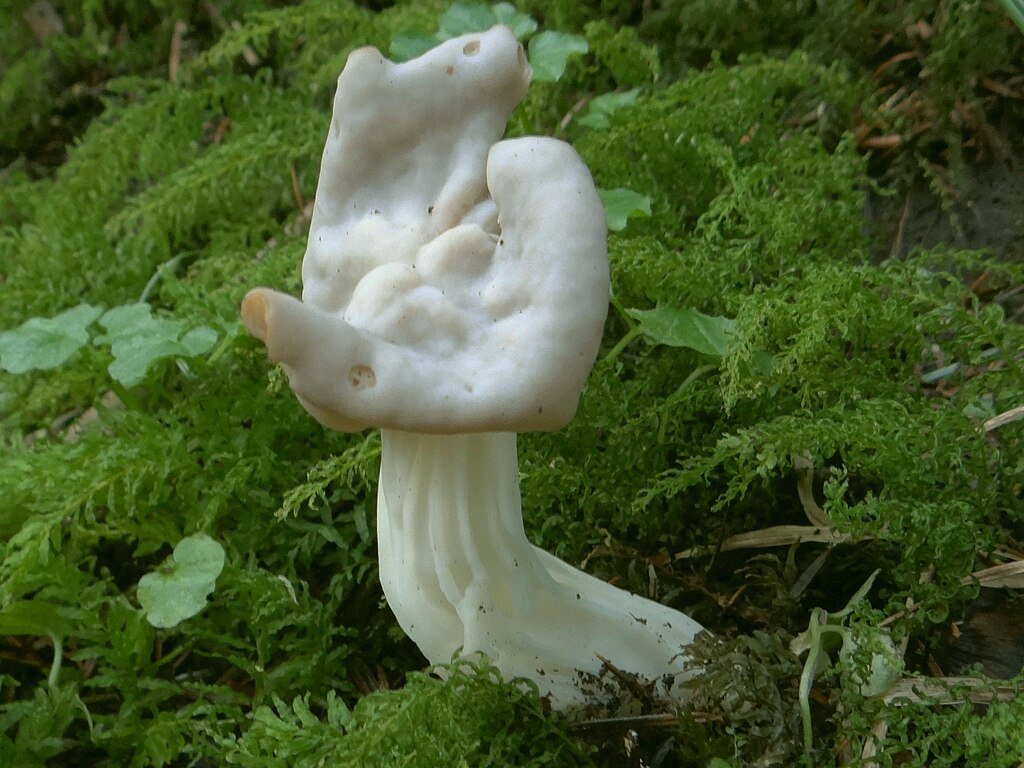
- Irregularly saddle-shaped and deeply lobed, measuring 2 to 6 cm wide. The surface is wavy and convoluted, ranging in color from whitish to pale ochraceous or grey-white, with a buff or tan underside. The margin is not fused to the stem.
- Stem
- Substantial and stout, measuring 2 to 12 cm tall and 1 to 2 cm thick. It is white to cream in color, hollow, and characterized by deep vertical furrows or grooves.
- Fruit body
- An apothecial fungus appearing as an irregularly folded blob, found growing solitarily or in small groups on soil.
Sporecast is better in the app
Plan ahead with 10-day forecasts, see what people are finding nearby, get photo IDs, and track your finds.
Edibility
This species contains monomethylhydrazine (MMH) and is generally considered of poor culinary quality. While small quantities of cooked specimens are unlikely to cause harm, it was formerly regarded as edible but is now treated with caution. It may be mistaken for other Helvella species or the remains of an old common stinkhorn.
Misidentification can be fatal. Never eat a mushroom unless you're 100% sure. This information may be inaccurate. Always consult multiple sources.
Nutrient Source
EctomycorrhizalIt forms a symbiotic relationship with trees, exchanging nutrients with the tree's roots.
Common Names
- Danish
- Kruset foldhat
- Dutch
- Roetkluifzwam
- English
- White Saddle
- French
- Helvelle crêpue
- German
- Herbstlorchel
- Norwegian
- steenmorkler, uægte morkler
- Norwegian Bokmål
- gråstilket høstmorkel
- Welsh
- Coesyn Rhychog Gwyn
Synonyms
- Costapeda crispa
- Helvella atra
- Helvella barlae
- Helvella nigricans
- Helvella nivea
- Helvella pityophila
- Otidea sparassis
- Phallus costatus
- Phallus crispus
- Wynnella sparassis