
Habitat
Found on the trunks and rotting wood of deciduous trees, with a strong preference for beech. It typically grows in old broad-leaved woodlands and may function as a weak parasite. Fruit bodies appear singly or in small, fused tiers on dead or fallen wood.
Photos
Appearance
- Fruit body
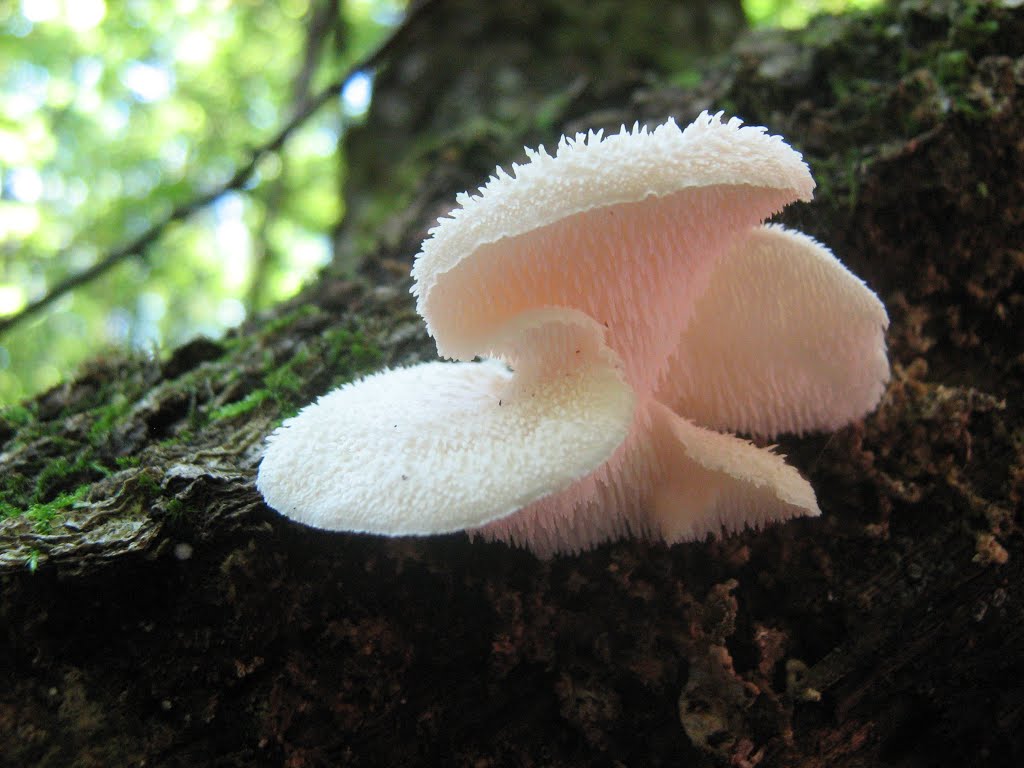
- Semicircular to shell-shaped brackets measuring 5 to 20 cm across; often found in tiered or overlapping clusters with wavy, lobed edges and a textured upper surface featuring warts, fibrous scales, or sterile spines.
- Spines
- Short, crowded, and conical spines hanging from the underside, measuring 5 to 15 mm long; color ranges from cream to pinkish-white.
- Flesh
- Thick, soft, and ranging in color from white to cream.
- Stem
- Not distinct or separate from the main body of the fungus.
- Spore print
- White.
- Smell
- Nondescript but pleasant.
- Taste
- Mild and pleasant.
Sporecast is better in the app
Plan ahead with 10-day forecasts, see what people are finding nearby, get photo IDs, and track your finds.
Edibility
This species has a mild, pleasant taste and smell with a soft flesh texture. While uncommon and potentially vulnerable, it is generally considered to have the same edibility qualities as Hericium erinaceus. It is unlikely to be confused with any fungi outside of its own genus.
Misidentification can be fatal. Never eat a mushroom unless you're 100% sure. This information may be inaccurate. Always consult multiple sources.
Nutrient Source
SaprotrophicIt obtains nutrients by breaking down dead organic matter, primarily from hardwood trees like beech. It grows on dead standing trees, fallen wood, or stumps.
Common Names
- Danish
- Børstepigsvamp
- Dutch
- Gelobde pruikzwam
- English
- Tiered Tooth
- Finnish
- tupasorakas
- German
- Dorniger Stachelbart
- Norwegian Bokmål
- børstepiggsopp
- Norwegian Nynorsk
- børstepiggsopp
- Swedish
- gyttertagging, gyttrad taggsvamp
- Ukrainian
- Герицій вусиковий
- Welsh
- Pigau Haenog
Synonyms
- Creolophus cirrhatus
- Creolophus corrugatus
- Creolophus diversidens
- Dryodon cirrhatum
- Dryodon corrugatus
- Dryodon diversidens
- Hericium diversidens
- Hydnum cirrhatum
- Hydnum corrugatum
- Hydnum diversidens
- Hydnum paradoxum
- Pleurodon cirrhatus
- Steccherinum cirrhatum