
Habitat
Woodland
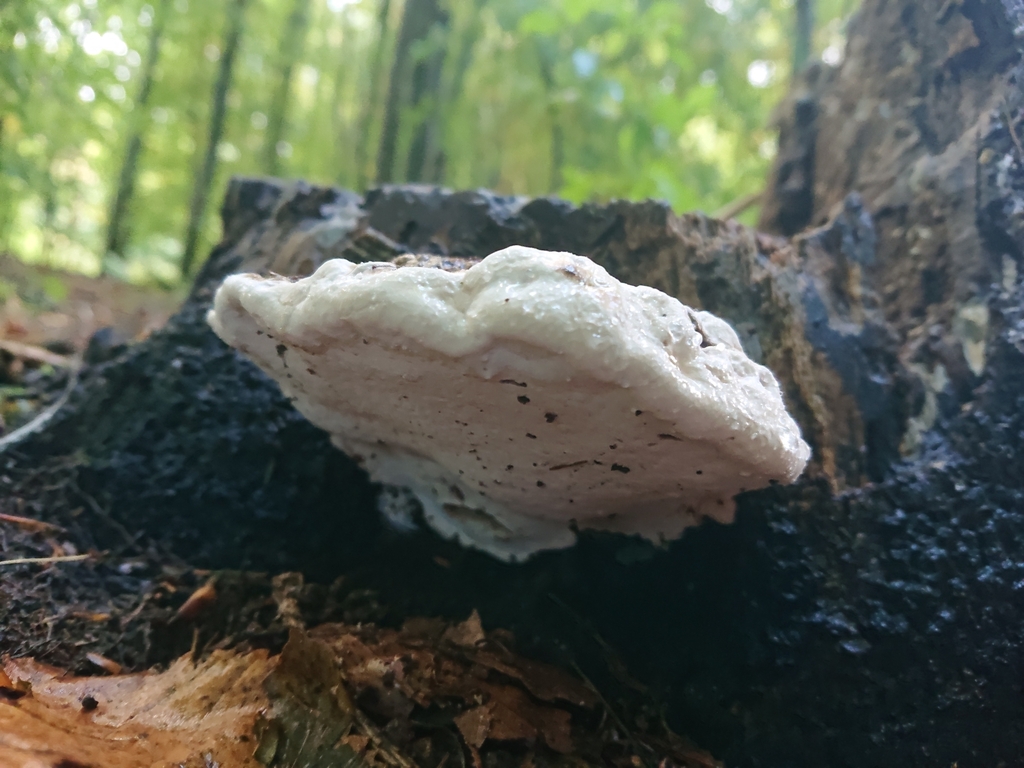
This fungus grows on the living trunks of coniferous trees and occasionally on broad-leaved trees. Fruitbodies are typically found very close to the soil level and may be partially hidden by surrounding vegetation. It causes significant white pocket rot and often grows in small, overlapping clusters.
Photos
Appearance
- Fruit body
- Perennial, bracket-like structure measuring 5 to 15 cm; forms spreading patches or overlapping clusters often attached low to the ground. The top surface ranges from flat to convex with irregular concentric grooves and a wavy, rounded margin. Texture transitions from velvety to smooth over time.
- Pore surface
- Colored white to cream and often featuring a warty texture. Pores are rounded or angular, with a density of 2 to 5 per millimeter.
- Tubes
- Arranged in layers, with each layer measuring less than 4 mm deep; color is white to cream.
- Flesh
- White to cream in color with a fibrous, corky consistency.
- Spore print
- White.
- Smell
- Reminiscent of emulsion paint.
Sporecast is better in the app
Plan ahead with 10-day forecasts, see what people are finding nearby, get photo IDs, and track your finds.
Edibility
unknown
Misidentification can be fatal. Never eat a mushroom unless you're 100% sure. This information may be inaccurate. Always consult multiple sources.
Nutrient Source
facultativeThis species is capable of both decomposing dead organic matter and infecting living trees, meaning it can obtain nutrients from dead material or by attacking living hosts.
Common Names
- Basque
- ardagai ezpainzuri
- Danish
- Almindelig rodfordærver
- Dutch
- Dennenmoorder, Dennemoorder
- English
- Root Rot, Root Fomes
- Finnish
- männynjuurikääpä
- French
- Polypore du rond des pins
- German
- Wurzelschwamm
- Norwegian Bokmål
- fururotkjuke, rotkjuke
- Norwegian Nynorsk
- fururotkjuke
- Spanish
- yesquero añoso
- Swedish
- rotticka
- Welsh
- Golosged y Gwraidd
Synonyms
- Boletus annosus
- Boletus cryptarum
- Boletus epiphegus
- Cunninghamella meineckella
- Fomes annosus
- Fomes annosus
- Fomes cryptarum
- Fomitopsis annosa
- Friesia annosa
- Heterobasidion annosum
- Heterobasidion cryptarum
- Inodermus cryptarum
- Oedocephalum meineckellus
- Phellinus cryptarum
- Physisporus makraulos
- Placodes annosus
- Polyporus annosus
- Polyporus cryptarum
- Polyporus fuscus
- Polyporus gillotii
- Polyporus macraulos
- Polyporus makraulos
- Polyporus marginatoides
- Polyporus nordmannii
- Polyporus scoticus
- Polyporus scoticus
- Polyporus serpentarius
- Polyporus subpileatus
- Polystictoides fuscus
- Polystictus cryptarum
- Poria cryptarum
- Poria makraulos
- Poria scutata
- Pycnoporus annosus
- Scindalma annosum
- Scindalma cryptarum
- Spiniger meineckellus
- Spongioides cryptarum
- Trametes annosa
- Trametes radiciperda
- Trametes scutata
- Ungulina annosa