
Habitat
Hydnum repandum is found on the ground in woodland environments, growing as solitary fruit bodies, in small groups, or in large rings and troop-like formations. It is an ectomycorrhizal species that inhabits both deciduous and coniferous forests. It is frequently associated with broad-leaved trees such as beech and oak, where it is often found among leaf litter; in coniferous woods, it is commonly associated with spruce and pine and may grow in mossy areas. In the Northeastern United States and Canada, it is also noted to occur in mixed hardwood forests.
Photos
Appearance
- Fruit body
- Typically robust and fleshy, occurring singly, in small groups, or in fused tufts and rings.
- Cap
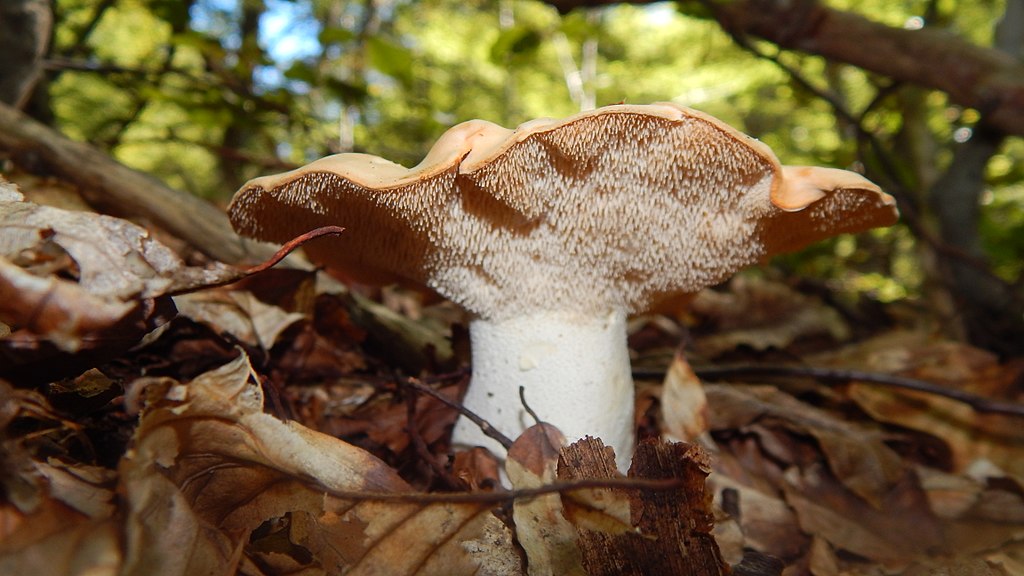
- 3–17 cm across, convex to flattened and often centrally depressed with age. The surface is smooth or finely velvety (suede-like), sometimes irregularly lobed or wavy at the margin, which is often inrolled. Color ranges from cream and pale yellow to buff or peach-orange, frequently staining deeper orange or yellow-brown when damaged.
- Spines
- Found on the underside in place of gills; 2–10 mm long, crowded, and fragile, easily detaching. They are whitish to salmon-pink or cream and typically run down the stem (decurrent).
- Stem
- 2–10 cm long and 1.5–4 cm thick; stout, cylindrical, or slightly tapered. It is often positioned off-center (excentric) and is white to cream-colored, bruising yellow to orange-brown, especially near the base.
- Flesh
- Thick, firm, and white; slowly bruises yellow-brown or orange. It has a pleasant, mild, or fruity smell and a taste that is initially mild to sweet but often becomes slightly bitter or acrid after a few seconds.
- Spore print
- White.
Sporecast is better in the app
Plan ahead with 10-day forecasts, see what people are finding nearby, get photo IDs, and track your finds.
Edibility
A choice edible species with a texture similar to chanterelles, though the flesh can be slightly brittle or rubery. The flavor is initially mild or sweet but often turns bitter or acrid, especially when raw; this bitterness is reduced by cooking for a significant period or blanching before frying. The spines are the bitterest part and can be easily scraped off with a spoon to prevent them from detaching and sticking to other mushrooms in a harvest. While it has no poisonous lookalikes in Europe, avoid the pure white variety Hydnum repandum var. album, which is reported to have a disagreeable bitter taste.
Misidentification can be fatal. Never eat a mushroom unless you're 100% sure. This information may be inaccurate. Always consult multiple sources.
Nutrient Source
EctomycorrhizalIt forms a mutually beneficial symbiotic relationship with the roots of trees, exchanging nutrients and water with the host tree.
Common Names
- Basque
- tripaki, tripaki argi, tripak, ziza-zuri
- Catalan
- llengua de bou, Llengua de bou, llengua bovina, llengüetes, llengua de vedella
- Danish
- Hvid pigsvamp, Almindelig pigsvamp
- Dutch
- rossige stekelzwam, Gele stekelzwam
- English
- Hedgehog Fungus, Wood Hedgehog, Terracotta Hedgehog
- Finnish
- vaaleaorakas
- French
- Pied de mouton
- German
- Semmel-Stoppelpilz
- Norwegian
- baarhat, guulstikle
- Norwegian Bokmål
- sørlig blek piggsopp
- Spanish
- ciervita, Lengua de gato, gamuza, lengua de gato, lengua de vaca, pie de cordero, pié de cordero
- Welsh
- Pigau Draenog y Coed
Synonyms
- Dentinum repandum
- Fungus erinaceus
- Hydnum album
- Hydnum aurantium
- Hydnum bicolor
- Hydnum bulbosum
- Hydnum clandestinum
- Hydnum diffractum
- Hydnum flavidum
- Hydnum medium
- Hydnum pallidum
- Hydnum portae
- Hydnum repandum
- Hydnum roseum
- Hydnum rufescens — Terracotta Hedgehog
- Hydnum washingtonianum
- Hypothele repanda
- Lophium medium
- Sarcodon abietinus
- Sarcodon repandus
- Sarcodon rufescens
- Tyrodon repandus