
Habitat
This species grows on the ground in deciduous, coniferous, and mixed hardwood forests. It is frequently found in wet areas or among Sphagnum moss, growing singly, in clusters, or in rings. It is often found in the same proximity as its relative, the Hedgehog Fungus.
Photos
Appearance
- Cap
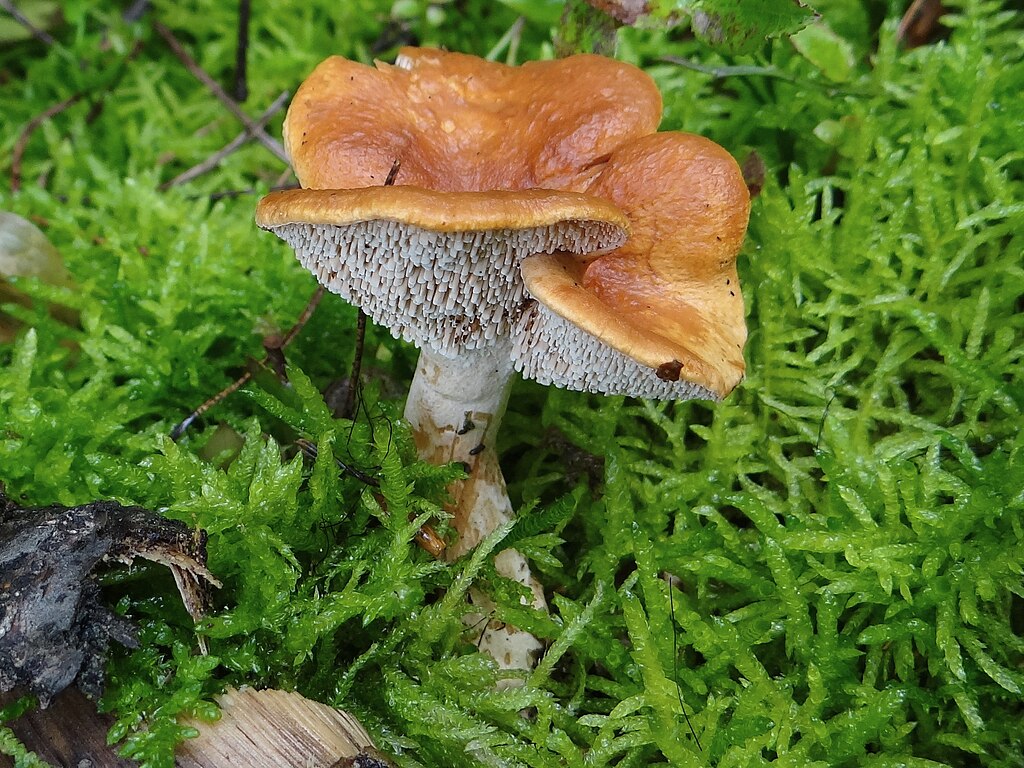
- Small to medium-sized, measuring 2-5 cm; convex to flattened and slightly depressed. Colors range from orange-brown to terracotta, often paler at the margin and sometimes showing faint concentric zones. The surface is finely velvety or woolly, and the shape is often irregularly lobed or fused with others.
- Spines
- Up to 0.4 cm long, easily detached from the cap. They are colored white, pale yellow, or salmon-buff and are adnate or nearly free, not running down the stem.
- Stem
- 1-3 cm long, often positioned off-center. It is white or pale flesh-toned, bruising yellow or darker with age. The surface is initially covered in fine woolly fibers but becomes smooth over time.
- Flesh
- White and rather crumbly in texture.
- Spore print
- White.
- Smell
- Faint and pleasant.
- Taste
- Slightly bitter when raw.
Sporecast is better in the app
Plan ahead with 10-day forecasts, see what people are finding nearby, get photo IDs, and track your finds.
Edibility
This species has a faint, pleasant smell and can have a slightly bitter taste when eaten raw. It is similar to the larger and more robust Hedgehog Fungus (Hydnum repandum), but is generally smaller and has a more crumbly texture. Other similar species include Hydnum umbilicatum, which is distinguished by a deeply sunken cap center.
Misidentification can be fatal. Never eat a mushroom unless you're 100% sure. This information may be inaccurate. Always consult multiple sources.
Nutrient Source
EctomycorrhizalIt forms a mutually beneficial relationship with trees, where it helps the tree absorb water and minerals, and in return, receives sugars produced by the tree through photosynthesis.
Common Names
- Basque
- tripaki gorriska
- Catalan
- picornell de pí, picornell de pi
- Dutch
- Rossige stekelzwam
- English
- Terracotta Hedgehog
- Finnish
- rusko-orakas
- German
- Rotgelber Stoppelpilz
- Norwegian Bokmål
- sørlig rødgul piggsopp
- Spanish
- pie de cordero, Lengua de gato, gamuza, pie derdero, Gamuza, lengua de gato rojiza, lengua de gato
- Welsh
- Pigau Draenog Cochlyd
Synonyms
- Dentinum rufescens
- Dentinum rufescens
- Hydnum carnosum
- Hydnum rufescens
- Hydnum sulcatipes
- Tyrodon rufescens