
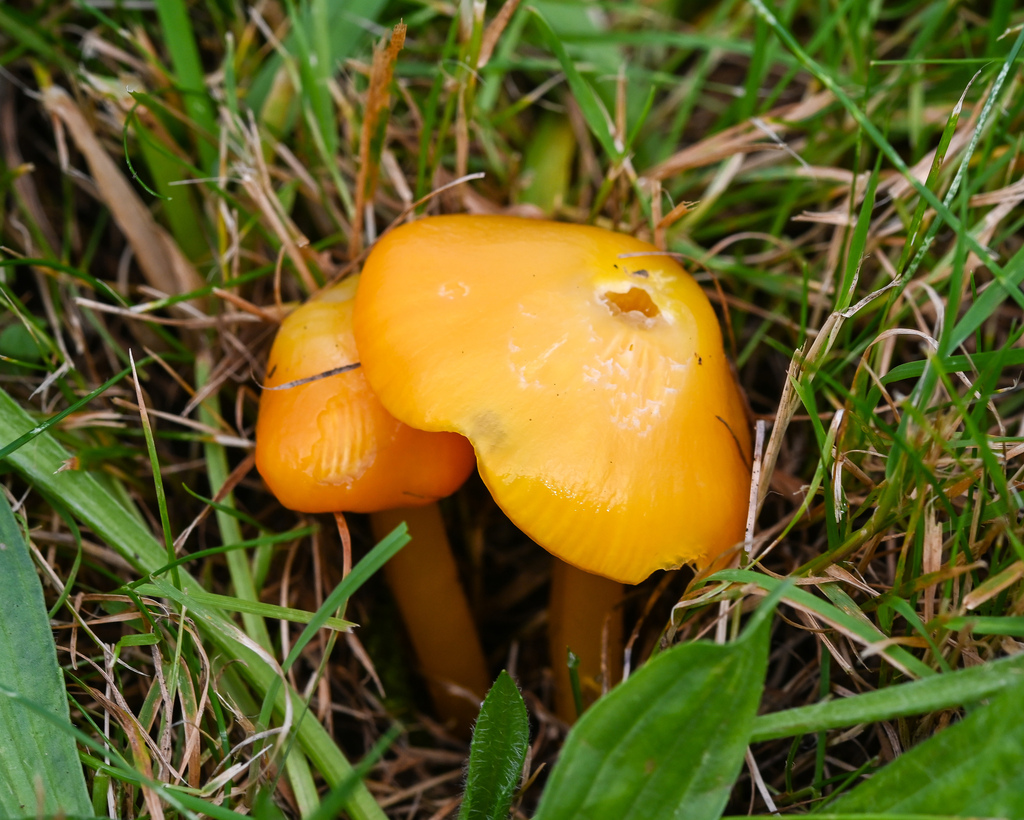
Habitat
This species is found on soil among moss and short grass in unimproved grasslands, cemeteries, and occasionally in woodland. It typically grows individually or in small groups.
Photos
Appearance
- Cap
- Measuring 3 to 7 cm across; initially convex, maturing to a flattened shape often with a broad central bump; the surface is notably sticky or slimy with fine lines visible near the edges.
- Stem
- Standing 5 to 7 cm tall; relatively slender and equal in width, though often flattened or grooved; the surface is slimy and smooth, topped with a pale, slightly powdery or scaly apex.
- Gills
- Widely spaced and broad; changing from an initial white to a persistent lemon yellow; attached to the stem either broadly or narrowly.
- Flesh
- Yellow throughout, sometimes appearing slightly darker just beneath the cap surface.
- Spore print
- White.
Sporecast is better in the app
Plan ahead with 10-day forecasts, see what people are finding nearby, get photo IDs, and track your finds.
Edibility
This species has a mild taste but is frequently listed as being of unknown edibility or simply not edible in various regions. It can be easily confused with other yellow waxcaps, and while none of those lookalikes are known to be seriously poisonous, they may lack clear safety records or could cause adverse reactions in some individuals.
Misidentification can be fatal. Never eat a mushroom unless you're 100% sure. This information may be inaccurate. Always consult multiple sources.
Nutrient Source
otherThis species is believed to be biotrophic, meaning it obtains nutrients from living organisms. While not strictly parasitic, it forms a relationship with plants, possibly mosses, rather than decomposing dead organic matter.
Common Names
- Catalan
- Pixacunill
- Danish
- Gul vokshat
- Dutch
- incl. Oranje wasplaat, Gele wasplaat
- English
- Golden Waxcap
- Finnish
- keltavahakas
- German
- Stumpfer Saftling
- Norwegian
- kantsopp, guulsopp
- Norwegian Bokmål
- gul vokssopp
- Norwegian Nynorsk
- gul vokssopp
- Spanish
- Higroforo amarillo
- Swedish
- gul vaxskivling, gulvaxing
- Welsh
- Cap Cŵyr Euraidd
Synonyms
- Agaricus chlorophanus
- Godfrinia chlorophana
- Hydrocybe chlorophana
- Hygrocybe euroflavescens
- Hygrophorus chlorophanus
- Hygrophorus euroflavescens
- Hygrophorus pertractatus