
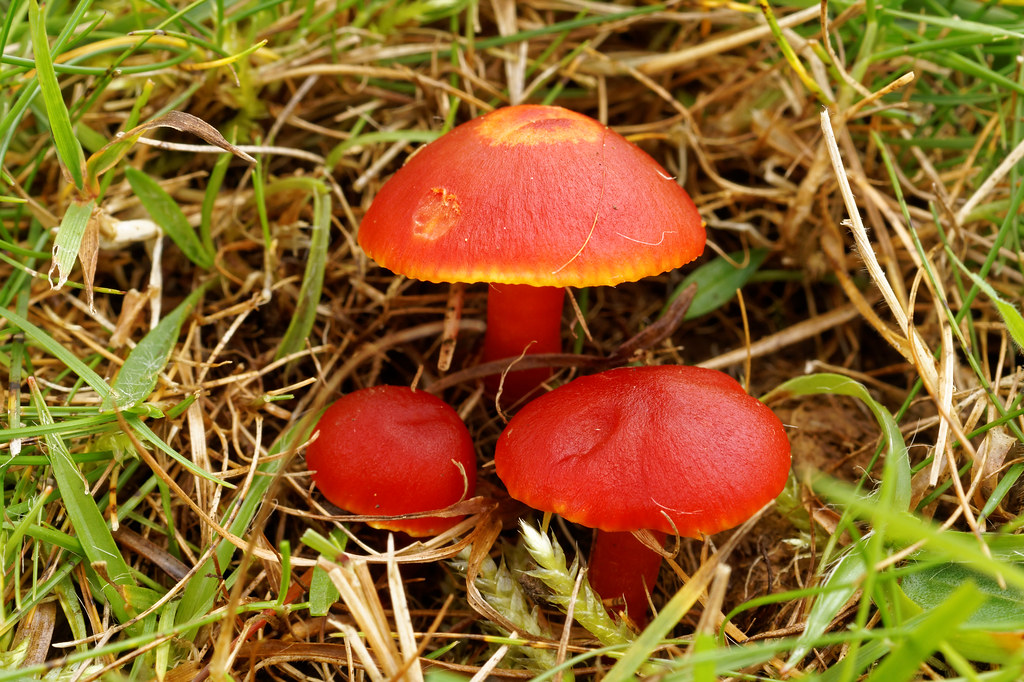
Habitat
This species is primarily found on soil among grasses in meadows, pastures, and coastal areas. It thrives in locations with short turf and heathland but generally avoids woodland, though some regional occurrences are noted in duff and moss under redwood trees. In North America, it may even be found under rhododendrons. It typically grows in small groups or larger troops.
Photos
Appearance
- Cap
- Measuring 2 to 5 centimeters across, initially bell-shaped or hemispherical, becoming convex to flat with age. It often features a small, nipple-like umbo and is colored deep scarlet to blood-red. The surface is smooth and can feel slightly slimy or greasy when young, becoming dry and occasionally finely roughened as it matures.
- Stem
- Approximately 2 to 7 centimeters long and up to 15 millimeters thick, it is often stout and can be compressed, flattened, or hollow. The color matches the cap but typically fades to yellow or white at the base. The surface is smooth or finely lined.
- Gills
- Attached to the stem with a decurrent tooth, these are broad and spaced fairly apart. They vary in color from yellow in youth to blood-red or orange-red as they mature, often retaining a paler yellowish edge.
- Flesh
- Thin and fragile, colored red, orange, or yellow depending on the tissue location. It has no distinctive odor and a mild, faint taste.
- Spore print
- White.
Sporecast is better in the app
Plan ahead with 10-day forecasts, see what people are finding nearby, get photo IDs, and track your finds.
Edibility
This mushroom is edible with a mild, indefinite taste, though it is not recommended by some due to issues associated with the closely related Crimson Waxcap. It can be confused with other edible red-orange waxcaps, particularly the larger Crimson Waxcap. There are no dangerous lookalikes specifically mentioned as a threat to this species.
Misidentification can be fatal. Never eat a mushroom unless you're 100% sure. This information may be inaccurate. Always consult multiple sources.
Nutrient Source
otherThis fungus obtains nutrients by interacting with living plants, potentially forming mycorrhizal associations, and may also derive nutrients from soil invertebrates.
Common Names
- Basque
- ezko gorri-txiki, ezko gorritxikia
- Danish
- Cinnober-vokshat
- Dutch
- Scharlaken wasplaat
- English
- Scarlet Hood, Scarlet Waxy Cap, Scarlet Waxcap
- Finnish
- punavahakas
- French
- Hygrophore cocciné
- German
- Kirschroter Saftling
- Norwegian Bokmål
- mønjevokssopp
- Norwegian Nynorsk
- mønjevokssopp
- Spanish
- higróforo purpúreo
- Swedish
- blodvaxing, blodvaxskivling
- Ukrainian
- Гігроцибе багряний
- Welsh
- Cap Cŵyr Coch
Synonyms
- Agaricus coccineus
- Agaricus miniatus
- Gymnopus coccineus
- Hygrocybe marchii
- Hygrocybe miniata
- Hygrophorus coccineus
- Hygrophorus coccineus
- Pseudohygrocybe coccinea