
Habitat
This common species is found on the ground, often occurring in clusters or small groups. Its preferred habitats include various types of grassland such as lawns, short turf, and both unimproved and semi-improved pastures. It also grows in soil within woodlands.
Photos
Appearance
- Cap
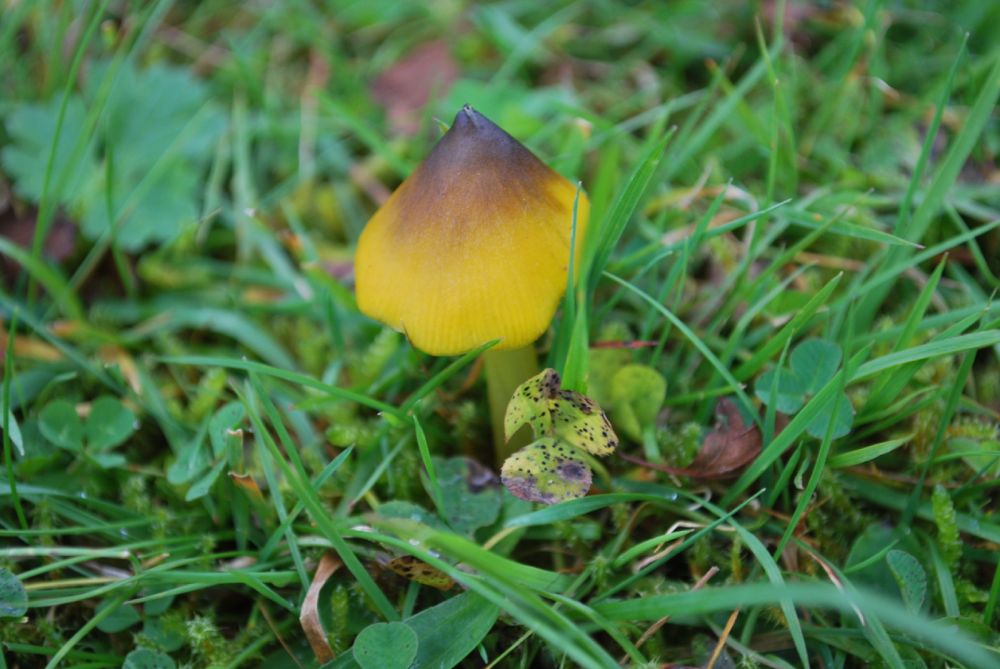
- 1.5–8 cm across; sharply conical to bell-shaped, often with a prominent point or irregular lobes. Colors range from orange and scarlet to blood-red, sometimes paler at the margin. Surface can be smooth, finely scaly, or slightly greasy. All parts turn black on exposure or with age.
- Stem
- 2–10 cm long, 3–10 mm wide; slender and cylindrical with a fibrous, vertically lined surface. Color matches the cap or is yellowish-orange, often with a white base. Turns black when handled or bruised.
- Gills
- Adnexed to free from the stem, broad and closely packed. Colors vary from white-yellow to greenish-orange, staining black when bruised.
- Flesh
- Yellowish in the cap and white in the stem, but slowly or quickly turning black when cut or bruised. Taste and smell are mild or indistinct.
- Spore print
- White.
Sporecast is better in the app
Plan ahead with 10-day forecasts, see what people are finding nearby, get photo IDs, and track your finds.
Edibility
Consumption of this species is controversial as status ranges from edible to poisonous; it has been linked to an old poisoning report in China and should be approached with caution. Every part of the mushroom, including the flesh, stains black when bruised, handled, or aged. It can be confused with Hygrocybe conicoides, which also likely contains toxins but prefers sandy dune habitats and turns black more slowly. Other similar red or orange waxcaps like H. cuspidata and H. acutoconica can be distinguished by their tissues which do not blacken.
Misidentification can be fatal. Never eat a mushroom unless you're 100% sure. This information may be inaccurate. Always consult multiple sources.
Nutrient Source
otherThis fungus appears to have a biotrophic lifestyle, obtaining nutrients directly from living plant tissues. It is not a saprotroph that decomposes dead organic matter.
Common Names
- Basque
- ezko gorri-koniko, ezko gorrikonikoa
- Catalan
- Pixacunill, pixaconill
- Danish
- Kegle-vokshat, Oliven-vokshat
- Dutch
- Zwartwordende wasplaat
- English
- Blackening Waxcap, Blackening Wax-Cap, Witch's Hat, Conical Waxcap
- Finnish
- kartiovahakas
- French
- Hygrophore conique
- German
- Olivschwarzer Dünensaftling, Schwarzfaseriger Orangesaftling, Kegeliger Saftling
- Norwegian Bokmål
- kjeglevokssopp
- Spanish
- higróforo cónico, higróforo rojo cónico
- Swedish
- toppvaxskivling, toppvaxing
- Ukrainian
- Гігроцибе конічний
- Welsh
- Cap Cŵyr Duol
Synonyms
- Agaricus aurantius
- Agaricus conicus
- Agaricus tristis
- Godfrinia conica
- Hygrocybe chloroides
- Hygrocybe cinereifolia
- Hygrocybe conica
- Hygrocybe conicopalustris
- Hygrocybe olivaceoniger
- Hygrocybe olivaceonigra
- Hygrocybe pseudoconica
- Hygrocybe tristis
- Hygrocybe tristis
- Hygrophorus conicopalustris
- Hygrophorus conicus
- Hygrophorus conicus
- Hygrophorus conicus
- Hygrophorus olivaceoniger
- Hygrophorus tristis
- Hypophyllum conicum