
Habitat
This species is found in a wide variety of environments, including semi-improved and acidic grasslands, fields, pastures, heathlands, and mossy lawns. It also occurs in mixed, deciduous, and coniferous forests, where it grows on the ground, in leaf litter or rich humus, and occasionally on moss-covered decaying logs or rotting wood. It prefers sandy or mossy soil and typically grows in small groups or clusters.
Photos
Appearance
- Cap
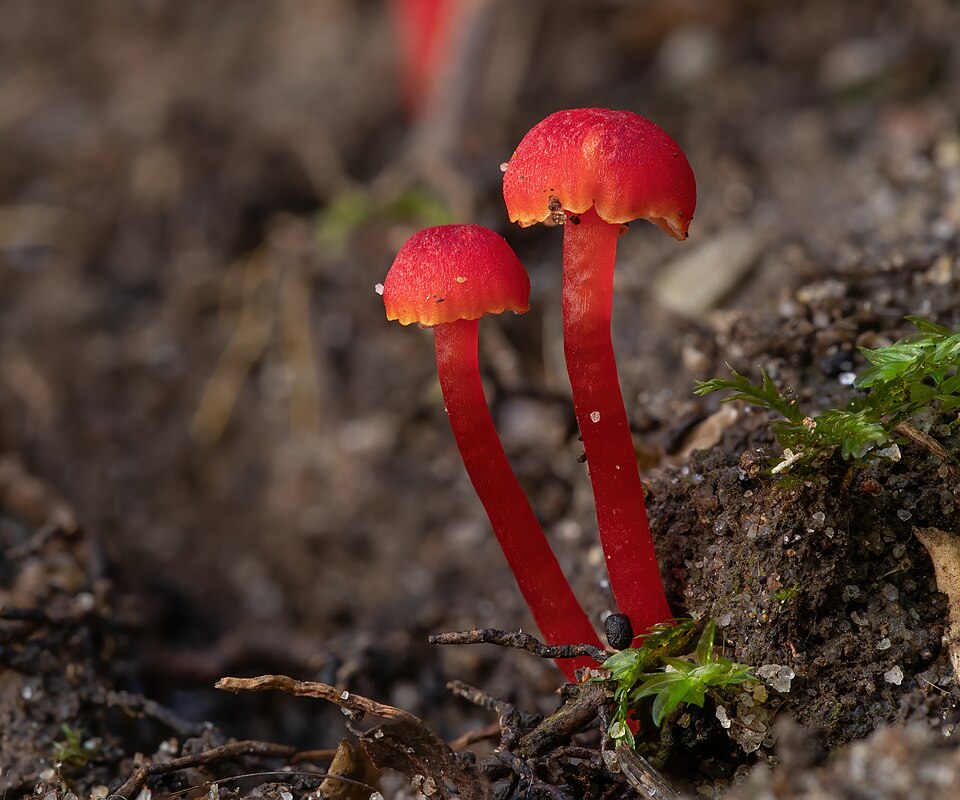
- 0.5–4 cm wide; initially hemispherical or convex, becoming flat or slightly depressed with age. The surface is dry to moist but never slimy, bright scarlet or orange-red, fading to yellow-orange. Often covered in fine, scurfy scales, especially near the center, and may have a wavy or scalloped margin that shows translucent striations.
- Stem
- 2–7 cm long, 2–6 mm thick; equal in width or tapering downward. Smooth and dry, colored similarly to the cap but often paler or yellowish toward the white base. Often becomes compressed or curved.
- Gills
- Broadly attached (adnate) to slightly decurrent; thick, waxy, and somewhat widely spaced. Color ranges from yellow to orange or scarlet, often with a paler yellow edge.
- Flesh
- Thin, fragile, and waxy; colored orange-red to yellow.
- Spore print
- White.
- Odor
- Indistinct or not distinctive.
- Taste
- Mild or indistinct.
Sporecast is better in the app
Plan ahead with 10-day forecasts, see what people are finding nearby, get photo IDs, and track your finds.
Edibility
This species has an indistinct or mild taste and a fragile texture. It is frequently confused with many other small red waxy caps, such as Hygrocybe squamulosa, which is similar but larger and more noticeably scaly. While some foragers value it, others consider it poor quality or too small to bother collecting.
Misidentification can be fatal. Never eat a mushroom unless you're 100% sure. This information may be inaccurate. Always consult multiple sources.
Nutrient Source
otherThis fungus is believed to be biotrophic, meaning it forms a symbiotic relationship with living plants, potentially colonizing their roots to obtain nutrients.
Common Names
- Basque
- ezkotxo
- Danish
- Mønje-vokshat
- Dutch
- Gewoon vuurzwammetje
- English
- Vermilion Waxcap
- Finnish
- mönjävahakas
- German
- Mennigroter Saftling
- Norwegian Bokmål
- liten mønjevokssopp
- Norwegian Nynorsk
- liten mønjevokssopp
- Spanish
- pequeño higróforo rojo
- Swedish
- mönjevaxing, mönjevaxskivling
- Ukrainian
- Гігроцибе дрібноніжковий
- Welsh
- Cap Cŵyr Fermiliwn
Synonyms
- Agaricus miniatus
- Hygrocybe strangulata
- Hygrocybe strangulata
- Hygrocybe strangulata
- Hygrophorus miniatus
- Hygrophorus strangulatus
- Pseudohygrocybe miniata