
Habitat
This common species is found in both coniferous and broad-leaved woodlands, appearing on acidic sites or alkaline soils. It frequently grows on needle litter, humus, or well-decayed logs and stumps. It is also often found in urban areas on wood chips, as well as on heathlands and occasionally near rushes in fens or carrs. It may grow solitarily, in clusters, or in large trooping groups.
Photos
Appearance
- Cap
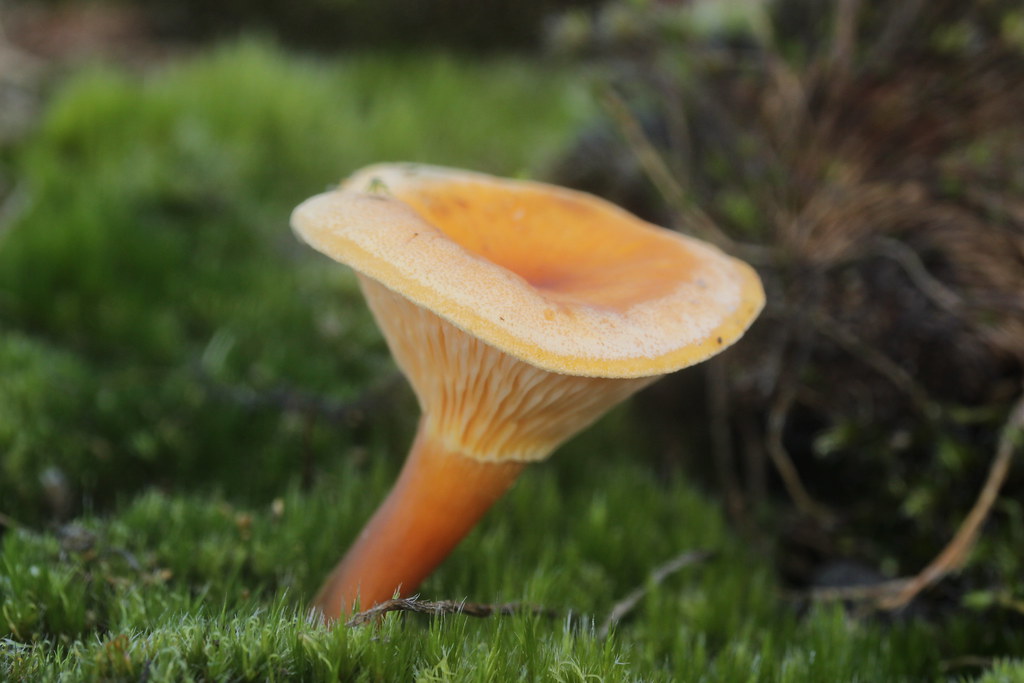
- 2–10 cm wide; initially convex with an inrolled margin, developing a central depression and eventually becoming funnel-shaped. The surface is dry, soft, and feels velvety or downy like chamois leather when young, becoming smoother or matted with age. Color is highly variable, ranging from bright orange and orange-yellow to orange-brown or even whitish-cream.
- Gills
- Deeply decurrent and crowded; they are thin and narrow rather than thick ridges. They fork repeatedly and often appear wavy or wrinkled. Color is typically bright to dull orange or yellow-orange, often more vibrant than the cap surface.
- Stem
- 2–7 cm long and 0.5–1 cm thick. It is often curved, sometimes eccentric (off-center), and equal or tapering toward the base. Texture is fibrous and soft, colored similarly to the cap though sometimes darker at the base. White mycelium or thread-like rhizomorphs may be present at the bottom.
- Flesh
- Thin and flabby or soft in texture; white to pale orange or yellowish. It is much more flexible and flimsy compared to the stringy, firm flesh of true chanterelles.
- Spore print
- White.
- Odor and Taste
- Flavor and smell range from indistinct to earthy, mushroomy, or slightly unpleasant.
Sporecast is better in the app
Plan ahead with 10-day forecasts, see what people are finding nearby, get photo IDs, and track your finds.
Edibility
Often confused with the chanterelle, this species is distinguished by its thin, repeatedly forking gills and soft, flabby, or tough texture rather than thick gill-like folds and stringy flesh. While sometimes described as edible, it is best avoided as it contains arabitol and can cause gastrointestinal upset or even alarming symptoms like hallucinations in some individuals. The taste has been described as indistinct, mushroomy, earthy, or unpleasant.
Misidentification can be fatal. Never eat a mushroom unless you're 100% sure. This information may be inaccurate. Always consult multiple sources.
Nutrient Source
SaprotrophicIt obtains nutrients by decomposing dead organic material found in forest litter and decaying wood.
Common Names
- Basque
- zizahori faltsua, zizahori faltsu
- Catalan
- pixacá toronja, fals rossinyol, pixacá taronja
- Danish
- Almindelig orangekantarel
- Dutch
- Valse hanenkam, Valse hanekam
- English
- False Chanterelle
- Finnish
- valevahvero
- French
- Fausse girolle
- German
- Falscher Pfifferling
- Norwegian Bokmål
- falsk kantarell
- Norwegian Nynorsk
- falsk kantarell
- Spanish
- Rebozuelo anaranjado, falso rebozuelo
- Swedish
- narrkantarell, falsk kantarell
- Welsh
- Siantrel Ffug
Synonyms
- Agaricus aurantiacus
- Agaricus subcantharellus
- Cantharellus aurantiacus
- Cantharellus aurantiacus
- Cantharellus aurantiacus
- Cantharellus brachypodes
- Cantharellus brachypodus
- Cantharellus lacteus
- Cantharellus ravenelii
- Cantharellus rufescens
- Clitocybe aurantiaca
- Clitocybe aurantiaca
- Hygrophoropsis aurantiaca
- Merulius aurantiacus
- Merulius aurantiacus
- Merulius brachypodis
- Merulius brachypodus
- Merulius nigripes
- Merulius ravenelii
- Merulius rufescens