
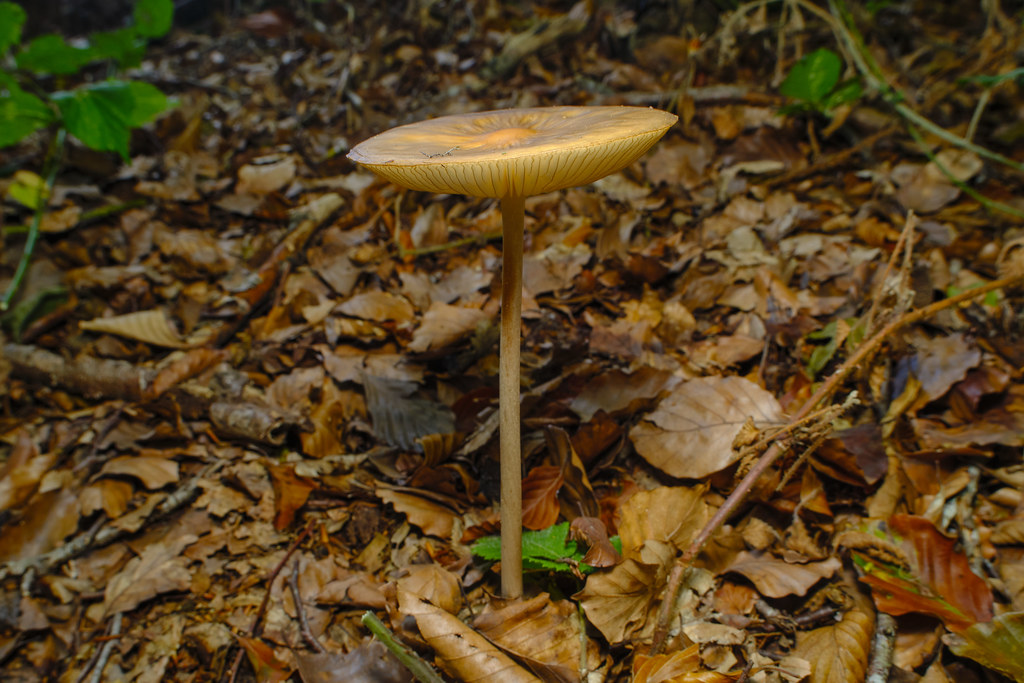
Habitat
This species occurs in proximity to deciduous trees, demonstrating a particular affinity for beech. It typically grows from buried woody debris or roots beneath the soil, though it is also found on well-rotted stumps. These mushrooms are often found solitary and can persist in locations where host trees have been removed as long as old root systems remain underground.
Photos
Appearance
- Cap
- 3–10 cm wide; initially bell-shaped or convex, maturing to a flattened shape with a broad central bump. The surface is slimy, often irregularly shaped, and marked by radial wrinkles. Colors range from pale ochre to olive-brown or tan.
- Stem
- 8–20 cm tall and 5–10 mm thick; slender and firm, tapering toward the top. It features a distinctive, long, tapering base that roots deeply into the ground. Its color is white at the top, becoming tan or the same color as the cap toward the base.
- Gills
- White, thick, and broad; they are widely spaced and typically attached narrowly to the stem.
- Flesh
- White and thin; the texture is fairly soft and slightly rubbery.
- Spore print
- White.
Sporecast is better in the app
Plan ahead with 10-day forecasts, see what people are finding nearby, get photo IDs, and track your finds.
Edibility
The flesh of this mushroom is thin and rubbery with a tough stem and indistinct taste. It can be confused with members of the shield family, which have pink spores rather than white, and include species that are inedible or mildly toxic.
Misidentification can be fatal. Never eat a mushroom unless you're 100% sure. This information may be inaccurate. Always consult multiple sources.
Nutrient Source
SaprotrophicIt obtains nutrients by decomposing dead organic matter, often found around tree stumps.
Common Names
- Dutch
- Beukwortelzwam
- English
- Rooting Shank
- French
- Mucicule radicante
- German
- Wurzelnder Schleimrübling
- Welsh
- Coesyn Gwreiddiog
Synonyms
- Agaricus napipes
- Agaricus napipes
- Agaricus radicatus
- Collybia macroura
- Collybia napipes
- Collybia radicans
- Collybia radicata
- Collybia radicata
- Collybia retigera
- Gymnopus radicatus
- Mucidula radicata
- Oudemansiella radicata — Rooting Shank
- Xerula radicata — Rooting Shank