
Habitat
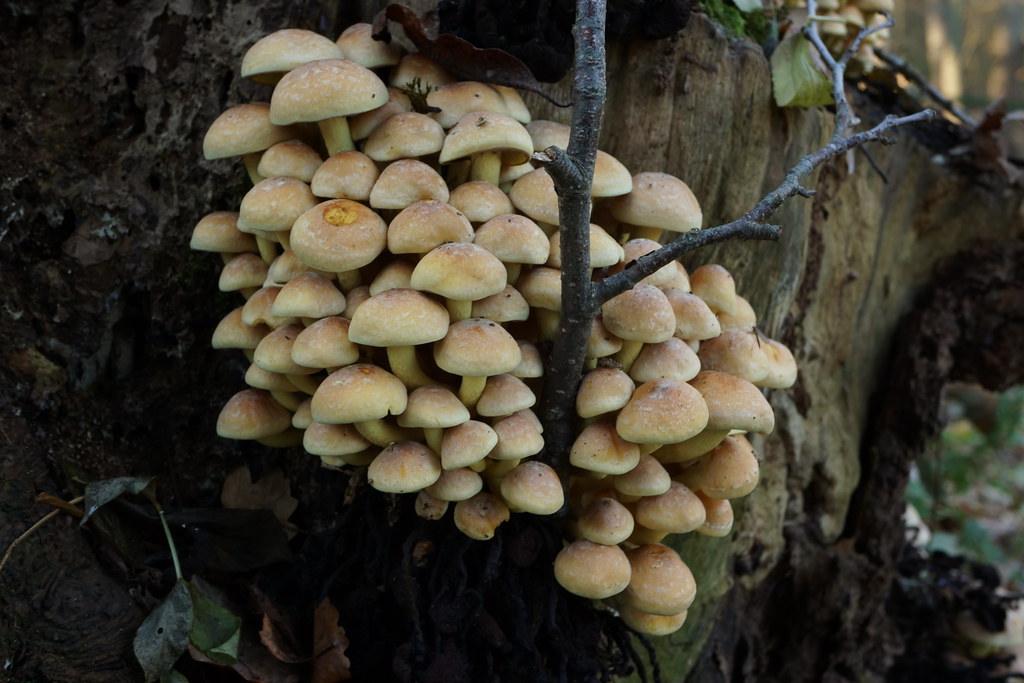
This common and widespread wood-decomposer is typically found in dense, often extensive clusters on stumps, logs, and large woody debris of both coniferous and broadleaf trees. It also grows on wood chips and can occasionally appear to be terrestrial when growing from buried wood. Fruiting bodies may be seen individually, in small groups, or in massive rows and clumps containing hundreds of specimens.
Photos
Appearance
- Cap
- 2–10 cm wide; initially convex, conical, or hemispheric, becoming broadly convex to nearly flat, often with a slight central hump (umbo). The surface is smooth and bright sulphur-yellow to lemon-yellow, typically shading into orange-tan or reddish brown at the center. The margin often retains pale yellow, cobwebby veil fragments.
- Gills
- Crowded and attached to the stem. Starting bright sulphur-yellow or greenish yellow, they eventually turn olive-green and finally dark purple-brown or grayish black as spores mature.
- Stem
- 3–12 cm tall and 2–10 mm thick; slender, cylindrical, and often curved. It is pale yellow at the top, becoming brownish or reddish brown toward the base. A faint ring zone is often present near the apex, frequently darkened by trapped spores.
- Flesh
- Thin and sulphur-yellow, transitioning to brownish at the base of the stem.
- Spore print
- Dark purple-brown to purplish black.
- Taste
- Intensely bitter.
- Odor
- Indistinct or faintly earthy and mushroom-like.
Sporecast is better in the app
Plan ahead with 10-day forecasts, see what people are finding nearby, get photo IDs, and track your finds.
Edibility
This species is poisonous and causes severe gastrointestinal distress five to ten hours after consumption. While rare, more serious symptoms such as temporary paralysis and impaired vision have been reported. It is characterized by an intensely bitter taste, which usually serves as a deterrent. It can be confused with the edible Conifer Tuft and Brick Tuft, as well as Sheathed Woodtuft and Honey Fungus, all of which lack the distinctive greenish-blue or yellow-green gill color. Other lookalikes include certain Pholiota species and the Blue-green Flamecap, which can be distinguished by their brown or rusty orange spores and lack of bitter taste.
Misidentification can be fatal. Never eat a mushroom unless you're 100% sure. This information may be inaccurate. Always consult multiple sources.
Nutrient Source
SaprotrophicIt obtains nutrients by decomposing dead organic matter, such as fallen trees and wood.
Common Names
- Basque
- suge-ziza mingots, suge-ziza minogotsa
- Catalan
- bolet de pi, nematoloma groc, Bolet d´alsina
- Dutch
- Gewone zwavelkop, gewone of dwergzwavelkop
- English
- Sulphur Tuft
- Finnish
- kitkerälahokka
- French
- Hypholome fasciculé, Géophile, Nématolome en touffes, Hypholome en touffes
- German
- Grünblättriger Schwefelkopf
- Norwegian Bokmål
- besk svovelsopp
- Norwegian Nynorsk
- beisk svovelsopp
- Spanish
- hifoloma de láminas verdes, Hifoloma de láminas verdes, agárico fasciculado
- Swedish
- svavelgul slöjskivling, gyttrad svavelskivling
- Welsh
- Torth Felen
Synonyms
- Agaricus elaeodes
- Agaricus fascicularis
- Agaricus praticola
- Agaricus sadleri
- Agaricus subviridis
- Clitocybe sadleri
- Dryophila fascicularis
- Dryophyila fascicularis
- Geophila fascicularis
- Hypholoma elaeodes
- Hypholoma megapotamicum
- Hypholoma subviride
- Hypholoma sulphureum
- Naemateloma fasciculare
- Naematoloma elaeodes
- Naematoloma fasciculare
- Naematoloma subviride
- Nematoloma elaeodes
- Nematoloma fasciculare
- Pratella fascicularis
- Psilocybe fascicularis
- Psilocybe fascicularis
- Psilocybe subviridis