
Habitat
Woodland
This species grows in large, dense clusters on the dead wood of beech trees. It is typically found on bark, logs, and stumps.
Photos
Appearance
- Fruit body
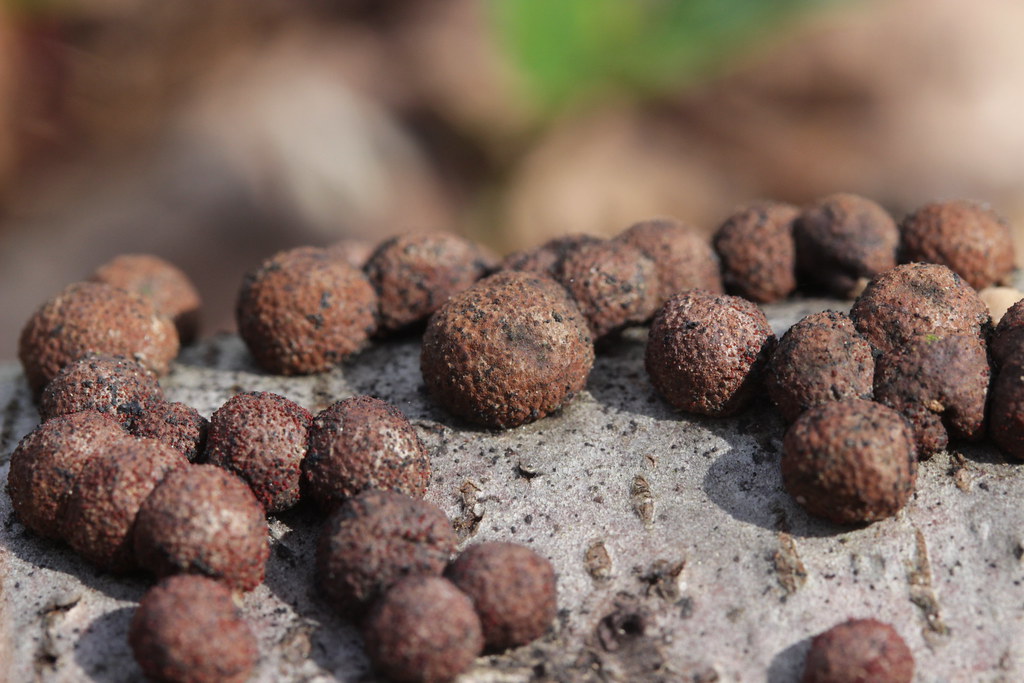
- Small, hard, and hemispherical structures measuring 0.1 to 1 centimeter across. They resemble strawberries or carbon balls with a notably bumpy, finely warted surface. Initially bright salmon-pink, they mature to a brick-red color and eventually turn black.
- Flesh
- Hard, carbon-like, and blackish in color.
- Spore print
- Dark brown.
Sporecast is better in the app
Plan ahead with 10-day forecasts, see what people are finding nearby, get photo IDs, and track your finds.
Edibility
Not edible
Misidentification can be fatal. Never eat a mushroom unless you're 100% sure. This information may be inaccurate. Always consult multiple sources.
Nutrient Source
SaprotrophicIt obtains nutrients by decomposing dead wood, primarily from beech trees.
Common Names
- Basque
- garatxo marroia
- Danish
- Kuljordbær
- Dutch
- Roestbruine kogelzwam
- English
- Beech Woodwart
- Finnish
- punasyylä
- French
- Hypoxylon en forme de fraise
- German
- Rötliche Kohlenbeere
- Norwegian Bokmål
- bøkekullsopp
- Norwegian Nynorsk
- bøkekolsopp
- Spanish
- Verruga marrón
- Swedish
- bokdyna
- Welsh
- Dafaden Ffawydd
Synonyms
- Botrytis ochracea
- Discosphaera radians
- Epixylon coccineum
- Gamosphaera fragiforme
- Hypoxylon argillaceum
- Hypoxylon coccineum
- Hypoxylon cupreum
- Hypoxylon enteromelum
- Hypoxylon majusculum
- Hypoxylon variolosum
- Hypoxylon variolosum
- Lycoperdon variolosum
- Nodulisporium ochraceum
- Peripherostoma fragiforme
- Peripherostoma fragiformis
- Sphaeria argillacea
- Sphaeria bicolor
- Sphaeria enteromela
- Sphaeria fragiformis
- Sphaeria fragiformis
- Sphaeria lateritia
- Sphaeria radians
- Sphaeria radiata
- Sphaeria rubra
- Sphaeria tuberculosa
- Stromatosphaeria fragiformis
- Valsa fragiformis
- Xylaria coccineum