
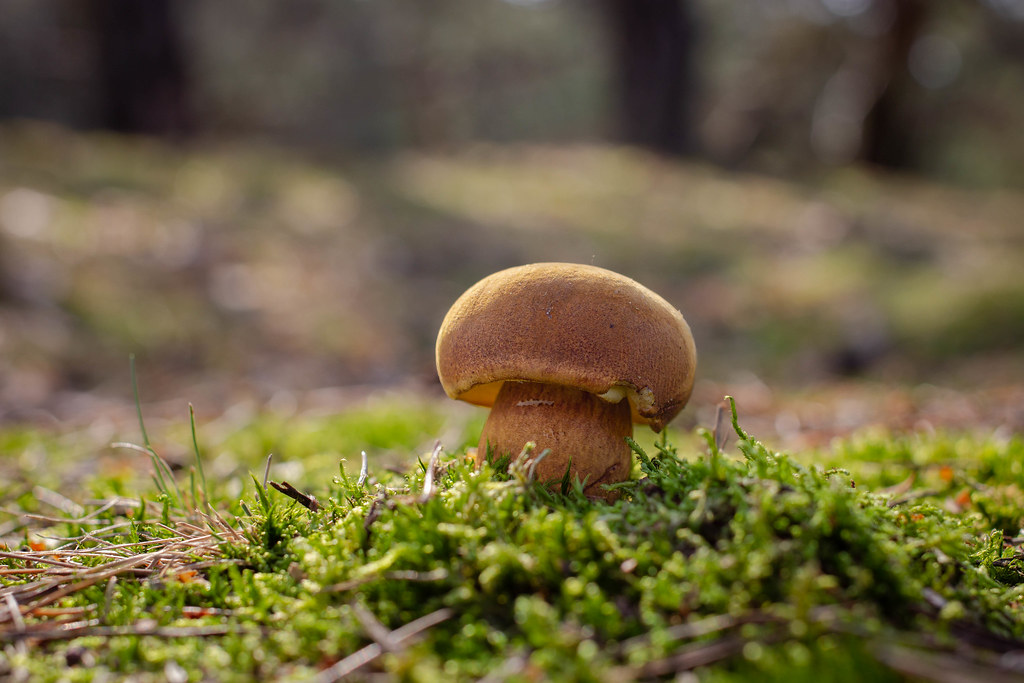
Habitat
This species is commonly found in mixed woodlands, particularly those containing beech or conifers such as pine and spruce. It prefers acidic or neutral soils and can be found growing solitary or in small groups on the ground or occasionally on well-rotted wood. It is known to inhabit sites where conifers previously grew and is also reported under hardwood trees.
Photos
Appearance
- Cap
- 3–14 cm across; hemispherical or convex, becoming flattened; reddish-brown, chestnut, or dark brick-colored; texture is initially finely downy but becomes smooth, polished, and sticky or slippery when wet.
- Stem
- 4–13 cm long and 0.8–4 cm wide; similar in color to the cap but often paler; surface is smooth or features brown fibrous streaks but never has a raised network (reticulation); may darken when handled.
- Pores
- Large and angular; initially cream to lemon-yellow, aging to olive; bruises distinctly blue-green or dark blue when touched.
- Tubes
- Yellow to lemon-yellow; adnate to slightly depressed around the stem; bruises blue or green-blue when cut or handled.
- Flesh
- White to lemon-yellow; turns faintly blue when cut, particularly above the tubes and at the stem apex; firm texture; can be vinaceous in the cap.
- Spore print
- Olive-brown to olive-green.
Sporecast is better in the app
Plan ahead with 10-day forecasts, see what people are finding nearby, get photo IDs, and track your finds.
Edibility
The flesh can be an acquired taste, noted for being strong, earthy, or pleasantly mushroomy. While it is often considered less infested with insect grubs than related species, beginners frequently mistake it for the Penny Bun (Boletus edulis). The pores and flesh above the tubes characteristically bruise blue-green when handled or cut.
Misidentification can be fatal. Never eat a mushroom unless you're 100% sure. This information may be inaccurate. Always consult multiple sources.
Nutrient Source
EctomycorrhizalIt forms a symbiotic relationship with trees, exchanging nutrients absorbed from the soil for sugars produced by the tree through photosynthesis.
Common Names
- Basque
- boleto bayo, Onto na, onddo arre, onto-arrea, ontouar, larro
- Catalan
- Sigró
- Danish
- Brunstokket rørhat
- Dutch
- Kastanjeboleet
- English
- Bay Bolete
- Finnish
- ruskotatti
- French
- Bolet bai
- German
- Maronenröhrling
- Norwegian Bokmål
- svartbrun rørsopp
- Norwegian Nynorsk
- svartbrun røyrsopp
- Slovak
- Suchohríb Hnedý
- Spanish
- Boleto bayo
- Swedish
- Brunsopp
- Welsh
- Cap Tyllog Gwinau Cleisiog
Synonyms
- Boletus badius — Bay Bolete
- Boletus glutinosus
- Boletus limatulus
- Boletus messanensis
- Boletus paludosa
- Boletus stejskalii
- Boletus vaccinus
- Ixocomus badius
- Rostkovites badius
- Suillus badius
- Suillus limatulus
- Suillus vaccinus
- Tubiporus vaccinus
- Viscipellis badia
- Xerocomus badius
- Xerocomus badius