
Habitat
This common species is found on the ground in soil, humus, moss, or duff. It occurs in a wide variety of environments, including deciduous, coniferous, and mixed woodlands, and is sometimes noted for a preference for younger forests. It frequently appears along path sides and can occasionally be found on lawns or gardens. It typically grows in solitary, scattered, or trooping clusters and forms mycorrhizal associations with trees.
Photos
Appearance
- Cap
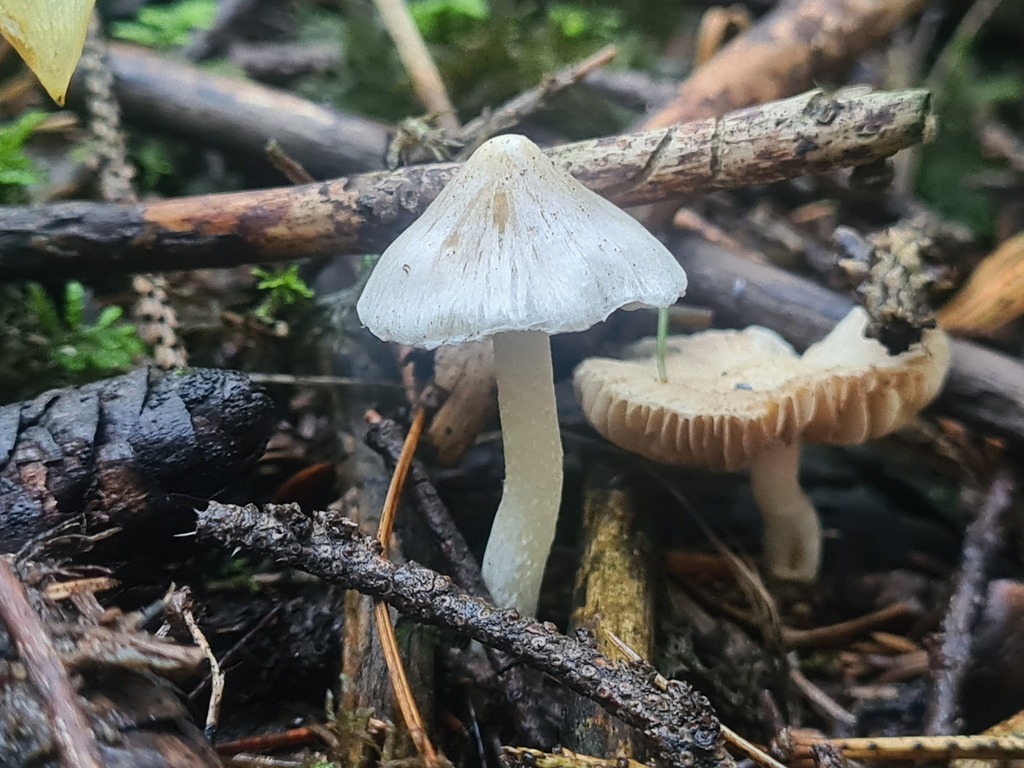
- 1–4 cm wide, initially conical or bell-shaped, maturing to convex or flat with a distinct, often sharp central bump (umbo). Surface is dry, smooth, and silky with fine radial fibers. Color varies by variety: either pure white to creamy (sometimes aging yellowish or grayish), or lilac to purple-lilac with an ochre-tinted center.
- Stem
- 2–7 cm long and 2–7 mm thick, slender and equal or slightly wider at the base, which can be bulbous. The surface is dry and silky-fibrillose, sometimes appearing minutely powdered (pruinose) near the top. Color is white in the typical form, or lilac (often with a white base) in the lilac variety.
- Gills
- Crowded and adnexed (narrowly attached), initially white, cream, or pale lilac, eventually maturing to a dull clay-brown or grayish-brown due to spores. The edges often remain paler and irregular.
- Flesh
- Thin, firm to fragile, and fibrous. Color is white in typical specimens or lilac-tinted in the lilac variety; it does not change color when cut.
- Spore print
- Brown to walnut-brown or grayish-brown.
- Odor
- Distinctive and typically described as earthy, mealy, spermatic, or occasionally like bleach or green corn.
- Partial veil
- A faint, cobweb-like (cortina) white veil is present on young specimens, often leaving temporary silky hairs on the cap margin and stem before disappearing.
Sporecast is better in the app
Plan ahead with 10-day forecasts, see what people are finding nearby, get photo IDs, and track your finds.
Edibility
This species is poisonous and contains muscarine. It has a notable odor variously described as earthy, mealy, spermatic, or like bleach, with a taste ranging from mild to acrid or unpleasant. It can be confused with The Miller, though that species is larger with pink spores and decurrent gills, or with Hebeloma species, which typically have a radish-like smell. The lilac variety could be mistaken for the Amethyst Deceiver or Lilac Bonnet. Other lookalikes include Inocybe pudica, which stains pinkish or peachy, and Inocybe insinuata, which has a stockier stature.
Misidentification can be fatal. Never eat a mushroom unless you're 100% sure. This information may be inaccurate. Always consult multiple sources.
Nutrient Source
EctomycorrhizalIt forms a symbiotic relationship with trees, exchanging nutrients with them.
Common Names
- Basque
- inozibe zuri, kono zuria
- Danish
- Lilla trævlhat
- Dutch
- Lila satijnvezelkop, Witte satijnvezelkop, satijnvezelkop
- English
- Lilac Fibrecap, White Fibrecap
- Finnish
- liilarisakas, valkorisakas
- French
- Inocybe terreux, Inocybe à lames couleur de terre
- German
- Erdblättriger Risspilz
- Norwegian Bokmål
- lilla silketrevlesopp
- Norwegian Nynorsk
- lilla silketrevlesopp
- Spanish
- Inocibe terrestre, inocibe blanco
- Swedish
- sidentråding, sidentrådskivling, violett sidentrådskivling, violett sidentråding
- Welsh
- Cap Ffibr Gwyn
Synonyms
- Agaricus candidus
- Agaricus clarkii
- Agaricus geophyllus
- Agaricus geophyllus
- Agaricus geophyllus
- Agaricus pleoceps
- Gymnopus geophyllus
- Inocybe affinis
- Inocybe clarkii
- Inocybe clarkii
- Inocybe fulva
- Inocybe lilacina — Lilac Fibrecap
- Inocybe reflexa