
Habitat
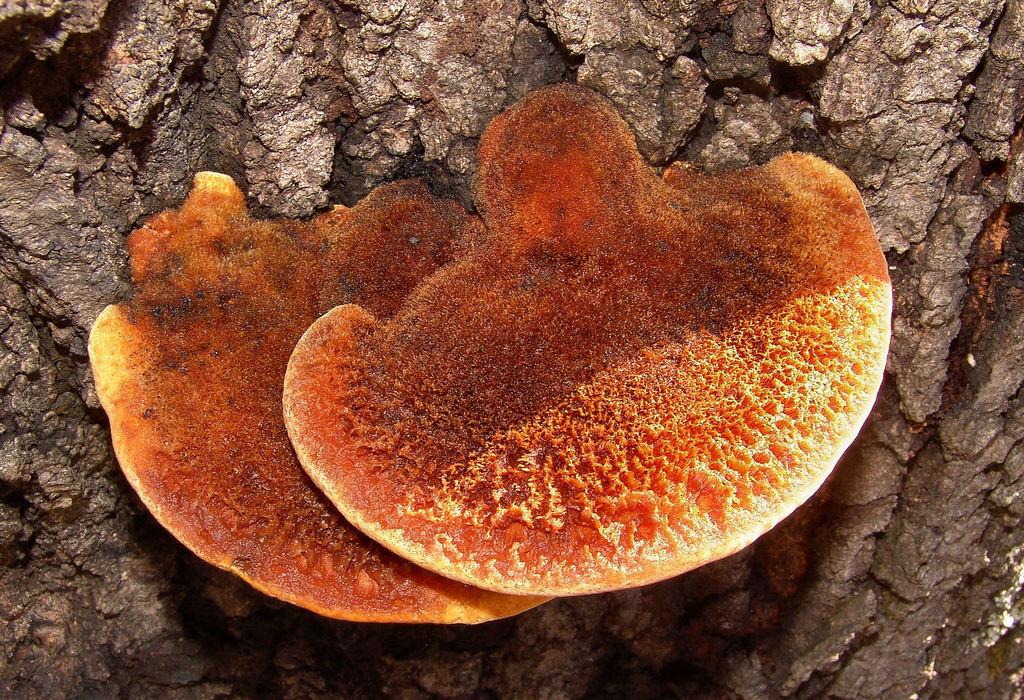
A weak parasite and wood decomposer found on living deciduous trees. It typically grows as solitary brackets or fused groups, often positioned high in the tree canopy. While it is particularly common on ash, it is also frequently found on oak, elm, walnut, and apple trees.
Photos
Appearance
- Bracket
- Fan-shaped to semicircular, measuring 5 to 25 cm across and up to 10 cm thick. Initially peach-colored or yellowish-orange, it matures to reddish-brown and eventually turns black. The upper surface is notably densely hairy or bristly when young, sometimes becoming smoother or more eroded with age.
- Pores
- Angular to circular, measuring 1 to 3 per mm. Initially pale buff, ochraceous, or yellowish, darkening to reddish-brown or black. In young specimens, they may exude hanging droplets of liquid.
- Tubes
- Range from 10 to 40 mm in length, colored ochraceous to rusty brown.
- Flesh
- Rusty brown to reddish-brown; soft, spongy, and watery when fresh, but becoming hard and brittle when dry.
- Stem
- Usually absent or occasionally a very small, rudimentary stalk where attached to the tree.
- Spore print
- Rusty brown, ochre-brown, or pale reddish-brown.
Sporecast is better in the app
Plan ahead with 10-day forecasts, see what people are finding nearby, get photo IDs, and track your finds.
Edibility
This species is considered inedible, though it is used in traditional Asian medicine and as a source for golden to reddish-brown dyes. The flesh has a mild taste and pleasant smell, with a soft or spongy texture that becomes hard when dry. Mature specimens are distinct, but very young ones may be confused with the Beefsteak Fungus, while other lookalikes include Inonotus texanus, Inonotus quercustris, Inonotus cuticularis, Inonotus rickii, and Ischnoderma resinosum.
Misidentification can be fatal. Never eat a mushroom unless you're 100% sure. This information may be inaccurate. Always consult multiple sources.
Nutrient Source
facultativeIt obtains nutrients by decomposing dead organic matter, but can also parasitize living trees, especially when they are weakened.
Common Names
- Basque
- lizar-ardagai iletsu
- Catalan
- bolet d´esca
- Danish
- Børstehåret spejlporesvamp
- Dutch
- Ruige weerschijnzwam
- English
- Shaggy Bracket
- Finnish
- mokkakääpä
- French
- Polypore herissé
- German
- Zottiger Schillerporling
- Norwegian Bokmål
- pelskjuke
- Norwegian Nynorsk
- pelskjuke
- Spanish
- yesquero radiado, Yesquero erizado, parásito facultativo, pan de rata
- Swedish
- pälsticka
- Welsh
- Ysgwydd Felfed
Synonyms
- Agaricus velutinus
- Boletus hirsutus
- Boletus hirtus
- Boletus hispidus
- Boletus spongiosus
- Boletus velutinus
- Boletus villosus
- Fomes hispidus
- Hemidiscia hispida
- Inodermus hispidus
- Inonotus hirsutus
- Inonotus tinctorius
- Phaeolus endocrocinus
- Phaeoporus hispidus
- Placodes tinctorius
- Polyporus endocrocinus
- Polyporus hispidus
- Polyporus pollinii
- Polyporus tinctorius
- Polystictus hispidus
- Xanthochrous hispidus
- Xanthochrous tinctorius