
Habitat
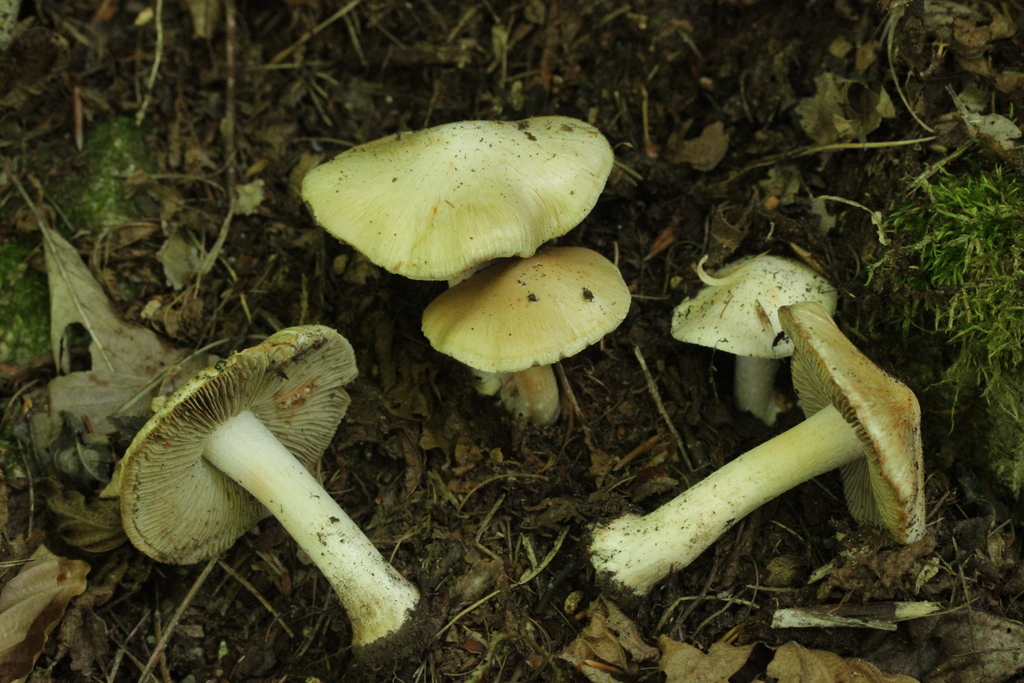
This species grows on soil in deciduous woodlands, showing a strong preference for beech trees. It is typically found on chalky or alkaline ground, often appearing along the sides of paths. Specimens may grow individually or in small groups.
Photos
Appearance
- Cap
- 2.5–8 cm wide, initially conical or bell-shaped, flattening with age while retaining a central bump; ivory to white surface covered in radial fibers that stain pink to brick-red; margin often splits or becomes lobed as it matures.
- Stem
- 30–100 mm long and 10–20 mm thick, stout and fibrous with a slightly swollen base; white, turning red when aged or bruised, particularly near the base.
- Gills
- Crowded and adnexed or adnate; starting white or rose-pink, eventually turning olive-brown; surfaces bruise red.
- Flesh
- White and generally unchanging when cut, though external surfaces frequently discolour to pinkish-red.
- Spore print
- Dull brown to olive-brown.
- Smell
- Faint and sweet when young, resembling cheap perfumed soap, becoming rank and unpleasant with age.
Sporecast is better in the app
Plan ahead with 10-day forecasts, see what people are finding nearby, get photo IDs, and track your finds.
Edibility
This species is deadly poisonous and contains lethal concentrations of muscarine, which can cause death unless treated quickly with atropine. It can be mistaken for woodland Agaricus species, which have rings and darker gills, or certain fieldcaps that lack its characteristic red staining and fibrous cap. All parts of the mushroom, including the white flesh, may bruise or age to a brick-red color, and the odor evolves from faintly sweet or soapy to rank and unpleasant.
Misidentification can be fatal. Never eat a mushroom unless you're 100% sure. This information may be inaccurate. Always consult multiple sources.
Nutrient Source
EctomycorrhizalIt forms a symbiotic relationship with trees, exchanging nutrients with them through their root systems.
Common Names
- Danish
- Giftig trævlhat
- Dutch
- Giftige vezelkop
- English
- Brick-red tear mushroom, Deadly Fibrecap, Red-staining Inocybe, Red-Staining Inocybe
- Finnish
- myrkkyrisakas
- French
- Inocybe de Patouillard, Inocybe de Printemps
- German
- Ziegelroter Risspilz
- Norwegian Bokmål
- vårtrevlesopp
- Norwegian Nynorsk
- vårtrevlesopp
- Swedish
- Patouillards trådskivling, tegelröd trådskivling, gifttråding
- Ukrainian
- Іноцибе Патуйяра
- Welsh
- Cap Ffibr Marwol
Synonyms
- Inocybe erubescens — Deadly Fibrecap
- Inocybe patouillardii — Deadly Fibrecap