
Habitat
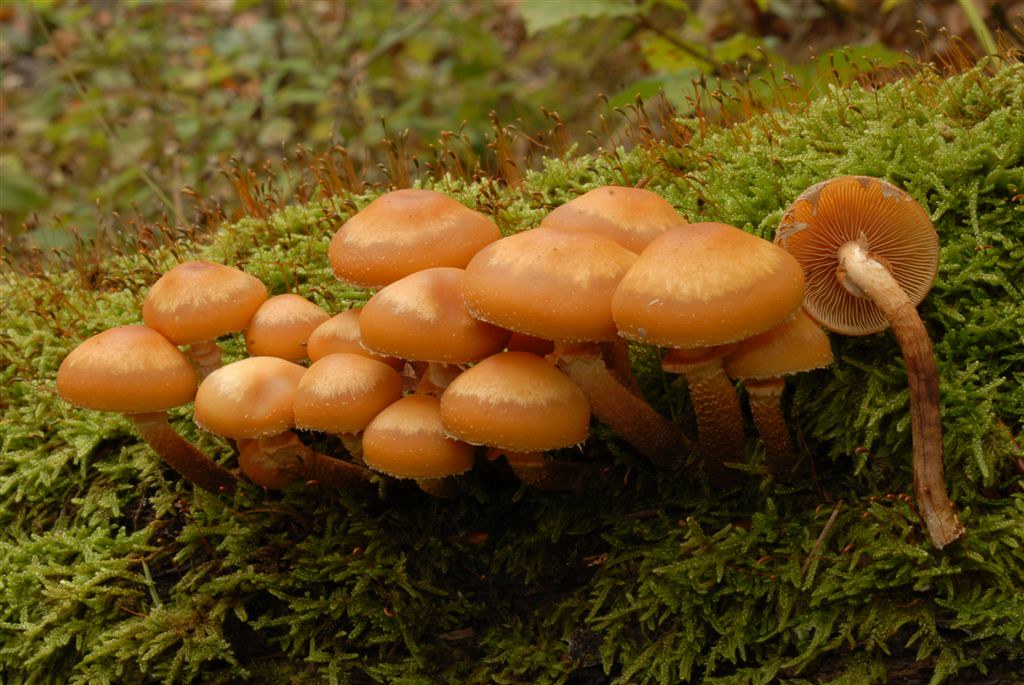
Kuehneromyces mutabilis is primarily found in dense, often extensive clusters or large troops on the stumps, trunks, and fallen branches of deciduous or broad-leaved trees. It also grows on decaying logs, other woody debris, and occasionally on buried wood or conifers. This species is frequently found amongst moss.
Photos
Appearance
- Cap
- 2–7 cm across; convex to bell-shaped, becoming flat with a broad central bump. The surface is smooth and distinctly hygrophanous, drying from the center outwards to create a two-toned appearance ranging from orange-cinnamon or reddish-brown when moist to pale ochre or tan when dry.
- Stem
- 3–10 cm long, slender and equal or tapering toward the base. It is whitish or light tan at the apex, becoming dark brown to blackish near the bottom. The surface features a distinct, often spreading ring, below which the stem is covered in coarse, upright, brownish scales.
- Gills
- Crowded and broadly attached to slightly decurrent; initially pale whitish or yellow, maturing to a deep cinnamon or reddish-brown.
- Flesh
- Thin and firm; white to pale brown or buff.
- Spore print
- Cinnamon-brown to deep ochre or reddish-brown.
- Fruit body
- Grows in dense, often extensive clusters and large tufts on stumps and logs of deciduous trees, and occasionally conifers.
Sporecast is better in the app
Plan ahead with 10-day forecasts, see what people are finding nearby, get photo IDs, and track your finds.
Edibility
Extreme caution is required as this species is easily confused with the deadly poisonous Galerina marginata (Funeral Bell). Distinguishing features include a cap that dries from the center out to create a two-toned effect and a stem that is distinctly scaly below the ring, whereas Galerina marginata lacks these prominent scales. It is also found in very dense, large clusters on wood, while the poisonous lookalike tends to fruit in smaller groups. While the mushroom is described as having a pleasant odor and a mild, mushroomy taste, the stems are tough and should be discarded.
Misidentification can be fatal. Never eat a mushroom unless you're 100% sure. This information may be inaccurate. Always consult multiple sources.
Nutrient Source
SaprotrophicIt obtains nutrients by decomposing dead organic matter, primarily from wood of hardwood and conifer trees.
Common Names
- Basque
- egur-ziza aldakor, elur-ziza aldakorra
- Danish
- Foranderlig skælhat
- Dutch
- Stobbezwammetje
- English
- Sheathed Woodtuft
- Finnish
- koivunkantosieni
- French
- Pholiote changeante
- German
- Stockschwämmchen
- Northern Sami
- šluppotgieddespábba
- Norwegian Bokmål
- stubbeskjellsopp
- Norwegian Nynorsk
- stubbeskjelsopp
- Spanish
- Foliota cambiante
- Swedish
- Föränderlig Tofsskivling
- Welsh
- Siobyn Coed Bacsiog
Synonyms
- Agaricus mutabilis
- Agaricus mutabilis
- Dryophila mutabilis
- Galerina leucolepidota
- Galerina mutabilis
- Kuehneromyces leucolepidotus
- Lepiota caudicina
- Pholiota mutabilis