
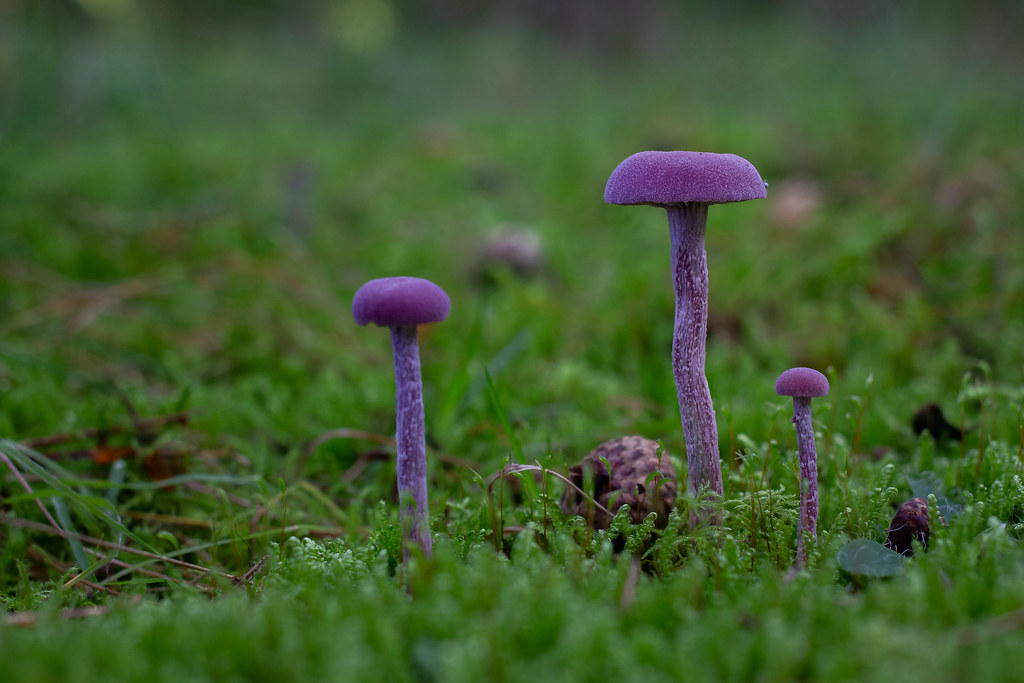
Habitat
This common species occurs on soil and within wet, mossy areas or dried-up low pools. It is typically found in both deciduous and coniferous woodlands, showing a strong preference for growing near Beech trees. It thrives in nutrient-rich locations and may appear singly, in groups, or in tufted clusters.
Photos
Appearance
- Cap
- 1–6 cm broad; shapes range from convex or slightly umbonate to flattened or centrally depressed; deep purplish-lilac when moist, fading to pale lilac-buff or whitish when dry; surface may be slightly scurfy at the center or lined toward the edge.
- Stem
- 3–10 cm long, 5–10 mm thick; same color as the cap; often irregularly flattened, twisted, or wavy; hollow with age, featuring mealy texture at the apex and whitish fibers or lilac downy mycelium at the base.
- Gills
- Deep lilac but may become powdered white with spores; thick, broad, and widely spaced; attachment is adnate to slightly decurrent.
- Flesh
- Thin; whitish to pale lilac or the same color as the cap.
- Spore print
- White to pale blue.
- Smell
- Faint, sweet, or mildly mushroomy.
- Taste
- Mild or pleasant.
Sporecast is better in the app
Plan ahead with 10-day forecasts, see what people are finding nearby, get photo IDs, and track your finds.
Edibility
While edible and noted for its mild, sweet flavor, this species can accumulate arsenic from pesticides or wood preservatives and contains traces of hydrogen cyanide. Some regions have recommended against its sale as food due to these chemical risks. It may be confused with the poisonous Rosy Bonnet, which is pinker and less fibrous, or the poisonous Lilac Fibrecap, which features crowded rather than distant gills. Edible Violet Webcaps and purple Cortinarius species are also similar, though the latter have rusty-brown gills and spore prints rather than the white spore print of this mushroom.
Misidentification can be fatal. Never eat a mushroom unless you're 100% sure. This information may be inaccurate. Always consult multiple sources.
Nutrient Source
EctomycorrhizalIt forms a symbiotic relationship with trees, exchanging nutrients obtained from the soil for sugars produced by the tree through photosynthesis.
Common Names
- Danish
- Violet ametysthat
- Dutch
- Amethistzwam
- English
- Amethyst Deceiver
- Finnish
- lehtolohisieni
- French
- Laque améthyste
- Norwegian Bokmål
- ametystsopp
- Norwegian Nynorsk
- ametystsopp
- Swedish
- ametistskivling
- Welsh
- Twyllwr Piws
Synonyms
- Agaricus amethystinus
- Agaricus lividopurpureus
- Clitocybe amethystina
- Collybia amethystina
- Laccaria hudsonii