
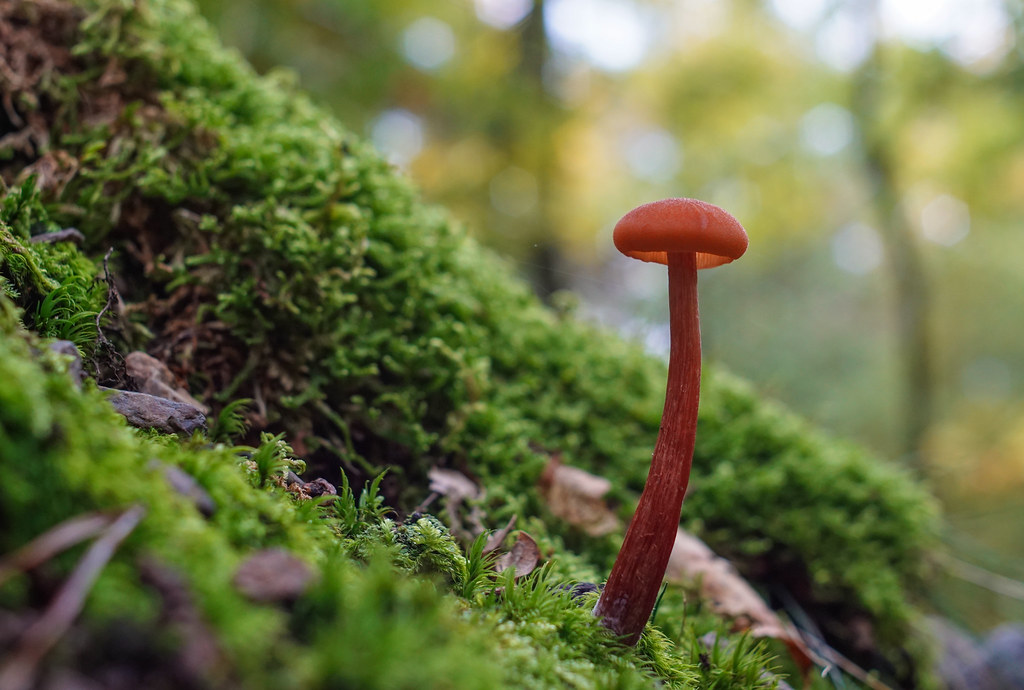
Habitat
This common and widespread mushroom grows on soil, humus, or ground across a variety of environments, including broad-leaved, coniferous, and mixed woodlands. It is frequently found in association with trees such as birch, pine, oak, beech, and tanoak. Beyond forests, it thrives on moorland, heathland, gardens, and among short grass. It exhibits a 'weedy' growth habit, appearing in solitary, scattered, or clustered formations, sometimes in large troops or tufts, and can even occur in areas quite distant from its mycorrhizal partners.
Photos
Appearance
- Cap
- 0.5–6 cm wide, initially convex with an inrolled margin, becoming flat, uplifted, or depressed; often highly distorted or wavy in age. Color ranges from orange-brown to pinkish-cinnamon or buff, fading significantly when dry; surface is smooth to finely scaly and can be translucent-striate at the margin when moist.
- Stem
- 1.5–10 cm long, 0.2–1 cm thick, equal or widening toward the base. It is firm, tough, and fibrous, often twisted or flattened, and colored similarly to or darker than the cap. The surface is covered in white or twisting fibrils, with white mycelium typically present at the base.
- Gills
- Adnate to slightly decurrent, thick, and well-spaced. They are pinkish, orange-pink, or buff-colored, sometimes appearing floury or waxy as they become covered in white spores.
- Flesh
- Thin, tough, and fibrous; color is similar to the cap, ranging from pale pinkish-buff to light brown.
- Spore print
- White.
Sporecast is better in the app
Plan ahead with 10-day forecasts, see what people are finding nearby, get photo IDs, and track your finds.
Edibility
This species has a mild, mushroomy flavor and a thin, fibrous texture. It is famously nicknamed the Deceiver due to its extreme variability in appearance, which often confuses foragers. While common, it should be distinguished from the Scurfy Twiglet (Tubaria furfuracea), which has brown spores and grows on wood debris, as well as Laccaria bicolor, which is identified by its violet basal mycelium.
Misidentification can be fatal. Never eat a mushroom unless you're 100% sure. This information may be inaccurate. Always consult multiple sources.
Nutrient Source
EctomycorrhizalIt forms a symbiotic relationship with the roots of trees, exchanging nutrients with them.
Common Names
- Danish
- Rød ametysthat
- Dutch
- Gewone fopzwam
- English
- Deceiver
- Finnish
- lohisieni
- French
- Clitocybe laqué
- German
- Roter Lacktrichterling, Violetter Lacktrichterling
- Norwegian Bokmål
- lakssopp, vanlig lakssopp
- Norwegian Nynorsk
- vanleg lakssopp, lakssopp
- Swedish
- laxskivling
- Welsh
- Twyllwr Gloyw
Synonyms
- Agaricus amethysteus
- Agaricus farinaceus
- Agaricus incanus
- Agaricus janthinus
- Agaricus laccatus
- Agaricus rosellus
- Agaricus roseus
- Camarophyllus laccatus
- Clitocybe amethystea
- Clitocybe laccata
- Clitocybe laccata
- Collybia laccata
- Laccaria affinis
- Laccaria amethystea
- Laccaria anglica
- Laccaria anglica
- Laccaria carbonicola
- Laccaria farinacea
- Laccaria laccata
- Laccaria laccata
- Laccaria scotica
- Omphalia amethystea
- Omphalia farinacea
- Omphalia laccata
- Omphalia rosella
- Russuliopsis laccata