
Habitat
Occurs in coniferous, broad-leaved, and mixed woodlands, frequently preferring acidic soil and associating with birch and pine. It is also found on heathland, moorland, and in humus. Specimens may grow singly, in scattered groups, or in large clusters.
Photos
Appearance
- Cap
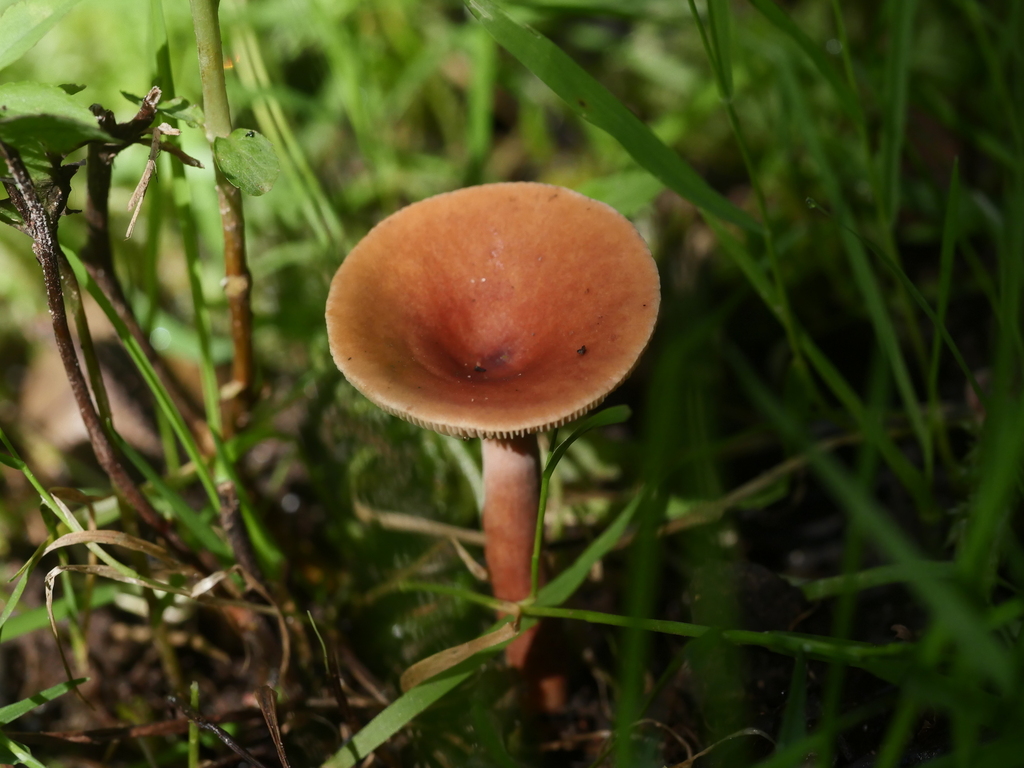
- 2.5 to 6 cm wide, initially convex then flattening and becoming depressed, often featuring a small central bump. The surface is smooth and matt, colored red-brown to brick-red, often darker at the center with a persistently inrolled margin.
- Stem
- 3 to 8 cm tall, slender and cylindrical or slightly tapering downwards. It is colored similarly to the cap, sometimes darker at the base or velvety at the apex, eventually becoming hollow.
- Gills
- Crowded and slightly decurrent, ranging from pinkish-cream to ochre and eventually red-brown.
- Flesh
- Red-brown to pale brown.
- Milk
- White and fairly watery with a mild taste.
- Spore print
- Pale cream to cream.
- Odor
- Initially faint or slightly unpleasant when fresh, but developing a very strong fragrance of curry, maple syrup, or newly mown grass as it dries.
Sporecast is better in the app
Plan ahead with 10-day forecasts, see what people are finding nearby, get photo IDs, and track your finds.
Edibility
Possesses a strong scent of curry, maple syrup, or fenugreek that intensifies upon drying, though the fresh taste can be mild or slightly bitter. This species is mildly toxic and should only be consumed in small quantities, primarily used as a powdered spice for sauces or baked goods. Care must be taken not to confuse it with other small brown mushrooms, including the deadly Galerina marginata or similar-looking milkcaps like the unpleasant-smelling Lactarius rostratus or the watery-milk Lactarius fragilis.
Misidentification can be fatal. Never eat a mushroom unless you're 100% sure. This information may be inaccurate. Always consult multiple sources.
Nutrient Source
EctomycorrhizalIt gains nutrients by forming a symbiotic relationship with tree roots, exchanging nutrients from the soil for sugars from the tree.
Common Names
- Basque
- kanfor-esneki
- Danish
- Kamfer-mælkehat
- Dutch
- Kruidige melkzwam
- English
- Curry-Scented Milk-Cap, Curry Milkcap
- Finnish
- sikurirousku
- French
- Lactaire à odeur de punaise, Lactaire à odeur de chicorée
- German
- Kampfer-Milchling
- Norwegian Bokmål
- duftriske
- Norwegian Nynorsk
- duftriske
- Spanish
- lactario alcanforado
- Swedish
- kamferriska, curryriska
- Welsh
- Cap Llaeth Cyri
Synonyms
- Agaricus camphoratus
- Agaricus cimicarius
- Galorrheus camphoratus
- Lactarius cimicarius
- Lactarius fragilis
- Lactarius rutaceus
- Lactarius terryi
- Lactifluus camphoratus
- Lactifluus terryi