
Habitat
This mushroom is primarily associated with pines, particularly lodgepole, shore, Monterey, and Bishop pines. It grows on the ground in soil, moss beds, or duff, and is known to inhabit both acidic and alkaline sites, including limestone areas. While typically found in pine forests, some varieties or related species are found in cold, wet coniferous forests among spruce, fir, and hemlock. It usually fruits in scattered groups, clusters, or troops.
Photos
Appearance
- Cap
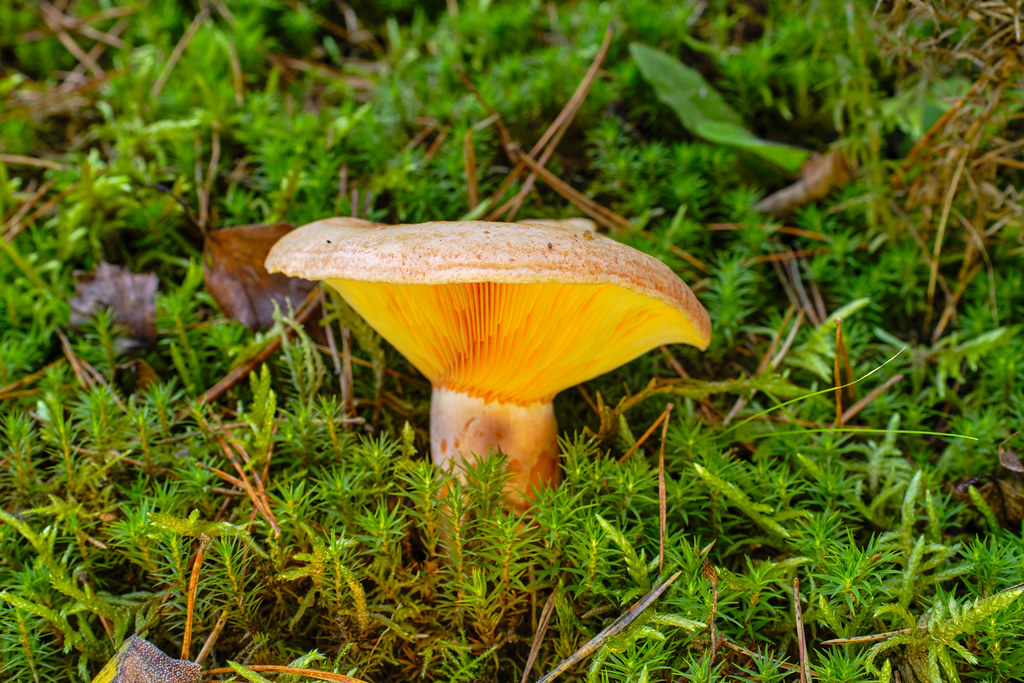
- 3–15 cm wide; initially convex with an inrolled margin, later flattening or becoming funnel-shaped. The surface is smooth, slightly sticky when wet, and marked with concentric bands or mottling. Color ranges from orange and salmon to rosy-buff, frequently developing dull green or turquoise stains with age or handle.
- Gills
- Closely spaced and slightly decurrent (extending down the stem). They are pale pinkish-orange, apricot, or saffron, and slowly bruise or stain green when damaged.
- Stem
- 3–7 cm long and 1–3 cm thick; stout and cylindrical, occasionally tapering toward the base. Color is similar to the cap but often paler, sometimes featuring shallow, darker orange spots (scrobiculi), a whitish sheen when young, and green staining.
- Flesh
- Firm and brittle with a grainy texture. Pale yellow to yellowish-orange, it discolors to carrot-orange or wine-red shortly after being cut before eventually turning dull green.
- Milk
- Sparse and bright orange (carrot-colored). It may remain orange or slowly turn reddish or wine-colored before eventually staining the mushroom tissue green.
- Spore print
- Varies from pale yellow or cream to pale ochre.
- Odor
- Distinctive and pleasant, described as sweet, spicy, or fruity.
- Taste
- Mild to slightly bitter or slowly acrid.
Sporecast is better in the app
Plan ahead with 10-day forecasts, see what people are finding nearby, get photo IDs, and track your finds.
Edibility
While considered a delicacy in Europe with a spicy, fruity smell and mild to slightly bitter taste, North American varieties are often described as having an off-putting grainy texture and lacking flavor. Younger, firm specimens are less grainy, and slow cooking or blanching can improve texture and remove bitterness. It is frequently infested with insect larvae. It must be distinguished from the poisonous Lactarius xanthogalactus, which has white latex that stains bright yellow, and various lookalikes such as L. deterrimus, L. salmonicolor, and L. rubrilacteus.
Misidentification can be fatal. Never eat a mushroom unless you're 100% sure. This information may be inaccurate. Always consult multiple sources.
Nutrient Source
EctomycorrhizalThis mushroom forms a mutually beneficial relationship with trees, exchanging nutrients and minerals from the soil for sugars produced by the tree through photosynthesis. It grows in association with coniferous trees like pines.
Common Names
- Basque
- esne gorri, esne-gorri, esnegorri
- Catalan
- Rubeyolas, Rovelló, Paracha, rovellón, pinetell, Pinatell
- Dutch
- Smakelijke melkzwam
- English
- Saffron Milk-Cap, Saffron Milkcap
- Finnish
- männynleppärousku
- French
- Lactaire délicieuse
- German
- Echter Reizker
- Norwegian Bokmål
- furumatriske
- Norwegian Nynorsk
- furumatriske
- Spanish
- nízcalo, Mízcalo, Níscalo, enilado de ocote, hongo enilado, míscalo, esnegorri, seta de cardenillo, nizcalo, rovellón, nícalo
- Swedish
- läckerriska, tallblodriska, läcker riska
- Welsh
- Cap Llaeth Saffrwm
Synonyms
- Agaricus deliciosus
- Amanita deliciosa
- Galorrheus deliciosus
- Lactarius laeticolor
- Lactarius laeticolor
- Lactarius lamelliporus
- Lactarius lateritius
- Lactifluus deliciosus