
Habitat
This mushroom is specifically associated with spruce trees, occurring in spruce plantations, coniferous woodlands, and mountainous regions. It is typically found growing on soil in small groups or trooping patterns.
Photos
Appearance
- Cap
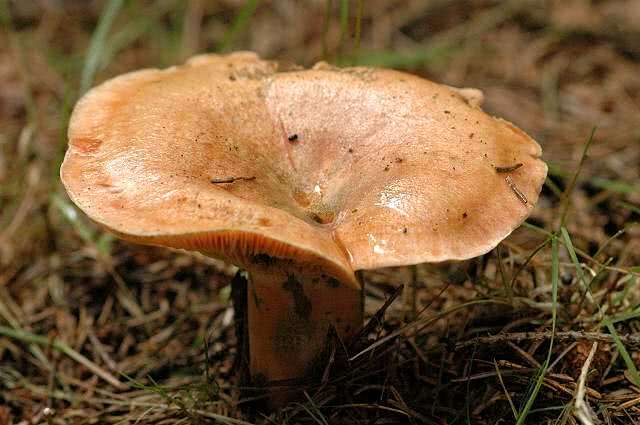
- Measuring 4 to 15 cm across, it begins convex and matures into a funnel shape with an inrolled edge. Its orange surface features concentric rings or blotches, is slightly sticky when moist, and develops significant green staining with age or when bruised.
- Stem
- 3 to 6 cm long, stout, and cylindrical or slightly tapered. It is colored like the cap and often features darker orange pits or indentations and green blotches.
- Gills
- Crowded and slightly running down the stem. They are orange-yellow, bruising green or slowly turning orange after damage.
- Flesh
- Pale yellow to carrot-colored. When cut, it transitions to a pale wine-red color within 10 to 30 minutes, turning dark wine-red after about an hour, and eventually greenish.
- Milk
- Carrot-orange and sparse, with a bitter or resinous taste. It slowly turns a dull wine-red color after exposure.
- Spore print
- Pale yellow to ochre.
- Smell
- Sweet and fruity, reminiscent of carrots.
Sporecast is better in the app
Plan ahead with 10-day forecasts, see what people are finding nearby, get photo IDs, and track your finds.
Edibility
This mushroom has a bitter, resinous, or carroty flavor and is frequently infested with larvae. It is often confused with the Saffron Milkcap, though it uniquely stains dark wine-red over time and bruising develops greenish patches. While consumption in large amounts may cause urine to turn red, this is not a health risk.
Misidentification can be fatal. Never eat a mushroom unless you're 100% sure. This information may be inaccurate. Always consult multiple sources.
Nutrient Source
EctomycorrhizalThis mushroom forms a symbiotic relationship with trees, exchanging nutrients with their roots.
Common Names
- Danish
- Gran-mælkehat
- Dutch
- Peenrode melkzwam
- English
- False Saffron Milkcap
- Finnish
- kuusenleppärousku
- French
- Lactaire de l'épicéa
- German
- Fichtenreizker
- Norwegian Bokmål
- granmatriske
- Norwegian Nynorsk
- granmatriske
- Swedish
- granblodriska, blodriska
- Welsh
- Cap Llaeth Saffrwm Ffug