
Habitat
This species grows exclusively near birch trees in various environments, including woodland, heathland, grassland, and self-sown copses. It is commonly found on sandy soil and appears to favor neutral or alkaline sites rather than acidic ones. It can also be found in urban areas such as gardens and lawns where birch has been introduced, typically appearing in scattered groups, clusters, or occasionally in rings.
Photos
Appearance
- Cap
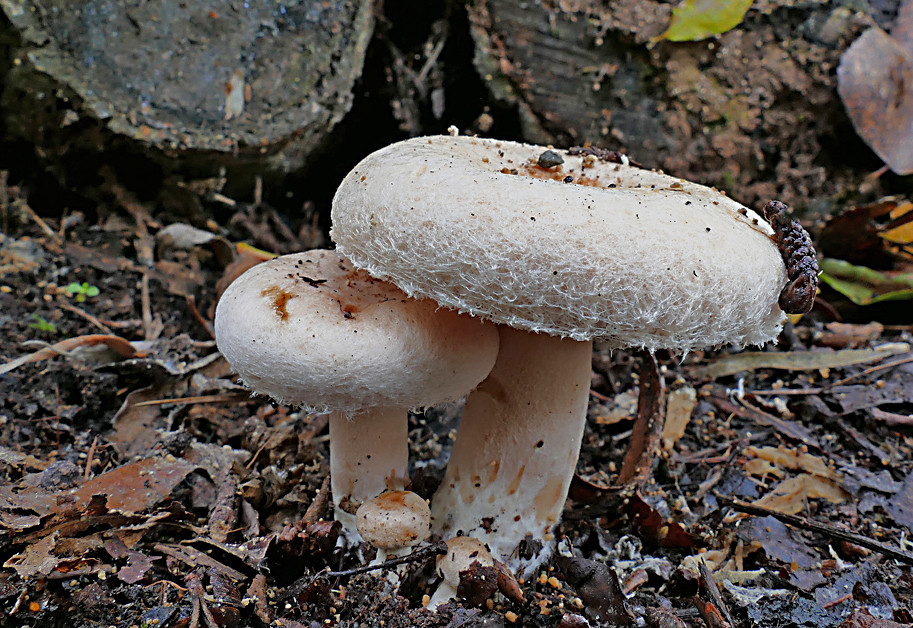
- 4–10 cm wide, convex then flattened with a depressed center; creamy white to rosy buff or pinkish cinnamon, sometimes with darker irregular patches but generally lacking strong concentric bands. The margin is tightly inrolled and noticeably hairy or shaggy.
- Stem
- 2–7 cm long and 1–2.5 cm thick, stout and equal or slightly tapering; concolorous with the cap, often with a rosy or pinker apex; surface is smooth to finely downy, becoming hollow with age.
- Gills
- Crowded and slightly decurrent; whitish with a salmon or pinkish tinge, darkening as the fruit body matures.
- Flesh
- Thick and firm, though fragile; white to pale cream or pinkish white.
- Milk
- White, sometimes drying yellowish; flavor is very hot and acrid; consistency is often sparse.
- Spore print
- Pale cream to ivory, often featuring a faint salmon or pinkish tint.
- Smell
- Faint or indistinct, sometimes reminiscent of Pelargonium.
Sporecast is better in the app
Plan ahead with 10-day forecasts, see what people are finding nearby, get photo IDs, and track your finds.
Edibility
Eating this mushroom can cause poisoning or illness, though it is sometimes listed as edible with caution if specific preparation is used. The white milk and flesh have a very hot, acrid taste and a faint smell of Pelargonium. It is very similar in appearance to Lactarius torminosus, although it is typically smaller, paler, and less woolly.
Misidentification can be fatal. Never eat a mushroom unless you're 100% sure. This information may be inaccurate. Always consult multiple sources.
Nutrient Source
EctomycorrhizalIt forms a symbiotic relationship with trees, exchanging nutrients through the soil via its root-like hyphae.
Common Names
- Danish
- Dunet mælkehat
- Dutch
- Donzige melkzwam
- English
- Downy Milk Cap, Bearded Milkcap
- Finnish
- villakarvarousku
- French
- Lactaire pubescent
- German
- Flaumiger Milchling
- Norwegian Bokmål
- blek skjeggriske
- Norwegian Nynorsk
- bleik skjeggriske
- Swedish
- blek skäggriska
- Welsh
- Cap Llaeth Barfog
Synonyms
- Agaricus pubescens
- Lactarius albus
- Lactarius betulae
- Lactifluus pubescens
- Mycena pubescens