
Habitat
This common species is found on soil, particularly in acidic deciduous or broad-leaved woodlands and heaths. It is most frequently associated with birch trees, including young woodlands, self-sown copses, and even planted ornamental birches. It typically grows solitarily or in small trooping groups.
Photos
Appearance
- Cap
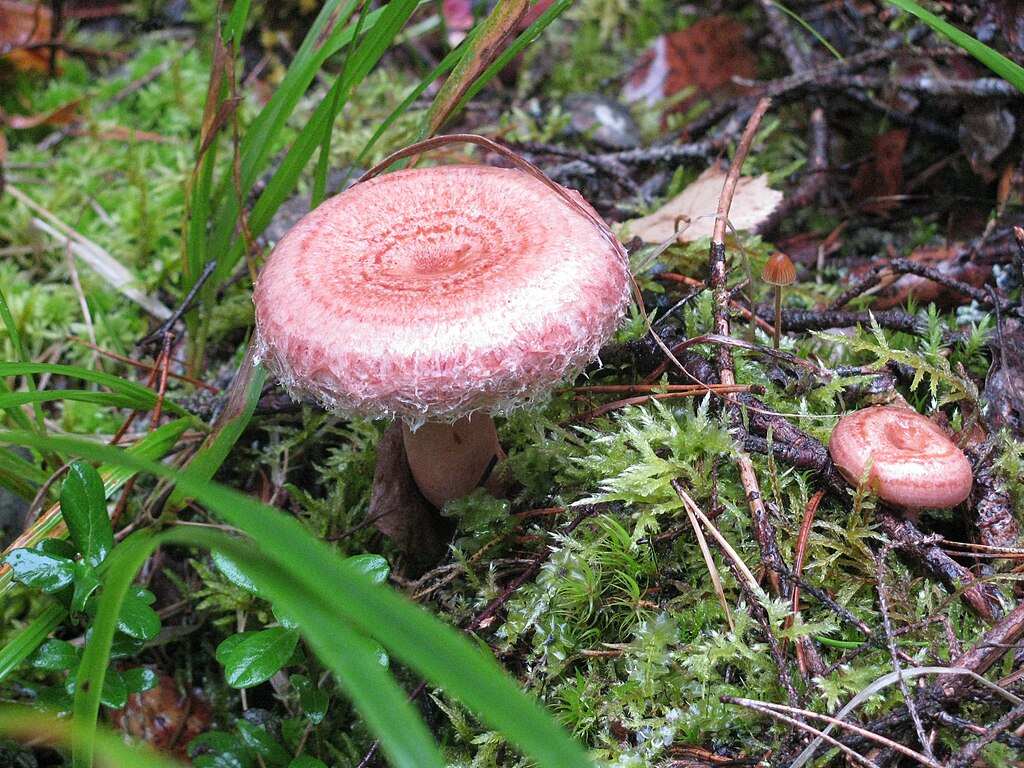
- 4–15 cm wide; initially convex or hemispherical, becoming flattened with a depressed center or funnel-shaped. The surface is pale pink to salmon-buff with distinct concentric darker bands. It is sticky when wet and covered in woolly fibers, featuring a prominently inrolled margin that is densely bearded with white hairs.
- Stem
- 3–8 cm long and 1–2 cm thick; cylindrical to spindle-shaped, sometimes tapering at the base. It is pale flesh-colored to salmon, often paler than the cap, and may have irregular pits. Initially finely downy, it becomes smooth and hollow with age.
- Gills
- Crowded and slightly decurrent, sometimes forked near the stem. Colors range from white to pale pink or salmon-buff, turning tan as they age.
- Flesh
- White to whitish, sometimes with pink flushes; firm and brittle when young, becoming flaccid in age.
- Milk
- Abundant white liquid that does not change color upon exposure to air. It has an extremely hot, acrid, or peppery taste.
- Spore print
- Pale cream to yellowish-cream, occasionally exhibiting a faint pink or salmon tint.
Sporecast is better in the app
Plan ahead with 10-day forecasts, see what people are finding nearby, get photo IDs, and track your finds.
Edibility
Consuming this species raw causes severe oral blisters and gastrointestinal distress. While widely considered poisonous, it is traditionally eaten in Northern and Eastern Europe after being parboiled twice with the water discarded, or through pickling and salting. The flesh has a very hot, acrid, and peppery taste, and it may be confused with the Pitted Milk Cap or other hairy milkcaps.
Misidentification can be fatal. Never eat a mushroom unless you're 100% sure. This information may be inaccurate. Always consult multiple sources.
Nutrient Source
EctomycorrhizalIt forms a symbiotic relationship with trees, exchanging nutrients with their root systems.
Common Names
- Basque
- esnegorri faltsu
- Catalan
- rovelló de cabra
- Danish
- Skægget mælkehat, Elv-mælkehat
- Dutch
- Baardige melkzwam
- English
- Woolly Milk-Cap, Woolly Milkcap
- Finnish
- karvarousku
- French
- Lactaire à toison, Lactaire aux tranchées, Lactaire des sapins, Lactaire aux coliques
- German
- Grubiger Weißtannen-Milchling, Birken-Milchling
- Northern Sami
- riesaraski
- Norwegian Bokmål
- skjeggriske
- Norwegian Nynorsk
- skjeggriske
- Spanish
- rovelló de cabra, esnegorri fatsu, falso níscalo del abedul, níscalo falso
- Swedish
- skäggriska
- Welsh
- Cap Llaeth Gwlanog
Synonyms
- Agaricus cilicioides
- Agaricus intermedius
- Agaricus torminosus
- Galorrheus cilicioides
- Galorrheus torminosus
- Lactarius cilicioides
- Lactarius intermedius
- Lactarius intermedius
- Lactarius nordmanensis
- Lactarius torminosus — Woolly Milkcap
- Lactifluus cilicioides
- Lactifluus intermedius
- Lactifluus intermedius
- Lactifluus torminosus