
Habitat
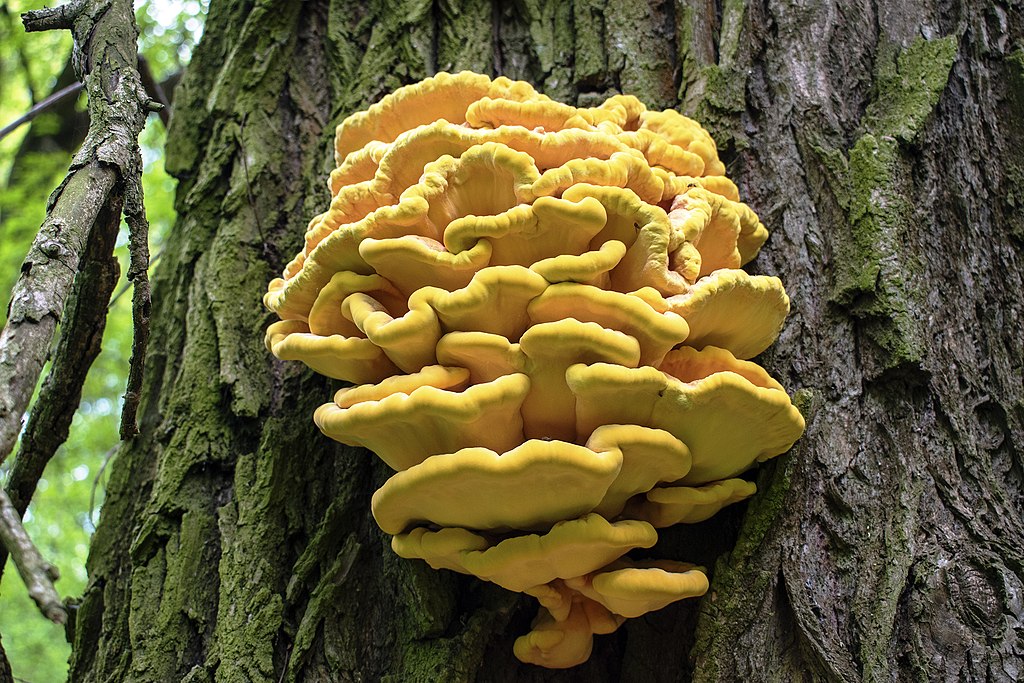
This species is found on both living and dead wood, including standing trees, fallen logs, and stumps. It primarily grows on broad-leaved trees, particularly oak, beech, cherry, sweet chestnut, willow, maple, and black locust. While it favors hardwoods, it is also known to grow on conifers such as yew. As a parasite, it causes red-brown cubical rot or heart rot in living trees. Fruitbodies typically appear in large, overlapping, fan-shaped clusters or tiers along the trunk and sides of the tree.
Photos
Appearance
- Bracket
- Large, fleshy, and fan-shaped or semicircular, measuring 5–40cm across. Typically grows in tiered, overlapping clusters. Colors range from bright sulphur-yellow to vivid orange-red or salmon-orange, often with a yellow margin. The surface is uneven, lumpy, or wrinkled, with a suede-like or velvety texture, becoming pale or straw-colored when dry.
- Pores
- Bright sulphur-yellow, becoming paler or straw-colored over time. Pores are small and circular to ovate, with a density of roughly 1–5 per mm.
- Tubes
- Short, measuring between 1.5–4mm long, and sulphur-yellow in color.
- Flesh
- Thick and succulent when young, sometimes exuding a yellowish juice. It is initially cream to yellow-orange but turns white, dry, and crumbly or chalky with age. It has a mild smell and a taste that is slightly sour or reminiscent of chicken.
- Spore print
- White.
Sporecast is better in the app
Plan ahead with 10-day forecasts, see what people are finding nearby, get photo IDs, and track your finds.
Edibility
Best eaten when young and fresh, this mushroom is noted for a chicken-like texture and a flavor that ranges from lemony to sour as it matures. While widely considered a delicacy, it can cause gastrointestinal distress or allergic reactions in some individuals, particularly if undercooked, eaten in excessive quantities, or harvested from yew, cherry, or conifer trees. Consumption alongside alcohol is specifically discouraged if the specimen was found on black locust or conifers to avoid vomiting. It should be distinguished from Laetiporus cincinnatus, which has white pores, and the Giant Polypore, which lacks bright coloring and a chicken-like scent.
Misidentification can be fatal. Never eat a mushroom unless you're 100% sure. This information may be inaccurate. Always consult multiple sources.
Nutrient Source
facultativeIt obtains nutrients by decomposing dead wood, but can also act as a parasite on living trees weakened by disease.
Common Names
- Basque
- ardagai hori, ardagai hori-sufrea
- Catalan
- gírgola groga, gírgolaoga
- Danish
- Svovlporesvamp
- Dutch
- Zwavelzwam
- English
- Sulphur Polypore, Chicken-Of-The-Woods, White-pored Chicken Of The Woods, Chicken Of The Woods
- Finnish
- rikkikääpä
- French
- Polypore soufré
- German
- Schwefelporling
- Norwegian Bokmål
- svovelkjuke
- Spanish
- Poliporo azufrado, poliporo azufrado, girgolaoga, políporo azufrado
- Swedish
- svavelticka
- Welsh
- Ysgwydd Felen
Synonyms
- Agarico-carnis flammula
- Agarico-pulpa styptica
- Agaricus speciosus
- Boletus amaricans
- Boletus caudicinus
- Boletus caudicinus
- Boletus citrinus
- Boletus citrinus
- Boletus coriaceus
- Boletus lingua-cervina
- Boletus ramosus
- Boletus ramosus
- Boletus sulphureus
- Boletus sulphureus
- Boletus tenax
- Boletus tenax
- Calvatia versispora
- Cerinomyces aurantiacus
- Ceriomyces aurantiacus
- Ceriomyces neumanii
- Cladomeris casearius
- Cladomeris sulphurea
- Cladoporus fulvus
- Cladoporus ramosus
- Cladoporus sulphureus
- Cladosporus fulvus
- Grifola sulphurea
- Laetiporus cincinnatus — White-pored Chicken Of The Woods
- Laetiporus speciosus
- Laetiporus speciosus
- Laetiporus sulphureus
- Laetiporus versisporus
- Leptoporus casearius
- Leptoporus caudicinus
- Leptoporus ramosus
- Leptoporus sulphureus
- Merisma sulphureum
- Polypilus casearius
- Polypilus caudicinus
- Polypilus sulphureus
- Polyporellus caudicinus
- Polyporellus caudicinus
- Polyporellus rubricus
- Polyporus candicinus
- Polyporus casearius
- Polyporus caudicinus
- Polyporus caudicinus
- Polyporus caudicinus
- Polyporus ceratoniae
- Polyporus ceratoniae
- Polyporus cincinnatus
- Polyporus citrinus
- Polyporus ramosus
- Polyporus rostafinskii
- Polyporus rubricus
- Polyporus sulphureus
- Polyporus todarii
- Ptychogaster aurantiacus
- Ptychogaster aureus
- Ptychogaster versisporus
- Sistotrema sulphureum
- Sporotrichum versisporum
- Stereum speciosum
- Tyromyces sulphureus