
Habitat
This mushroom is found on the ground in open broad-leaved woodlands, appearing solitary, in clusters, or in small groups. It is strongly associated with hardwoods such as aspen, poplar, birch, and oak, though it may occasionally be found with willow, lime, sweet chestnut, beech, and pine. In certain regions, similar species under this name have also been observed growing in coniferous forests.
Photos
Appearance
- Cap
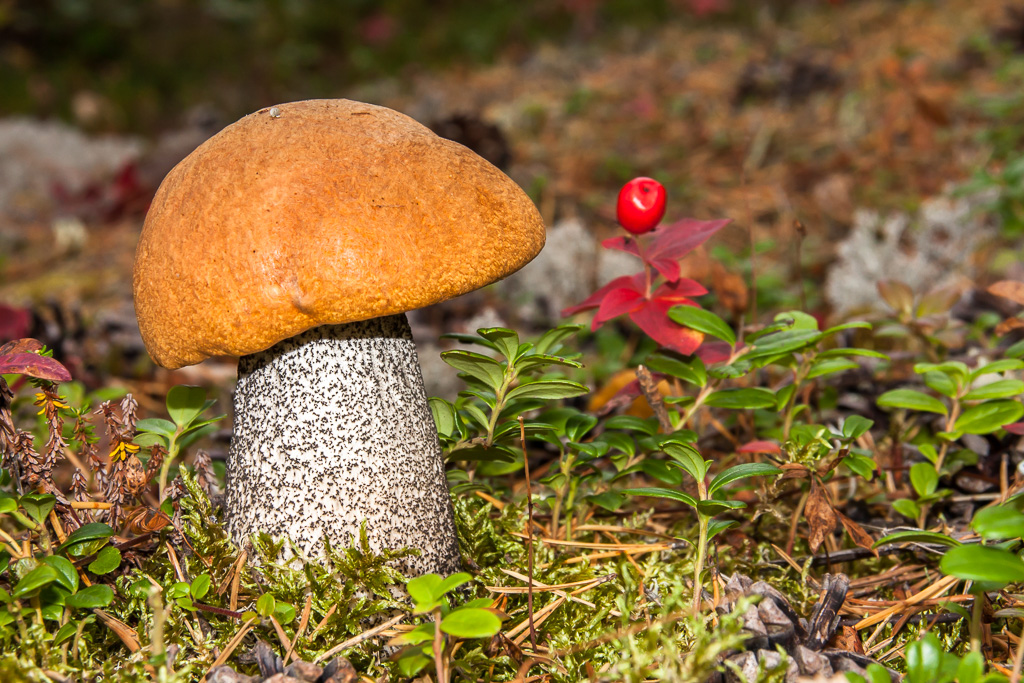
- Measuring 3–20 cm wide; shape ranges from hemispherical or conical to convex, eventually flattening. The surface is orange, apricot, chestnut-brown, or brick-red, with a texture that is smooth, slightly downy, or matted-hairy when young. The margin features a distinct, overhanging skirt of tissue often divided into small triangular flaps.
- Stem
- 5–27 cm long and 1.8–4.8 cm thick; cylindrical or swollen at the base. The surface is covered in small scales (scabers) that start white or pale but transition to orange-brown, rusty-red, and eventually dark brown or black. The base may bruise wine-red or greenish-blue.
- Pores
- Small and angular; initially white to cream, staining vinaceous, greyish, or olive-brown when bruised or with age.
- Tubes
- White to pale buff, turning vinaceous, brownish, or cigar-brown upon exposure or bruising.
- Flesh
- Firm and white to cream. When cut, it transitions through a color sequence, typically staining pinkish or vinaceous first, then darkening to grey, sepia, or blackish; the stem base sometimes exhibits a blue-green flush.
- Spore print
- Ochraceous-buff, cinnamon, or walnut-brown.
Sporecast is better in the app
Plan ahead with 10-day forecasts, see what people are finding nearby, get photo IDs, and track your finds.
Edibility
The flesh has a pleasant taste and smell, but it undergoes a distinct color change when cut or bruised, turning from white to pink or wine-red before eventually darkening to bluish-grey or black. Caution is advised as poisonings have been reported for similar orange-capped boletes. It can be confused with Leccinum insigne, which lacks the initial pink staining, and Leccinum versipelle; other lookalikes include Leccinum vulpinum, Leccinum manzanitae, and the Aspen Scaberstalk.
Misidentification can be fatal. Never eat a mushroom unless you're 100% sure. This information may be inaccurate. Always consult multiple sources.
Nutrient Source
EctomycorrhizalThis fungus forms a symbiotic relationship with trees, helping them absorb nutrients from the soil in exchange for sugars from the tree.
Common Names
- Basque
- onddo laranja, onto laranja
- Catalan
- abró
- Danish
- Orange aspe-rørhat, Rustrød skælrørhat
- Dutch
- Rosse populierboleet, Eikeboleet, Eikenboleet, Kruipwilgboleet
- English
- Red-capped Scaber Stalk, Orange Oak Bolete, Orange Bolete
- Finnish
- lehtopunikkitatti, tammenpunikkitatti
- French
- Bolet orangé
- German
- Eichen-Rotkappe
- Norwegian Bokmål
- eikeskrubb
- Norwegian Nynorsk
- eikeskrubb
- Spanish
- Hongo anaranjado, boleto anaranjado, Ecótipo, Guilleries
- Swedish
- aspsopp, eksopp
- Welsh
- Cap Tyllog Oren
Synonyms
- Boletopsis rufa
- Boletus aurantiacus
- Boletus aurantiacus
- Boletus orantiacus
- Boletus quercinus
- Boletus rufus
- Boletus salicola
- Boletus sanguinescens
- Gyroporus rufus
- Krombholzia aurantiaca
- Krombholziella aurantiaca
- Krombholziella quercina
- Krombholziella rufa
- Krombholziella rufa
- Krombholziella salicicola
- Krombholziella salicola
- Leccinum decipiens
- Leccinum populinum
- Leccinum quercinum
- Leccinum quercinum
- Leccinum rufum
- Leccinum salicicola
- Leccinum salicola
- Suillus aurantiacus
- Trachypus aurantiacus
- Tubiporus rufus