
Habitat
Occurring either solitarily or in small groups on soil, this species is specifically associated with aspen and other poplar trees. It is often found in open areas away from dense woodland.
Photos
Appearance
- Cap
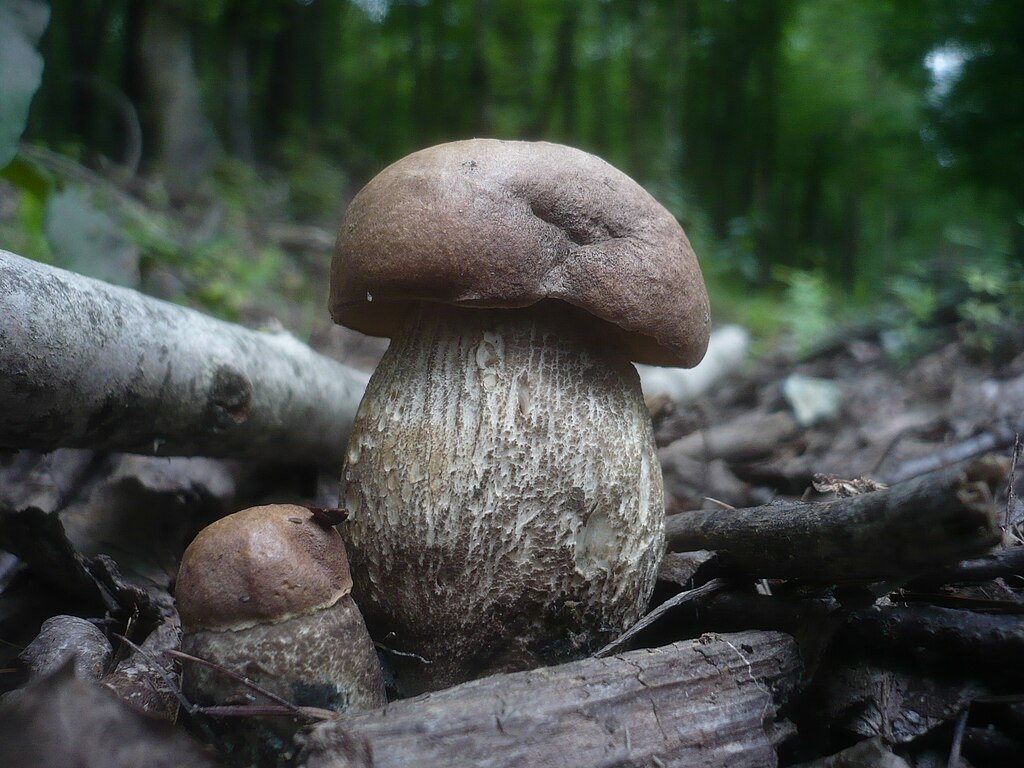
- Measuring 4 to 16 cm across, the cap is hemispherical to convex. The surface transitions from finely downy to smooth and may crack near the margin with age; the cuticle is dry to slightly sticky when wet and overhangs the tube margin. Colors vary from light cinnamon-buff and grey-brown to red-brown.
- Stem
- 8 to 17 cm long and 2 to 3.5 cm thick, the stem is stout and cylindrical with a slightly bulbous base. It is covered in dark brown or blackish scales that are smaller near the white apex, against a buff-colored background. The base frequently shows blue-green bruising or tints.
- Flesh
- Notably firm and white when fresh. When cut, it turns salmon-pink or peach in the cap and vinaceous-grey in the stem, eventually staining blackish throughout. The stem base often shows distinct blue-green patches.
- Tubes
- Adnexed to nearly free from the stem, transitioning from white or cream to pale yellowish-buff or grey-buff.
- Pores
- Very small and rounded; initially white or cream, they eventually darken and bruise olive-brown to coffee-brown.
- Spore print
- Walnut-brown to olivaceous yellow-brown.
Sporecast is better in the app
Plan ahead with 10-day forecasts, see what people are finding nearby, get photo IDs, and track your finds.
Edibility
This mushroom has a very firm texture with a mild and pleasant taste. It is commonly confused with other brown-capped Leccinum species, all of which are considered edible. While the flesh is initially white, it will slowly change color to salmon-pink, then turn blackish or blue-green when cut or bruised.
Misidentification can be fatal. Never eat a mushroom unless you're 100% sure. This information may be inaccurate. Always consult multiple sources.
Nutrient Source
EctomycorrhizalIt forms a symbiotic relationship with trees, exchanging nutrients and carbon compounds with the trees' root systems.
Common Names
- Danish
- Poppel-skælrørhat
- Dutch
- Harde populierboleet
- English
- Slate Bolete
- Finnish
- ruskopunikkitatti
- French
- Bolet rude des trembles
- German
- Harter Pappel-Rauhfußröhrling
- Norwegian Bokmål
- brun ospeskrubb
- Norwegian Nynorsk
- brun ospeskrubb
- Swedish
- brun aspsopp
- Welsh
- Cap Tyllog Cras
Synonyms
- Boletus duriusculus
- Boletus duriusculus
- Boletus nigrescens
- Boletus populinus
- Boletus rufus
- Gyroporus duriusculus
- Krombholzia duriuscula
- Krombholziella duriuscula
- Krombholziella duriuscula
- Suillus duriusculus
- Trashypus duriusculus