
Habitat
This species is found exclusively in association with birch trees. It typically grows on soil in broad-leaved woodlands, but it is also very common in urban landscapes, gardens, and on lawns where ornamental birches have been planted. While it frequently occurs on acidic sites, it is also noted to inhabit wet heaths and damp areas. It can be found growing solitarily, in scattered troops, or in small groups.
Photos
Appearance
- Cap
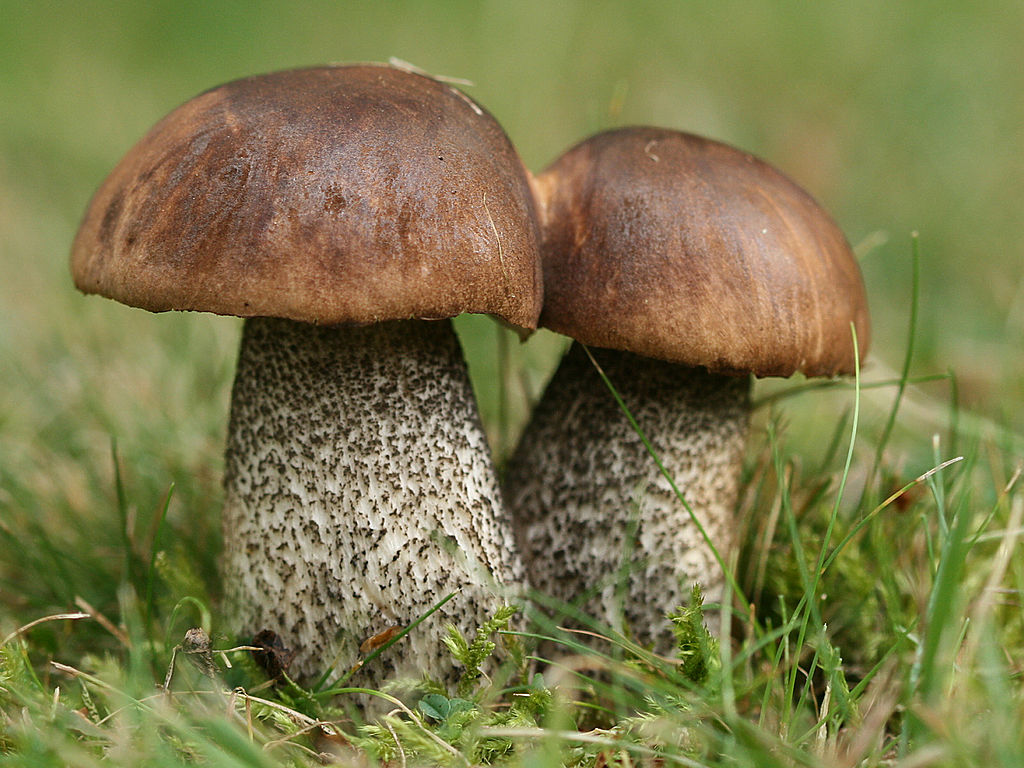
- 5–15 cm across, hemispheric or bun-shaped, becoming convex to flat; surface is dry and finely woolly or suede-like, but becomes tacky to slimy in wet weather; color ranges from walnut-brown and tan to hazel, grey-brown, or olive-brown, often fading with age.
- Stem
- 5–20 cm long and 1.5–4 cm thick; club-shaped or equal; white to pale grey ground color, densely covered in small brownish-black scales (scabers) often arranged in lines or a network.
- Pores
- Small and angular; initially white, cream, or grey-white, becoming dingy tan or olive-buff with age; bruises ochraceous, pale red-brown, or light grey-brown.
- Tubes
- Deeply depressed around the stem; white to pale grey, transitioning to dirty ochraceous or brownish-grey as the spores mature.
- Flesh
- White and thick; firm in youth but becoming very soft and watery or marshmallowy; generally unchanging when cut, though some forms may flush pale pink, coral, or brownish over time.
- Spore print
- Brown, walnut-brown, or dusky brown.
Sporecast is better in the app
Plan ahead with 10-day forecasts, see what people are finding nearby, get photo IDs, and track your finds.
Edibility
While edible, the flesh of this mushroom is often described as very soft, watery, or slimy, and it is usually best when collected young and firm. The flavor and smell are generally considered pleasant or mild. Though it has no toxic lookalikes, foragers should be aware that widespread reports of stomach upset exist for this species. It may be confused with other similar Leccinum species found under birch, such as the Ghost Bolete (Leccinum holopus), which is rare and of little culinary value.
Misidentification can be fatal. Never eat a mushroom unless you're 100% sure. This information may be inaccurate. Always consult multiple sources.
Nutrient Source
EctomycorrhizalThis mushroom forms a symbiotic relationship with birch trees, exchanging nutrients with them through their root systems.
Common Names
- Catalan
- albereny, alberen, Albareny, molleró aspre, molleric
- Danish
- Rødmende birke-rørhat, Nøddebrun skælrørhat, Hvid skælrørhat, Brun skælrørhat
- Dutch
- Donkerbruine berkenboleet, Gewone berkenboleet, gewone berkeboleet, Witte berkenboleet, Blozende berkenboleet, donkerbruine berkeboleet, blozende berkeboleet, witte berkeboleet
- English
- Brown Birch Bolete, Brown Birch-Bolete, Blushing Bolete
- Finnish
- lehmäntatti, vaivaislehmäntatti, rusolehmäntatti
- French
- Bolet rude à chair rose, Bolet rude
- German
- Zigarrenbrauner Birkenpilz, Haselnussfarbener Birkenpilz, Gemeiner Birkenpilz
- Norwegian
- klæbpils, klæbsopp
- Norwegian Bokmål
- rødnende brunskrubb, fjellskrubb, brunskrubb
- Norwegian Nynorsk
- brunskrubb, fjellskrubb, raudnande brunskrubb
- Spanish
- Boleto áspero, boleto de pie escabroso, boleto escabroso, boleto áspero
- Swedish
- björksopp, rensopp, strävsopp, rodnande strävsopp
- Welsh
- Cap Tyllog Brown Bedw
Synonyms
- Boletus albus
- Boletus avellaneus
- Boletus gilletii
- Boletus niveus
- Boletus oxydabilis
- Boletus oxydabilis
- Boletus roseofractus
- Boletus rotundifoliae
- Boletus rotundifolius
- Boletus scaber
- Ceriomyces scaber
- Gyroporus scaber
- Krombholzia nivea
- Krombholzia oxydabilis
- Krombholzia rotundifoliae
- Krombholzia rufa
- Krombholzia scabra
- Krombholziella avellanea
- Krombholziella melaena
- Krombholziella nivea
- Krombholziella nivea
- Krombholziella oxydabilis
- Krombholziella roseofracta
- Krombholziella rotundifoliae
- Krombholziella scabra
- Krombholziella scabra
- Leccinum avellaneum
- Leccinum melaenum
- Leccinum niveum
- Leccinum oxydabile
- Leccinum oxydabile
- Leccinum rigidipes
- Leccinum roseofractum — Blushing Bolete
- Leccinum rotundifoliae
- Leccinum subcinnamomeum
- Suillus albus
- Suillus gilletii
- Suillus scaber
- Trachypus scaber
- Tubiporus scaber