
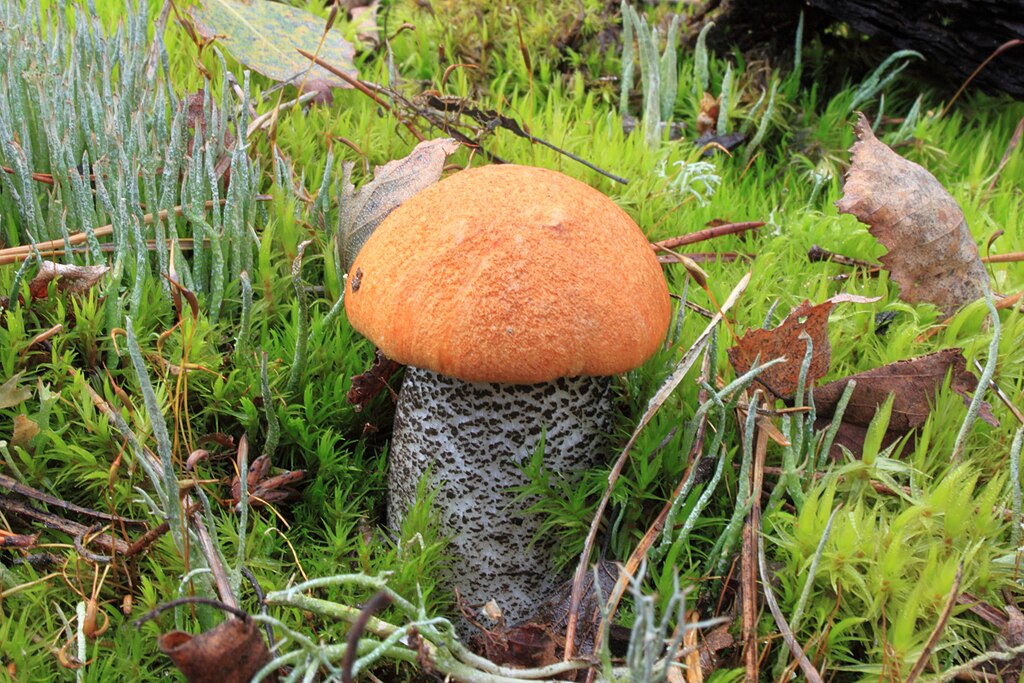
Habitat
This species occurs on the ground in association with birch trees. It is frequently found in scrubland, open woodlands, or acidic sites, often near isolated trees. It grows solitarily, in clusters, or in small trooping groups on soil. While most commonly associated with birch, orange-capped Leccinum species of this type are also noted to occur near conifers, aspen, cottonwood, madrone, and manzanita.
Photos
Appearance
- Cap
- 8–20 cm across; initially hemispherical then convex to flat; tawny orange to dull orange or yellowish brown; surface is slightly downy when young then smooth, dry to slightly sticky when wet; the margin features a distinct overhanging 'skirt' or flaps of sterile tissue.
- Stem
- 11–20 cm long and 1.5–4 cm thick, often swollen toward the base; white to grayish, densely covered with woolly, brownish-black to black scales or scabers; bruises grayish-purple; white mycelium at the base.
- Tubes
- Adnexed; white to buff, staining pale wine-red to vinaceous when cut.
- Pores
- Small and angular; initially mouse-grey to whitish, becoming ochraceous or brownish with age; bruises vinaceous or brownish.
- Flesh
- Firm and white; when cut, it changes to pink or grey-violet/vinaceous, then turns dark purplish-black; often shows blue-green or bluish tints in the stem base; taste and smell are mild and pleasant.
- Spore print
- Ochraceous walnut-brown.
Sporecast is better in the app
Plan ahead with 10-day forecasts, see what people are finding nearby, get photo IDs, and track your finds.
Edibility
While historically considered edible, this mushroom and other orange-capped species in the genus have been linked to multiple cases of gastrointestinal distress and may be toxic to some individuals. The flesh has a pleasant taste but must be cooked thoroughly or dried before use. It is closely related to Leccinum aurantiacum, which differentiaties itself by having orange-brown scabers in early stages rather than black.
Misidentification can be fatal. Never eat a mushroom unless you're 100% sure. This information may be inaccurate. Always consult multiple sources.
Nutrient Source
EctomycorrhizalIt forms a symbiotic relationship with trees, exchanging nutrients in a way that benefits both the fungus and the tree.
Common Names
- Catalan
- molleró rogenc
- Danish
- Plettet birke-rørhat, Orange skælrørhat
- Dutch
- Bleke berkenboleet, Oranje berkenboleet, Oranje berkeboleet, bleke berkeboleet
- English
- Orange Birch-Bolete, Orange Birch Bolete
- Finnish
- koivunpunikkitatti, kalvaspunikkitatti, pohjanpunikkitatti
- French
- Bolet roux
- German
- Birken-Rotkappe
- Northern Sami
- ruksesgusaguoppar
- Norwegian Bokmål
- rødskrubb
- Norwegian Nynorsk
- raudskrubb
- Swedish
- tegelsopp, tegelröd björksopp, tegelfärgad björksopp, blek björksopp
- Welsh
- Cap Tyllog Melyngoch Bedw
Synonyms
- Boletus atrostipitatus
- Boletus floccopus
- Boletus percandidus
- Boletus percandidus
- Boletus roseotinctus
- Boletus rufescens
- Boletus rufescens
- Boletus testaceoscaber
- Boletus versipellis
- Ceriomyces viscidus
- Krombholzia rufescens
- Krombholziella atrostipitata
- Krombholziella percandida
- Krombholziella roseotincta
- Krombholziella rufescens
- Krombholziella versipellis
- Leccinum atrostipitatum
- Leccinum percandidum
- Leccinum percandidum
- Leccinum roseotinctum
- Leccinum rufescens
- Leccinum rufescens
- Leccinum testaceoscabrum
- Leccinum testaceoscabrum
- Suillus versipellis
- Trachypus rufescens
- Trachypus rufescens