
Habitat
Found in various locations including broad-leaved woodlands, gardens, lawns, and waste ground. It typically grows on soil, humus, wood chips, and leaf litter. This species frequently inhabits disturbed sites such as urban areas, parks, yards, roadsides, and trails. It appears in clusters, small groups, or scattered troops, and while it occurs under various tree types, it is rarely found associate with conifers.
Photos
Appearance
- Cap
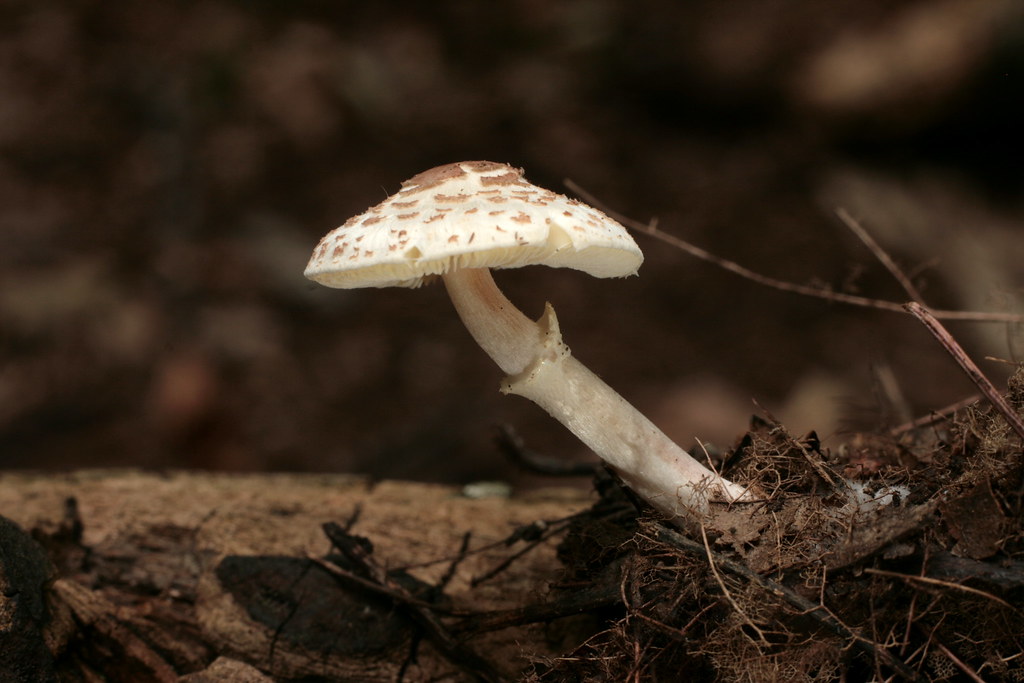
- 2–6.5 cm wide; initially bell-shaped, oval, or rounded-conical, maturing to convex or broadly convex with a distinct umbo. The surface is dry with a reddish-brown to dark brown center that breaks into small, often concentrically arranged scales on a white to creamy, silky background.
- Gills
- White to creamy, becoming slightly brownish or darker with age; crowded or close, broad, and free from the stem.
- Stem
- 2–8 cm long and 3–5 mm thick; slender, cylindrical, and white to light beige, sometimes developing pinkish-tan or flesh-colored tones. The surface is smooth to silky and may be covered in silvery-white fibrils.
- Partial veil
- Forming a thin, membranous ring on the stem that is fragile and often disappears or remains as tatters on the cap margin; the ring is typically white on top and occasionally brownish on the underside.
- Flesh
- White and very thin; fragile in the cap and more fibrous in the stem.
- Odor
- Strong and unpleasant; variously described as smelling like burnt rubber, burning hair, gas, metallic, or boiled sweets.
- Spore print
- White.
Sporecast is better in the app
Plan ahead with 10-day forecasts, see what people are finding nearby, get photo IDs, and track your finds.
Edibility
This species should be avoided as it is easily confused with extremely toxic mushrooms and other similar small species that require microscopic analysis for accurate identification. It is characterized by a strong, unpleasant odor variously described as burnt rubber, burning hair, gas-like, or metallic with a sweet component. While reports on taste vary from pleasant to unpleasant, its small size and similarity to dangerously poisonous relatives make it unsafe to consume.
Misidentification can be fatal. Never eat a mushroom unless you're 100% sure. This information may be inaccurate. Always consult multiple sources.
Nutrient Source
SaprotrophicIt obtains nutrients by decomposing dead or decaying organic material.
Common Names
- Basque
- galanperna usaintsu
- Danish
- Stinkende parasolhat
- Dutch
- Stinkparasolzwam
- English
- Stinking Dapperling, Stinking Parasol
- Finnish
- puistoukonsieni
- French
- Lépiote puante, Lépiote crêpue, Lépiote crêtée
- German
- Stink-Schirmling
- Norwegian Bokmål
- stankparasollsopp
- Norwegian Nynorsk
- stankparasollsopp
- Spanish
- paloma pudent, galanperna usaintsua, lepiota maloliente
- Swedish
- syrlig fjällskivling
- Welsh
- Pertyn Drewllyd
Synonyms
- Agaricus cristatus
- Agaricus granulatus
- Agaricus miculatus
- Agaricus punctatus
- Gyrophila miculata
- Lepiota felinoides
- Lepiota subfelinoides
- Lepiotula cristata
- Lepiotula cristata
- Tricholoma granulatum
- Tricholoma miculatum