
Habitat
A versatile and common decomposer found on soil and among leaf litter in mixed, broadleaf, or conifer forests. It is an aggressive recycler of organic matter and frequently occurs in gardens, parks, lawns, pastures, and along roadsides. It especially favors rich substrates such as compost piles, yard waste, and accumulated plant debris. While it is found in various urban environments and lower elevation woodlands, it is generally absent from undisturbed high-altitude forests. Use of biocides in urban growing areas should be noted as a concern for collectors. The species typically grows in small groups or troops, often forming distinctive fairy rings or arcs.
Photos
Appearance
- Cap
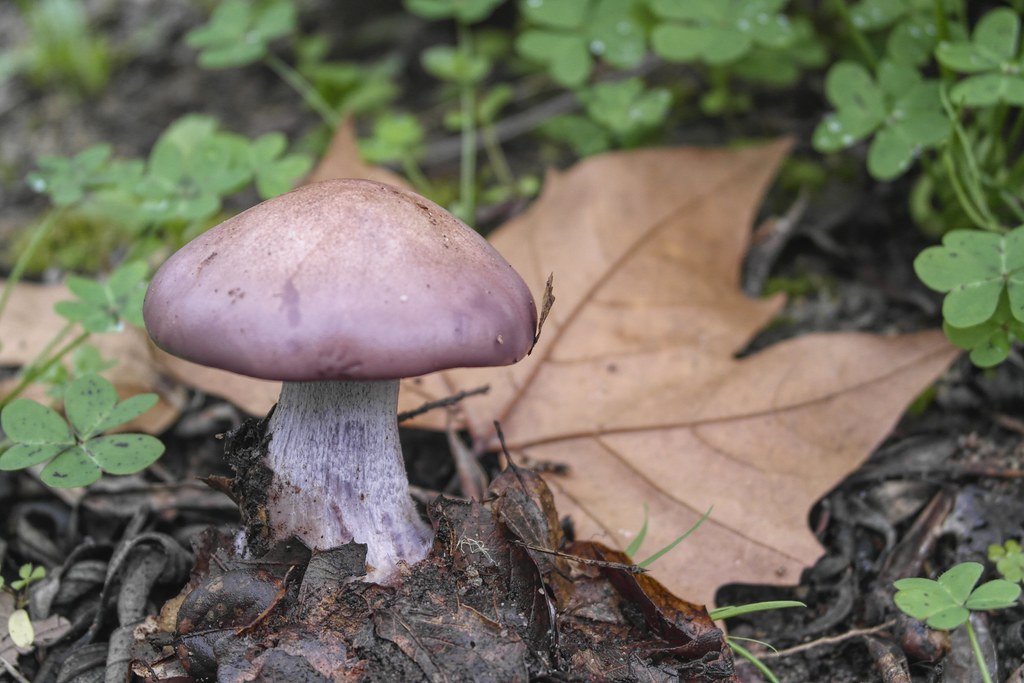
- 2.5–15 cm wide, starting convex with an inrolled margin and sometimes a broad hump, later flattening, becoming depressed or funnel-shaped; edges often wavy or irregular. The surface is smooth and may appear waxy, greasy when wet, or shiny when dry. Color is initially vibrant violet, bluish-lilac, or amethyst, fading with age to gray-brown, tan, or pinkish buff.
- Stem
- 2–11 cm tall and 1–4 cm thick; stout, equal in width or swollen/bulbous at the base. Surface is dry, with purple fibers or a mealy texture near the top. Color is lilac or bluish-purple, sometimes developing tan or silvery-grey tones, often with a fluffy lilac or purple mold-like growth (mycelium) at the base.
- Gills
- Crowded and closely spaced, attached to the stem and often notched or slightly running down it. Color is deep lilac or purple when young, typically retaining this color longer than the cap before eventually fading to a pale buff, ocher, or light brown.
- Flesh
- Thick and firm; marbled bluish-lilac or purple when fresh, sometimes fading to grey, tan, or whitish-beige. It can be notably watery when fresh.
- Spore print
- Pale pink to pinkish buff.
- Odour
- Strongly aromatic and pleasant, frequently described as floral, perfumed, or resembling the scent of frozen orange juice concentrate.
- Taste
- Mild, nutty, or occasionally slightly spicy.
Sporecast is better in the app
Plan ahead with 10-day forecasts, see what people are finding nearby, get photo IDs, and track your finds.
Edibility
Wood Blewits must always be cooked, as eating them raw can cause gastric upset and indigestion. Some individuals may experience allergic reactions or adverse effects regardless of preparation, so caution is advised for first-time consumption. Identifying this species requires distinguishing it from toxic purple Cortinarius (webcaps), which feature rusty-brown spores and cobweb-like veils on the stem, whereas the Wood Blewit has a pinkish spore print. Other similar species include the edible Sordid Blewit and Laccaria ochropurpurea. The mushroom is noted for a distinctive perfumed or flowery aroma, often compared to frozen orange juice, and it possesses a nutty or earthy flavor with a soft texture.
Misidentification can be fatal. Never eat a mushroom unless you're 100% sure. This information may be inaccurate. Always consult multiple sources.
Nutrient Source
SaprotrophicIt obtains nutrients by breaking down dead organic material such as fallen leaves and wood chips.
Common Names
- Danish
- Violet hekseringshat
- Dutch
- Paarse schijnridderzwam
- English
- Blewit, Wood Blewit
- Finnish
- sinivalmuska
- French
- Pied bleu, Tout-bleu, Tricholome nu
- German
- Violetter Rötelritterling
- Norwegian Bokmål
- blå ridderhatt
- Norwegian Nynorsk
- blå riddarhatt
- Swedish
- blåmusseron
- Welsh
- Coes Las y Coed
Synonyms
- Agaricus bicolor
- Agaricus bulbosus
- Agaricus nudus
- Agaricus tyrianthinus
- Clitocybe nuda
- Clitocybe tyrianthina
- Collybia lilacea
- Cortinarius bicolor
- Cortinarius nudus
- Gyrophila nuda
- Omphalia tyrianthina
- Paxillus nudus
- Rhodopaxillus nudus
- Rhodopaxillus nudus
- Tricholoma lilaceum
- Tricholoma nudum