
Habitat
Typically found growing in soil among plant debris, organic rubbish, and rotting vegetation. Common locations include woodland edges, hedgerows, and garden areas near compost piles. It often appears in large groups.
Photos
Appearance
- Cap
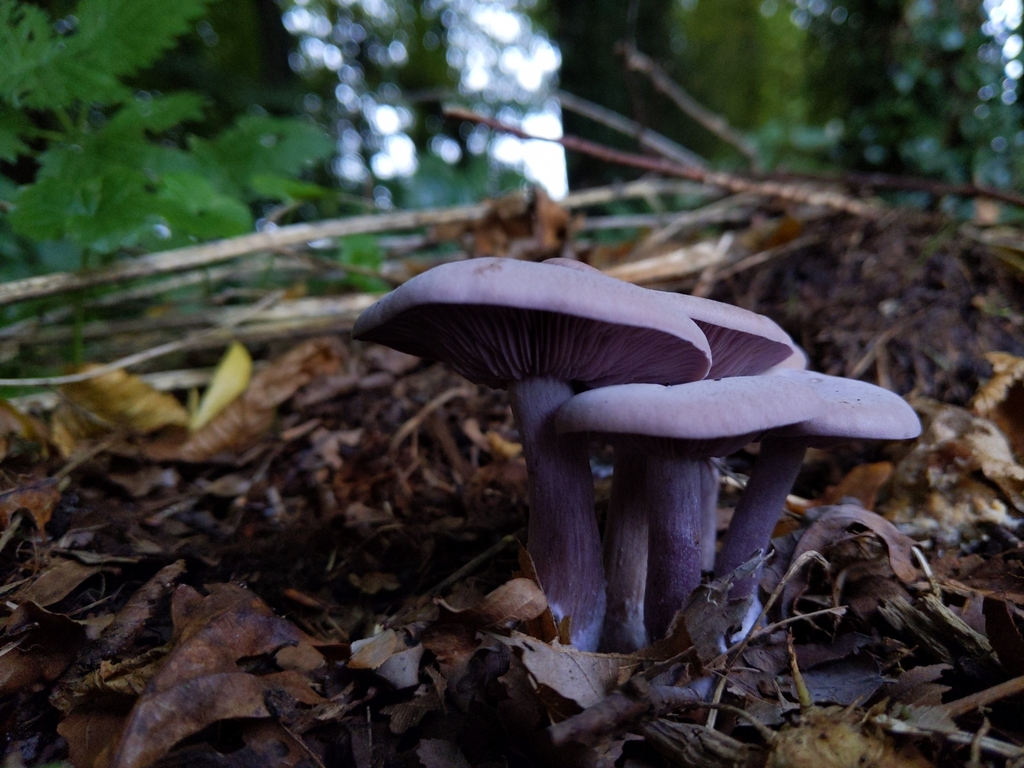
- Measuring 2–8 cm wide, initially convex but later flattening or becoming depressed. Often features a small central hump and wavy or irregular edges that can sometimes split. Color ranges from lilac to lilac-brown, fading to pale buff or brown as it dries.
- Stem
- 2–7 cm long and 5–8 mm thick, typically cylindrical or slightly swollen at the base. It is fibrous or woolly in texture and generally matches the color of the cap.
- Gills
- Crowded and notched where they meet the stem. Color starts as lilac or pale grey-lilac, eventually fading to a light brownish-buff.
- Flesh
- Thin and grayish with a distinct lilac tint.
- Spore print
- Ranging from pale pink to cream or greyish-lilac.
- Smell
- Faint and pleasantly sweet or perfume-like.
- Taste
- Mild and occasionally described as slightly floury.
Sporecast is better in the app
Plan ahead with 10-day forecasts, see what people are finding nearby, get photo IDs, and track your finds.
Edibility
This species has a mild to floury taste and a faint, sweet, perfume-like scent. It is very easily confused with the Wood Blewit, but is typically smaller, duller in color, and less aromatic. It should be distinguished by its slightly more elongated spores.
Misidentification can be fatal. Never eat a mushroom unless you're 100% sure. This information may be inaccurate. Always consult multiple sources.
Nutrient Source
SaprotrophicIt obtains nutrients by decomposing dead organic matter in the soil or leaf litter.
Common Names
- Danish
- Spinkel hekseringshat
- Dutch
- Vaalpaarse schijnridderzwam
- English
- Sordid Blewit
- Finnish
- orvokkivalmuska
- German
- Schmutziger Röteltrichterling
- Norwegian Bokmål
- lillabrun ridderhatt
- Norwegian Nynorsk
- lillabrun riddarhatt
- Swedish
- violmusseron
Synonyms
- Agaricus sordidus
- Agaricus sordidus
- Gyrophila sordida
- Lepista domestica
- Melanoleuca sordida
- Rhodopaxillus sordidus
- Tricholoma lilaceum
- Tricholoma sordidum
- Tricholoma sordidum