
Habitat
This species is a decomposer primarily found in open, grassy environments such as lawns, meadows, and parklands. It frequently occurs in human-influenced habitats including gardens (on soil, wood chips, or rich humus), roadsides, and urban areas. While it is occasionally found in woodlands—including broad-leaved, mixed, or coniferous forests—it is typically restricted to open glades, trail edges, and woodland margins. It fruits on the ground, growing in solitary fashion or in scattered groups, troops, arcs, and rings.
Photos
Appearance
- Cap
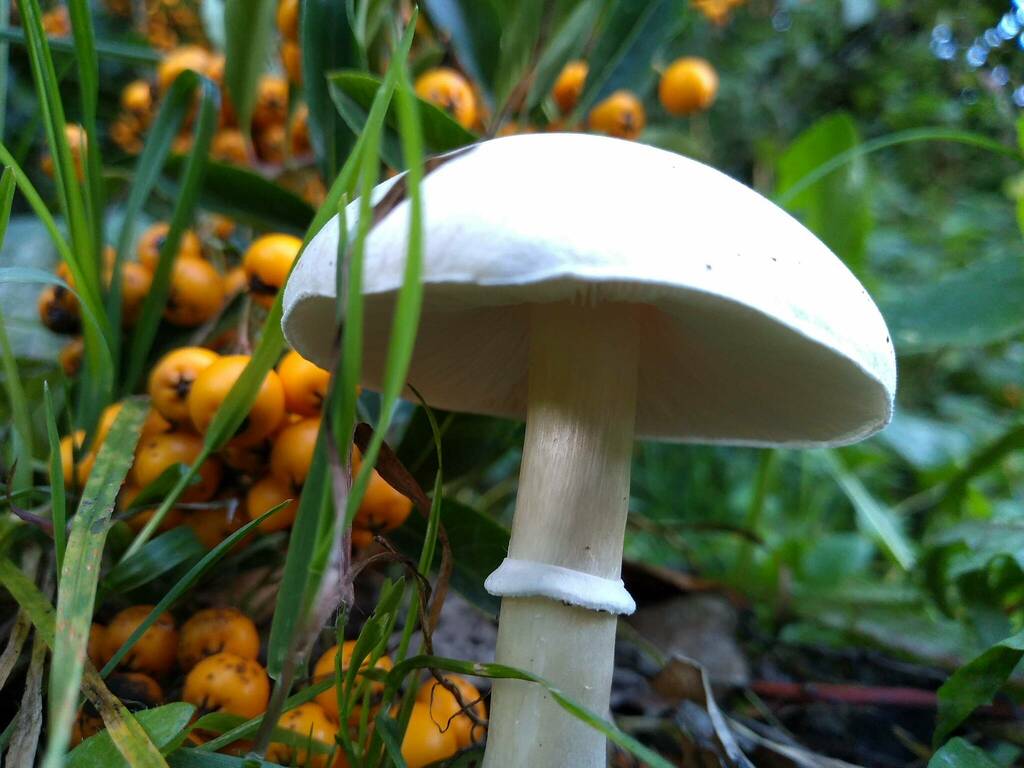
- 3–12 cm across; initially marshmallow-shaped, hemispheric, or boxy, expanding to broadly convex or nearly flat. The surface is dry, smooth, and silky with a metallic sheen, though it may occasionally develop tiny scales or feel finely velvety. Usually white to ivory, it can age to cream-ochre, pale beige, or light gray.
- Stem
- 4–12 cm long and 0.7–2 cm thick; slender and cylindrical with a slightly swollen or club-shaped base. It is smooth and white to grayish, sometimes becoming brownish or fibrous toward the bottom. The interior is fibrous and often develops a central hollow.
- Ring
- White, narrow, and membranous; located on the upper portion of the stem. It is often persistent, collar-like, and may become movable or free from the stem in maturity.
- Gills
- Free from the stem and crowded. Initially white or cream, they typically transition to pale pink, grayish-pink, or salmon-buff as the mushroom ages.
- Flesh
- Thick and white; may slowly bruise yellowish, pinkish, or light brown, particularly in the stem or at the base.
- Spore print
- White.
- Smell and Taste
- Odor is indistinct or pleasant; taste is mild.
Sporecast is better in the app
Plan ahead with 10-day forecasts, see what people are finding nearby, get photo IDs, and track your finds.
Edibility
Consumption is generally cautioned due to possible confusion with deadly poisonous Amanita species like the Destroying Angel and the white phase of the Death Cap, though those possess a cup-like volva at the base. While many consider it a good edible with a mild, pleasant flavor, it has been known to cause gastrointestinal upset or allergic reactions in some individuals, particularly the grayish forms. It is also easily confused with Agaricus species, which can be distinguished by their chocolate-brown mature gills and spores. For those who choose to eat it, it should be cooked well and sampled cautiously the first time.
Misidentification can be fatal. Never eat a mushroom unless you're 100% sure. This information may be inaccurate. Always consult multiple sources.
Nutrient Source
SaprotrophicIt obtains nutrients by decomposing dead organic matter from plants and other organisms in the soil.
Common Names
- Basque
- galamperna zuria, galanperna zuria
- Danish
- Rosabladet silkehat
- Dutch
- Blanke champignonparasol
- English
- White Dapperling
- Finnish
- valkoukonsieni
- French
- Lépiote pudique
- German
- Seidiger Champignonsschirmling, Rosablättriger Schirmpilz
- Spanish
- Lepiota blanca
- Swedish
- champinjonfjällskivling
- Welsh
- Pertyn Gwyn
Synonyms
- Agaricus cretaceus
- Agaricus holosericeus
- Agaricus holosericeus
- Agaricus laevis
- Agaricus leucothites
- Agaricus levis
- Agaricus naucinus
- Agaricus sphaerophorus
- Annularia laevis
- Annularia levis
- Annularia levis
- Lepiota holosericea
- Lepiota holosericea
- Lepiota leucothites
- Lepiota naucina
- Lepiota naucina
- Leucoagaricus holosericeus
- Leucoagaricus leucothites
- Leucoagaricus leucothites
- Leucoagaricus naucinus
- Leucocoprinus holosericeus
- Leucocoprinus naucinus
- Mastocephalus naucinus