
Habitat
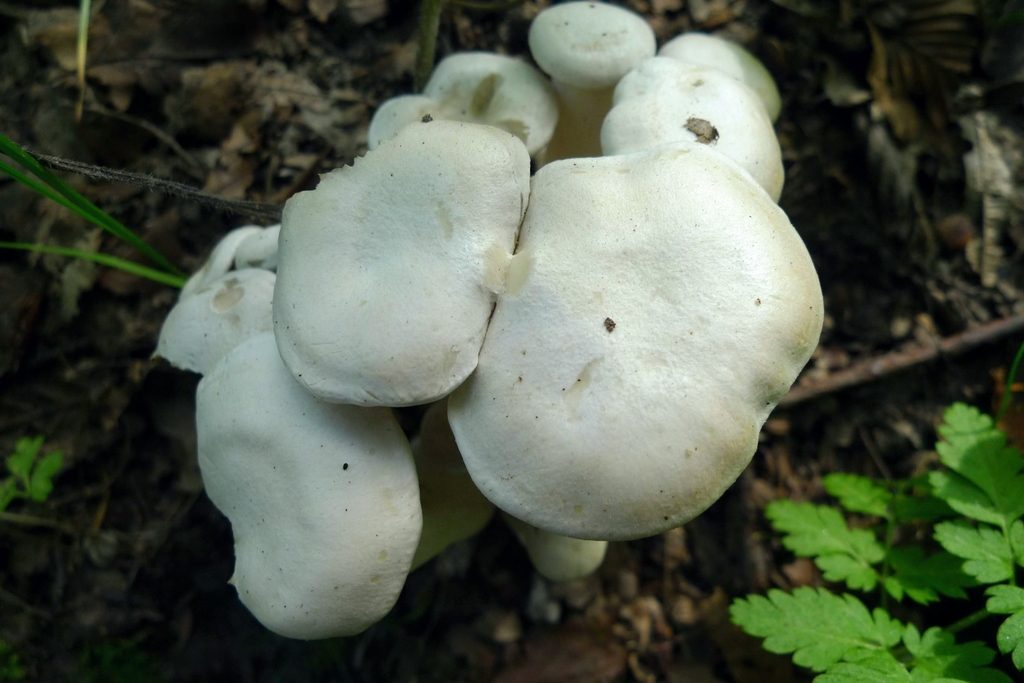
Leucocybe connata typically grows in dense, tufted clusters on soil or gravel. It is common in disturbed environments such as roadsides, trail edges, parks, gardens, and skid trails near logging operations. It is also found in mixed woodland and on adjacent grasslands, sometimes associated with oak trees or occurring among low herbaceous plants.
Photos
Appearance
- Cap
- 2.5–8 cm wide; white, chalky white, or ivory, sometimes becoming grayish or pale beige with age; shape ranges from hemispherical to convex, eventually flattening; often has a wavy or lobed margin that is inrolled when young; surface is smooth, finely downy, or covered in a chalky powder.
- Stem
- 3–10 cm long, 0.5–1.5 cm thick; white to pale beige; shape varies from cylindrical to tapering at the base or spindle-shaped; surface is smooth, finely fibrous, or slightly scaly; stems are frequently fused together at the base in dense clusters.
- Gills
- Attached (adnate) to slightly decurrent; white to cream, sometimes developing yellowish or pinkish-buff tints with age; close to crowded.
- Flesh
- White to pale beige; firm, fibrous, and tough; turns violet or blue-black when treated with iron salts (ferrous sulphate).
- Spore print
- White.
- Smell
- Indistinct to faint and pleasant; sometimes described as sweet.
- Taste
- Mild and pleasant.
Sporecast is better in the app
Plan ahead with 10-day forecasts, see what people are finding nearby, get photo IDs, and track your finds.
Edibility
While traditionally considered edible and described as having a pleasant sweet flavor or an asparagus-like taste, this species is no longer recommended due to reports that it contains carcinogens and bioactive compounds like muscarine. It is commonly confused with the poisonous Tricholoma album, which has a bitter taste and unpleasant smell, and the edible Tricholoma columbetta. Beginners should also be wary of the deadly Destroying Angel, though that species possesses a ring and a volva.
Misidentification can be fatal. Never eat a mushroom unless you're 100% sure. This information may be inaccurate. Always consult multiple sources.
Nutrient Source
SaprotrophicIt obtains nutrients by decomposing dead organic matter, such as fallen leaves and wood, found in the soil.
Common Names
- Danish
- Knippe-tragthat
- Dutch
- Witte bundelridderzwam
- English
- White Domecap
- Finnish
- nurmitupaskynsikäs
- French
- Lyophylle conné
- German
- Weißer Rasling
- Norwegian Bokmål
- hvit knippesopp
- Norwegian Nynorsk
- kvit knippesopp
- Swedish
- vit tuvskivling
- Welsh
- Pengrwm Wen
Synonyms
- Agaricus connatus
- Agaricus hebepodius
- Clitocybe connata
- Gyrophila connata
- Lyophyllum connatum — White Domecap
- Omphalia connata
- Tricholoma connatum