
Habitat
This common species is found in a variety of environments including woodland, heathland, pastures, and waste ground. It frequently occurs on rich soil in grassy woodland areas, along roadsides, and in open grassland. Fruit bodies typically grow in small groups or clusters.
Photos
Appearance
- Fruit body
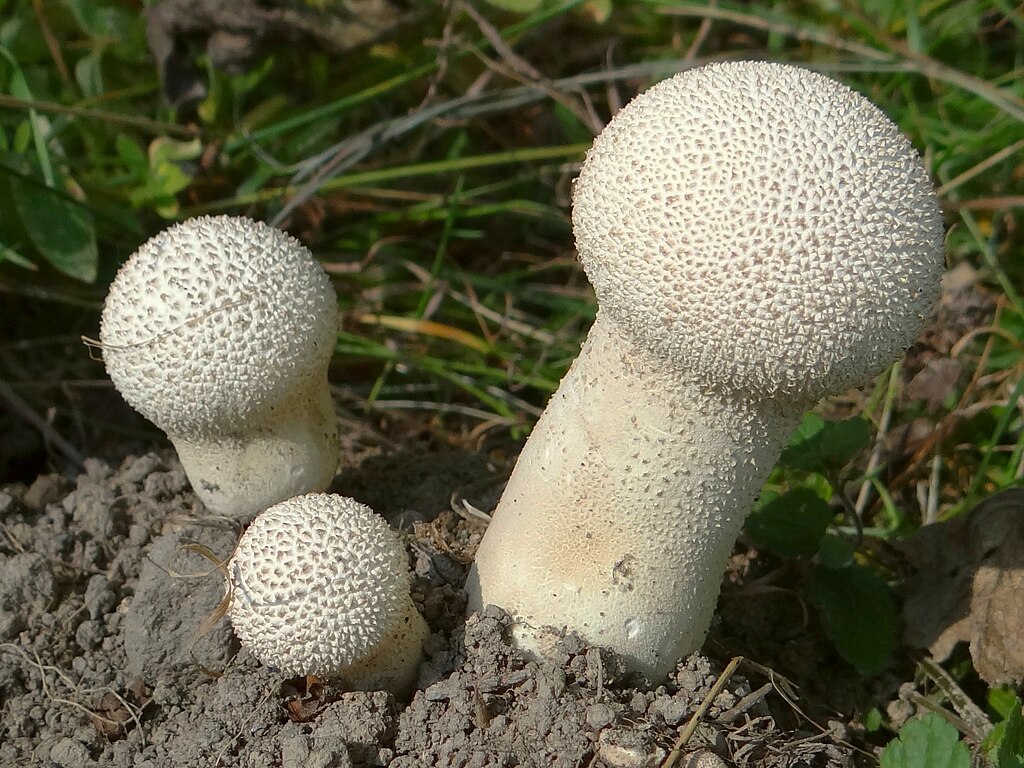
- Variable in size, ranging from 5 to 20 cm tall; typically pestle or club-shaped with a distinct head and a long, stout stem-like base.
- Surface
- Initially white to pale buff, darkening to ochraceous or brownish; covered in fine spines or pyramidal warts that eventually fall away to reveal a smooth, papery inner wall.
- Gleba
- The fertile interior starts white and firm, maturing to yellowish-brown and finally a powdery purplish-brown.
- Stem
- A long, sponge-like sterile base that often persists long after the upper spore-bearing portion has disintegrated.
- Spore print
- Olive-brown to dark brown.
Sporecast is better in the app
Plan ahead with 10-day forecasts, see what people are finding nearby, get photo IDs, and track your finds.
Edibility
This species is edible while the interior flesh is still young, white, and firm, though it is softer than the Giant Puffball. It can be confused with Lycoperdon utriforme, which is wider than it is tall, or the toxic Common Earthball, which is distinguished by its tough skin, dark interior, and unpleasant odor.
Misidentification can be fatal. Never eat a mushroom unless you're 100% sure. This information may be inaccurate. Always consult multiple sources.
Nutrient Source
SaprotrophicIt obtains nutrients by decaying dead organic matter, such as wood and soil litter. It is not dependent on living trees for survival.
Common Names
- Basque
- zaku-astaputz
- Danish
- Højstokket støvbold
- Dutch
- Plooivoetstuifzwam
- English
- Pestle-Shaped Puffball, Pestle Puffball
- German
- Beutelstäubling
- Norwegian Bokmål
- stilkrøyksopp
- Norwegian Nynorsk
- stilkrøyksopp
- Spanish
- bejín en forma de bolsa
- Welsh
- Coden Fwg Pen Pastwn
Synonyms
- Calvatia elata
- Calvatia excipuliformis
- Calvatia saccata
- Handkea excipuliformis
- Handkea excipuliformis
- Lycoperdon boletiforme
- Lycoperdon elatatum
- Lycoperdon elatum
- Lycoperdon excipuliformis
- Lycoperdon macrorhizon
- Lycoperdon pistilliforme
- Lycoperdon saccatum
- Lycoperdon saccatum
- Lycoperdon saccatum
- Utraria excipuliformis
- Utraria saccata