
Habitat
This common and widespread puffball is found in various environments, including broadleaf, mixed, and coniferous forests, as well as non-forested areas like grasslands, parks, and gardens. It typically grows on soil, humus, leaf litter, or well-decayed woody debris. It shows a preference for disturbed ground such as roadsides and trail edges and is increasingly found on wood chip mulch in urban settings. Fruit bodies appear singly, in scattered groups, or in large troops and clusters.
Photos
Appearance
- Fruit body
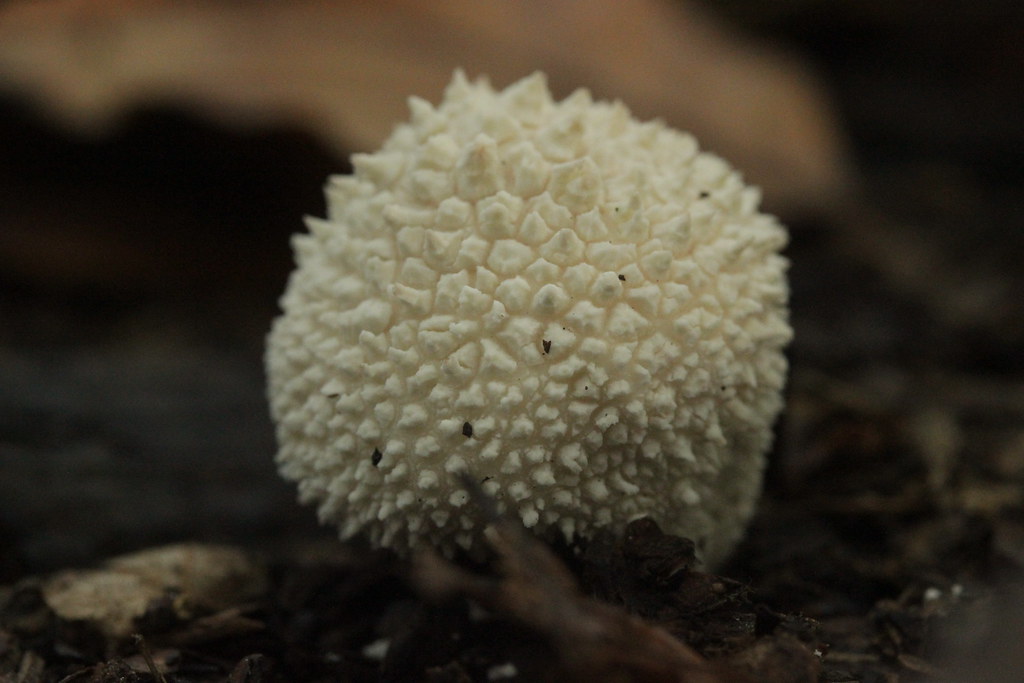
- Measuring 2–9 cm high and 1–6 cm across, it is typically shaped like an inverted pear, club, or top, featuring a rounded head that tapers into a distinct, stout stem-like base.
- Outer surface
- Initially white to creamy white, becoming yellowish-brown, ochraceous, or bronze-brown with age. It is densely covered in short, pyramidal warts or conical spines of two sizes; when the larger spines rub off, they leave a characteristic mesh-like or net-like pattern of scars.
- Inner wall
- A thin, papery, or membranous layer that eventually opens at the top via a small central pore to release spores.
- Flesh
- The upper reproductive part (gleba) starts firm and pure white, transitioning through yellowish-olive to a powdery olive-brown at maturity. The lower stem portion is a sterile, spongy base that often stays distinct from the spore mass.
- Spore print
- Olive-brown.
Sporecast is better in the app
Plan ahead with 10-day forecasts, see what people are finding nearby, get photo IDs, and track your finds.
Edibility
The flavor of this common puffball is mild. It is only edible when young and pure white throughout the interior; once the flesh begins to turn yellow, mushy, or brown, it should no longer be eaten. Foraging should be avoided in polluted areas or along roadsides because this species is known to bioaccumulate heavy metals. It can be confused with the poisonous Scleroderma genus or Amanita eggs, though the latter can be distinguished by cutting them vertically to check for a developing mushroom outline. Other similar lookalikes include the Dusky Puffball, which is best avoided, and the Pear Puffball, which grows on wood and lacks the characteristic net-like scar pattern left by detached spines.
Misidentification can be fatal. Never eat a mushroom unless you're 100% sure. This information may be inaccurate. Always consult multiple sources.
Nutrient Source
SaprotrophicIt obtains nutrients by decomposing dead organic matter, such as decaying wood and leaf litter.
Common Names
- Basque
- astaputz perladura, otso-putz, otzoputz, astaputz perladuna, astaputza
- Catalan
- pet de llop perl, esclatabufa piriforme, peu de raposu, pet de llop perlat, pet de llop
- Danish
- Krystal-støvbold
- Dutch
- Parelstuifzwam
- English
- Common Puffball
- Estonian
- Harilik Murumuna
- Finnish
- känsätuhkelo
- French
- Vesse de loup perlée
- German
- Flaschenstäubling
- Norwegian Bokmål
- vorterøyksopp
- Norwegian Nynorsk
- vorterøyksopp
- Spanish
- cuesco de lobo, Bejín areolado, cuesco de lobo perlado, bejín, Cuesco de lobo
- Swedish
- Vårtig Röksvamp
- Welsh
- Coden Fwg Gyffredin
Synonyms
- Lycoperdon bonordenii
- Lycoperdon gemmatum
- Lycoperdon hirtum
- Lycoperdon lacunosum
- Utraria gemmata