
Habitat
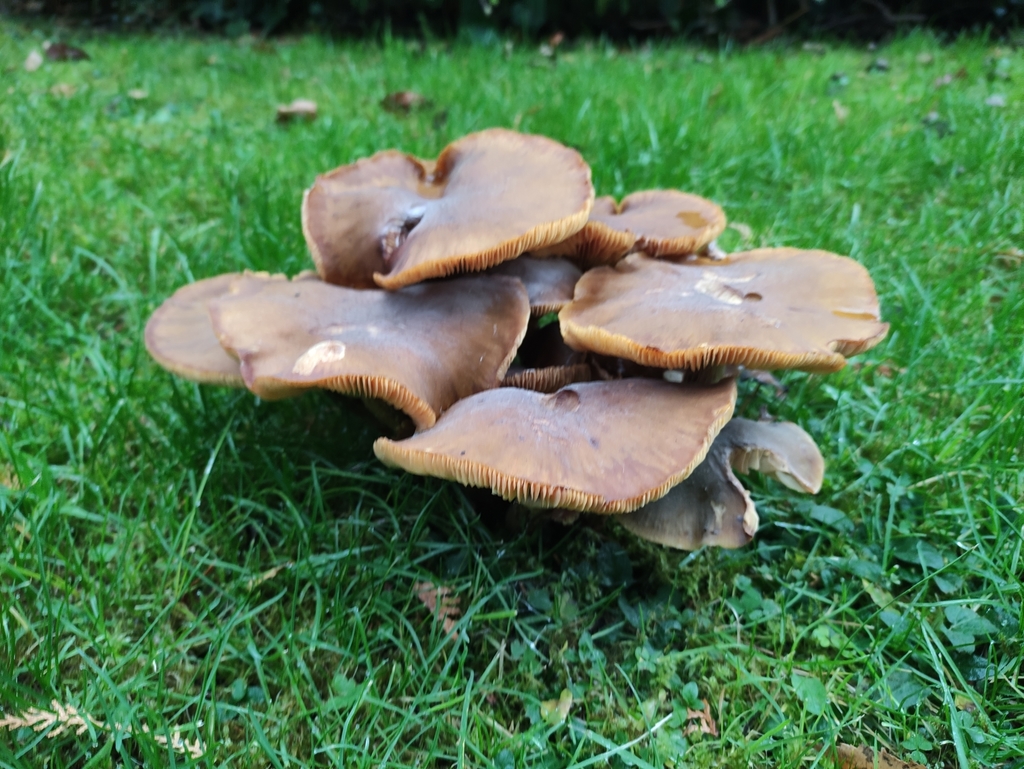
This species typically grows in large, dense, often fused clusters or tufted groups. It is frequently found on the ground in open woodlands, scrub, and grassland. It has a strong preference for disturbed areas such as roadsides, trailsides, campgrounds, cemeteries, gardens, and waste ground. It occurs on varied substrates including nutrient-poor soil, thin humus, and occasionally conifer or broad-leaved forest floors.
Photos
Appearance
- Fruit body
- Characteristically grows in large, dense, often fused clumps or tufted clusters containing multiple individual specimens.
- Cap
- 4-12 cm wide; initially hemispherical or rounded with an inrolled margin, becoming convex to flat with an irregular or wavy edge, often with a slight central hump. Surface is smooth, silky, or greasy, ranging in color from whitish and honey-tan to grey-brown or dark brown, frequently featuring streaks or mottled spots.
- Gills
- Crowded and narrowly attached to the stem, sometimes slightly running down it. Color is white to cream, sometimes aging to a dingy grey or straw yellow; texture is soft and waxy.
- Stem
- 3-12 cm long and 0.7-2.5 cm thick; tough, fibrous, and often curved or off-center. Usually white to cream at the top, becoming tan or brownish toward the base, which is frequently fused with other stems in the cluster.
- Flesh
- White to grayish; firm, tough, and fibrous-rubbery in consistency.
- Spore print
- White.
Sporecast is better in the app
Plan ahead with 10-day forecasts, see what people are finding nearby, get photo IDs, and track your finds.
Edibility
This mushroom has a mild flavor and firm, fibrous, or rubbery texture, though some describe the taste as acidic or similar to chicken. While considered a delicacy by some, there are reports of individual gastric allergies; long cooking may reduce this risk. It is critical to distinguish it from toxic Entoloma species, which possess pink spores and do not grow in dense clusters, and Lyophyllum gangrenosum, which has flesh that turns blue when cut. Other similar species include the poisonous Crowded White Clitocybe, which has a sour taste, and various grey or brown knights that lack the species' characteristic habit of growing in massive, fused clumps.
Misidentification can be fatal. Never eat a mushroom unless you're 100% sure. This information may be inaccurate. Always consult multiple sources.
Nutrient Source
SaprotrophicIt obtains nutrients by decomposing dead organic matter, such as leaf litter and decaying wood, in the soil.
Common Names
- Danish
- Røggrå gråblad
- Dutch
- Bruine bundelridderzwam, Bruinplaatbundelridderzwam
- English
- Fried Chicken Mushroom, Clustered Domecap
- Finnish
- tummatupaskynsikäs, tuhkatupaskynsikäs
- French
- Tricholome agrégé
- German
- Büschelrasling
- Norwegian Bokmål
- grå knippesopp, greinet sotgråhatt, greinet knippesopp
- Norwegian Nynorsk
- greinet sotgråhatt, grå knippesopp, greinet knippesopp
- Swedish
- mörk tuvskivling, röktuvskivling
- Welsh
- Pengrwm Glystyrog
Synonyms
- Agaricus aggregatus
- Agaricus cinerescens
- Agaricus conglobatus
- Agaricus dasypus
- Agaricus decastes
- Agaricus effocatellus
- Agaricus fumosus
- Agaricus fumosus
- Agaricus molybdinus
- Agaricus molybdinus
- Agaricus polius
- Agaricus romaleus
- Agaricus subdecastes
- Agaricus tumulosus
- Agaricus virgato
- Clitocybe aggregata
- Clitocybe aggregata
- Clitocybe cinerascens
- Clitocybe cinerescens
- Clitocybe coffeata
- Clitocybe conglobata
- Clitocybe decastes
- Clitocybe fumosa
- Clitocybe hortensis
- Clitocybe molybdina
- Clitocybe polia
- Clitocybe subdecastes
- Clitocybe subdecastes
- Clitocybe tumulosa
- Clitocybe tumulosa
- Collybia fumosa
- Gyrophila aggregata
- Gyrophila cinerescens
- Gyrophila conglobata
- Gyrophila decastes
- Gyrophila molybdina
- Lepista cinerascens
- Lyophyllum aggregatum
- Lyophyllum cinerescens
- Lyophyllum conglobatum
- Lyophyllum conglobatum
- Lyophyllum effocatellum
- Lyophyllum fumosum
- Nolanea fumosa
- Tricholoma aggregatum
- Tricholoma aggregatum
- Tricholoma cinerascens
- Tricholoma cinerescens
- Tricholoma conglobatum
- Tricholoma conglobatum
- Tricholoma decastes
- Tricholoma effocatellum
- Tricholoma fumosum
- Tricholoma fumosum
- Tricholoma molybdinum
- Tricholoma molybdinum
- Tricholoma tumulosum